EO Broker Review: Why You Should Avoid It
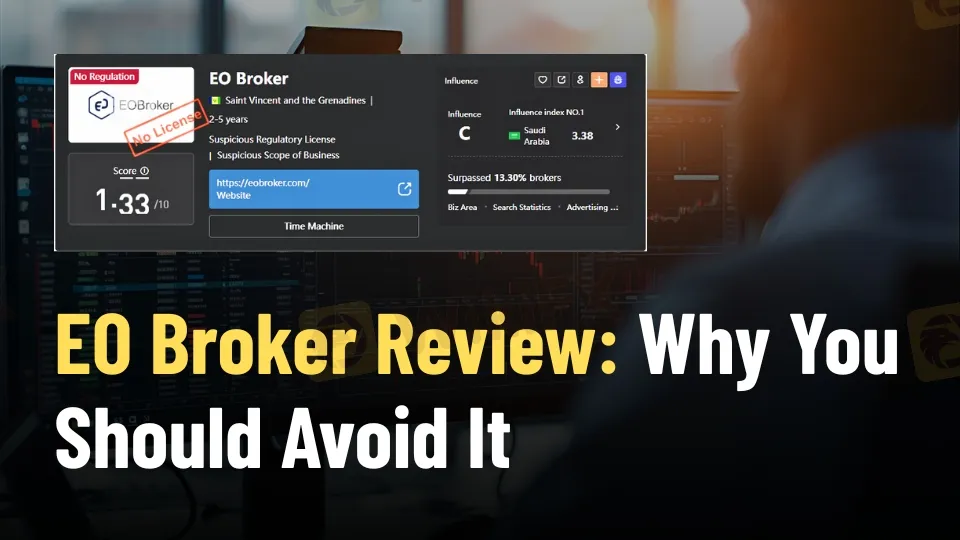
Abstract:EOBroker Review shows a low WikiFX score of 1.33/10. No regulation, fake license, and unsafe trading make this broker dangerous.
Introduction
In the crowded online trading space, legitimacy and transparency are non‑negotiable. Yet, EO Broker raises immediate red flags. Founded in 2021 and registered in Saint Vincent and the Grenadines, the broker operates without any valid regulatory license. Its WikiFX score of 1.33/10 underscores the risks. This investigative EO Broker Review examines the companys background, trading conditions, account structures, and regulatory shortcomings to explain why traders should steer clear.
EO Broker Regulation Status
The most pressing issue is regulation—or rather, the absence of it. EO Broker openly lists “No Regulation” and “Suspicious Regulatory License” in its profile. The broker is not licensed by any recognized financial authority. This means client funds are not protected under investor compensation schemes, and there is no oversight of its operations.
The domain status further compounds the risk. Records show client transfer prohibited, a warning sign that raises questions about ownership transparency and potential restrictions on moving accounts.
By contrast, regulated competitors such as IG, Saxo Bank, or Interactive Brokers hold licenses from tier‑one authorities (FCA, ASIC, SEC), offering far greater investor protection.
Company Background and Domain Transparency
- Founded: 2021
- Registered Region: Saint Vincent and the Grenadines
- Office Address: First Floor, First St. Vincent Bank Ltd., James Street, PO Box 1574, Kingstown
- Domain: eobroker.com
- Domain Registered On: March 27, 2021
- Expires On: March 27, 2029
- Updated On: April 3, 2023
The offshore registration in Saint Vincent and the Grenadines is a common tactic among unregulated brokers. While the region is known for lax oversight, serious trading firms avoid such jurisdictions to maintain credibility.
Trading Instruments Offered
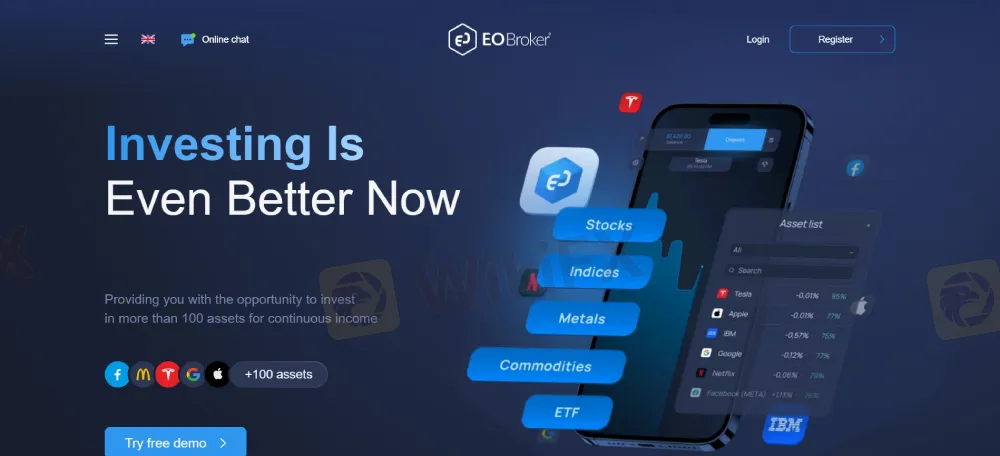
EO Broker advertises access to more than 100 assets, including:
- Stocks (Apple, Tesla, IBM, Google, Netflix, Facebook/META)
- Indices
- Commodities
- Metals
- ETFs
- Forex and Cryptos (listed but without valid licensing)
- Options and Bonds
While the product list appears broad, the lack of regulation makes these offerings unsafe. Traders cannot verify whether prices, spreads, or execution are genuine.
Account Types and Minimum Deposits
EO Broker promotes six account tiers:
| Account Type | Minimum Deposit | Features |
| Micro | $10 | Entry-level |
| Basic | $50 | Slight upgrade |
| Silver | $500 | Free consultations |
| Gold | $2,500 | Privileged features |
| Platinum | $5,000 | Priority withdrawal |
| Exclusive | Invitation only | Account manager access |
The low minimum deposit of $10 may attract beginners, but higher tiers demand significant capital without offering regulatory safeguards. Priority withdrawals for Gold, Platinum, and Exclusive accounts suggest preferential treatment, which is problematic in unregulated environments.
Trading Platforms
EO Broker relies on proprietary platforms:
- EO Broker App (mobile)
- Expert Option (desktop/PC)
- EO Broker Web (browser-based)
It does not support industry-standard MT4 or MT5, despite listing them in promotional material. This inconsistency is misleading. MT4/MT5 are widely trusted for transparency and third‑party integrations, while proprietary platforms often lack independent auditing.
Fees and Payment Methods
- Minimum Deposit/Withdrawal: $10
- Commissions: 0% (claimed)
- Payment Options: Visa, MasterCard, Maestro, UnionPay, JCB, Skrill, Neteller, Binance Pay
Although EO Broker advertises “no commissions,” the absence of regulation means hidden fees or withdrawal delays cannot be ruled out. Priority withdrawals for higher‑tier accounts further disadvantage smaller traders.
Pros and Cons
Pros
- Demo account with $100,000 virtual funds
- Low minimum deposit ($10)
- Multiple payment options
- 24/7 live chat support
Cons
- No regulation or license
- Suspicious domain status (client transfer prohibited)
- No MT4/MT5 support despite claims
- Regional restrictions across major markets (USA, UK, EU, Canada, Australia)
- Risk of unsafe withdrawals and fake licenses
Comparison Against Competitors
When compared to regulated brokers, EO Broker falls short:
- IG Group: FCA‑regulated, transparent pricing, global offices
- Saxo Bank: Licensed in Denmark, strong investor protections
- Interactive Brokers: SEC‑regulated, advanced platforms, broad product range
EO Brokers offshore registration, lack of oversight, and misleading platform claims place it far below industry standards.
Reported Risks and Warnings
The brokers WikiFX score of 1.33/10 is among the lowest in the industry. The platform explicitly warns: “Low score, please stay away!” This is not a minor caution but a direct advisory against engagement.
Bottom Line
This EO Broker Review highlights a broker that is unregulated, opaque, and unsafe. Despite offering a wide range of instruments and low entry deposits, the risks far outweigh any potential benefits. Traders face exposure to fake licenses, suspicious domain restrictions, and unreliable platforms.
Verdict: EO Broker is not a legitimate trading option. Investors should avoid it and instead choose regulated brokers with proven track records and transparent operations.

Read more
Pepperstone Review 2026: Massive Deposit & Withdrawal Complaints Against This Regulated Broker
Have you experienced issues with Pepperstone deposit & withdrawal processing? From your experience, do you feel that the Australia-based forex broker causes losses to its clients? Did the brokerage entity freeze your account and give you a margin call? All these trading allegations have been rampant on broker review platforms such as WikiFX. This Pepperstone review article takes a close look at the user complaints, especially in 2026. Additionally, we have given an overview of the regulatory framework under which the brokerage entity operates.

Wundersys vs tradgrip: Two Offshore Newcomers Go Head to Head — and Neither Brings Home a Trophy
Some broker comparisons end with a confident "go with this one." This is not one of them — and that honesty is exactly what makes it worth reading. Wundersys and tradgrip are two young, offshore-registered brokers that keep popping up in front of beginner traders, often through aggressive online marketing. Both promise the usual buffet: tight spreads, generous leverage, multiple account tiers. And both, according to WikiFX, sit near the very bottom of the safety scale. So instead of crowning a champion, this comparison is really about something more useful: learning to read the warning signs, understanding the small differences that still matter, and knowing why "the better of two risky options" is still a conversation about risk.
The 6 Lowest-Commission Forex Brokers South Asian Traders Are Flocking To in 2026
If you trade forex from India, Pakistan, Bangladesh, Sri Lanka, or Nepal, you already know the quiet truth that eats into every trader's results: it is not just the market that decides whether you profit — it is the cost of getting in and out of each trade. Shave a couple of dollars off your commission on every lot, multiply it across hundreds of trades a year, and you are looking at the difference between a strategy that works and one that bleeds out slowly. South Asian traders are some of the most cost-conscious in the world, and rightly so. So we pulled the data on the brokers most often recommended for the region, cross-checked every name on WikiFX, and ranked them by the one number that matters most here: what they actually charge you to trade. Before the list, one quick lesson that will make this whole ranking click.

XPO Fund Wants $10,000 Before You Trade a Single Real Dollar — Read This Stunning Revelation
If you have spent even a week inside trading communities lately, you already know the pitch by heart. Pass a quick "challenge," get handed a funded account worth tens of thousands of dollars, and keep up to 80% of everything you make. No risking your own savings, no slow grind of building capital from scratch — just skill, a small fee, and a fast track to the big leagues. It is the exact dream every new trader is secretly chasing, and an entire industry has sprung up to sell it. XPO Fund is one of the louder voices selling that story right now. Its website is slick, its plans sound generous, and its marketing leans hard on words like "industry's lowest fee" and "fast payouts." But before you reach for your card, there is one number sitting quietly on this firm's profile — a number it would rather you scroll past — that every experienced trader would beg you to look at first. And no, it is not the profit split. Let's pull XPO Fund apart piece by piece: what it actually is, who is real
WikiFX Broker
Latest News
Keeping Your Forex Profits Safe With Trailing Stop Losses
 WikiFX
Review 2026: Japan FSA Regulation, Platform Access, and Complaint Signals
WikiFXHEADWAY Review: Broker Complaints Point to Withdrawals, Zeroed Balances, and Login Blocks
WikiFXIndian Stocks Take a Beating, Sensex Falls by Over 600 Points Today: Check Out Why
WikiFXDollar Hits Two-Month High Amid Surging Yields
WikiFXGetting Started in Forex: Understanding Currency Pairs, Central Banks, and Legal Risks
WikiFXWTI Slumps As Treasury Yields Surge
WikiFXCySEC Withdraws Conotoxia Ltd Licence
WikiFX221 Under Investigation as Scam Losses Cross RM28 Million in Two Weeks
WikiFX24 markets.com Review 2026: Is This Forex Broker Safe?
WikiFXRate Calc

