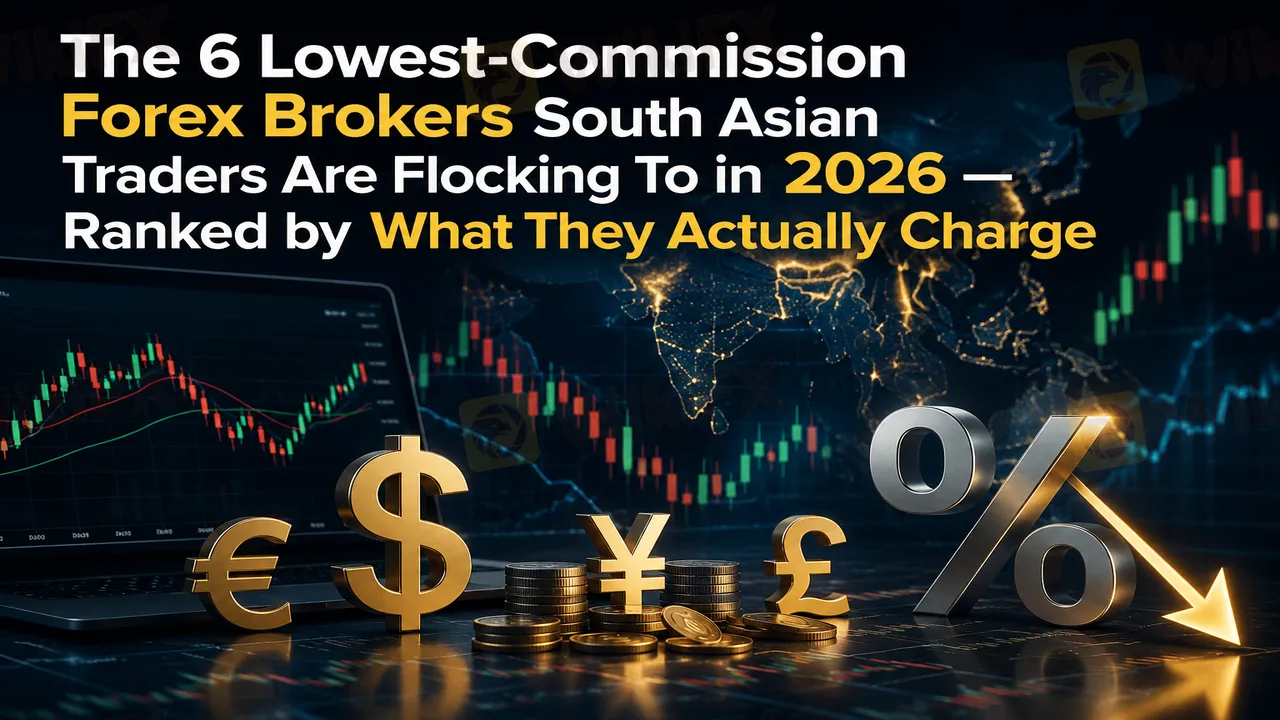
The 6 Lowest-Commission Forex Brokers South Asian Traders Are Flocking To in 2026

Abstract:If you trade forex from India, Pakistan, Bangladesh, Sri Lanka, or Nepal, you already know the quiet truth that eats into every trader's results: it is not just the market that decides whether you profit — it is the cost of getting in and out of each trade. Shave a couple of dollars off your commission on every lot, multiply it across hundreds of trades a year, and you are looking at the difference between a strategy that works and one that bleeds out slowly. South Asian traders are some of the most cost-conscious in the world, and rightly so. So we pulled the data on the brokers most often recommended for the region, cross-checked every name on WikiFX, and ranked them by the one number that matters most here: what they actually charge you to trade. Before the list, one quick lesson that will make this whole ranking click.
If you trade forex from India, Pakistan, Bangladesh, Sri Lanka, or Nepal, you already know the quiet truth that eats into every trader's results: it is not just the market that decides whether you profit — it is the cost of getting in and out of each trade. Shave a couple of dollars off your commission on every lot, multiply it across hundreds of trades a year, and you are looking at the difference between a strategy that works and one that bleeds out slowly. South Asian traders are some of the most cost-conscious in the world, and rightly so. So we pulled the data on the brokers most often recommended for the region, cross-checked every name on WikiFX, and ranked them by the one number that matters most here: what they actually charge you to trade.
Before the list, one quick lesson that will make this whole ranking click.
Commission vs Spread: Know What You Are Really Paying
A broker can charge you in two ways, and you need to understand both.
The spread is the gap between the buy and sell price of a currency pair — a cost baked invisibly into the prices you see. A commission is a separate, explicit fee charged per trade. Brokers typically offer two account styles: a standard account with no commission but wider spreads, and a raw or ECN account with razor-thin spreads plus a transparent commission. “ECN” (Electronic Communication Network) simply means your orders are routed closer to the real market.
Commissions are usually quoted per side (charged once when you open and again when you close) or per round turn (the full open-and-close cost). So “$2.25 per side” equals roughly “$4.50 per round-turn lot.” Keep that in mind as you read — the lower this number, the cheaper your trading.
One more term you will see, because it matters across South Asia: a swap is the interest fee for holding a position overnight, and an Islamic (swap-free) account removes it to comply with Sharia law. Most brokers below offer one.
Now, the ranking.
#1 — Fusion Markets: The Outright Commission Champion
WikiFX Score: 8.30 | Regulation: ASIC (Australia), FSA (Seychelles), VFSC (Vanuatu) | Commission: $2.25 per side ($4.50 round turn)
If “least commission” is the headline, Fusion Markets earns the crown for the most accessible low-cost setup. Its Zero account pairs raw spreads from 0.0 pips with a commission of just $2.25 per side — roughly 35% below the industry-standard $3.50 — and there is no minimum deposit, which is a huge deal for beginners in the region testing the waters with small capital. It is regulated by Australia's tier-one ASIC for its primary entity, supports MT4, MT5, cTrader, and TradingView, and offers swap-free options. For a cost-focused South Asian trader who wants the lowest realistic all-in cost without a big upfront commitment, this is the benchmark everyone else is measured against.
#2 — Tickmill: The Lowest Per-Side Commission (With Caveats)
WikiFX Score: 7.62 | Regulation: FCA (UK), CySEC (Cyprus), FSCA (South Africa), FSA (Seychelles) | Commission: $3 per side (Raw), and zero on the Classic account
On pure commission, Tickmill's Pro account undercuts almost everyone at $3 per side, and its high-volume Classic account drops to Zero. It is anchored by two tier-one regulators (the UK's FCA and Cyprus's CySEC), provides negative balance protection, and offers Islamic accounts — all genuinely attractive for serious South Asian traders. The honest caveat, straight from WikiFX: Tickmill's score was lowered to 7.62 over a cluster of unresolved client complaints (slippage and withdrawal delays), and it has appeared on certain regional regulator alert lists. The trading product is excellent; just go in informed, and confirm which regulated entity will hold your account.
#3 — IC Markets Global: The True-ECN Heavyweight
WikiFX Score: 9.10 | Regulation: ASIC (Australia), CySEC (Cyprus), FSA (Seychelles) | Commission: $3 per side (cTrader), $3.50 (Raw), scaling to $1.50 / $1 for high-volume tiers
IC Markets carries one of the highest WikiFX scores in this entire list at 9.10, and for many South Asian traders that extra layer of trust is worth a slightly higher commission. Its cTrader account charges $3 per side, while its Raw Pro ($5,000 minimum) and Raw Pro+ ($100,000 minimum) tiers drop to $1.50 and $1 per side respectively for heavy hitters. With deep liquidity from 50+ providers, lightning-fast execution, and triple-jurisdiction regulation, IC Markets is the pick for traders who want elite execution quality alongside competitive cost. It is also enormously popular across Asia, which means well-trodden support and payment pathways.
#4 — Exness: The South Asian Favorite
WikiFX Score: 8.33 | Regulation: FSCA (South Africa), FSA (Seychelles), and others | Commission: $0 on standard accounts; ultra-low on Zero/Raw accounts
No list aimed at this region is complete without Exness, which has become arguably the most-used broker across Pakistan, Bangladesh and Sri Lanka. Its appeal is twofold: commission-free standard accounts (cost lives in tight spreads) and ultra-low-cost Zero/Raw accounts for active traders, plus its signature instant automated withdrawals — a feature that directly addresses the number-one anxiety regional traders have about getting their money out. Add swap-free options and strong local payment support, and Exness's combination of low cost and convenience is hard to beat for everyday traders, even if its regulatory footprint leans more offshore than tier-one.
#5 — FP Markets: The Veteran All-Rounder
WikiFX Score: 8.67 | Regulation: ASIC (Australia), CySEC (Cyprus) | Commission: ~$3 per side | Minimum Deposit: $100
With over 20 years in business and a strong WikiFX score of 8.67, FP Markets brings something the newer names cannot: a long, stable track record. Its Raw account offers spreads from 0.0 pips with a commission around $3 per side, and it supports MT4, MT5, cTrader, and TradingView. The $100 minimum deposit is modest, the dual ASIC/CySEC regulation is reassuring, and execution speed and cost both rate highly. For a South Asian trader who wants low cost plus the comfort of a broker that has weathered multiple market cycles, FP Markets is a smart middle-ground choice.
#6 — XM: The Beginner-Friendly Zero-Commission Option
WikiFX Score: 9.14 | Regulation: ASIC and others | Commission: $0 on standard accounts | Minimum Deposit: ~$5
XM rounds out the list with the highest WikiFX score here (9.14) and a different cost philosophy: its standard accounts charge no commission at all, folding the cost into a spread from around 0.6 pips. With a minimum deposit of roughly $5, swap-free Islamic accounts, 1,400+ instruments, copy trading, and a famously strong educational program, XM is built for newcomers — and it has a massive, loyal following in South Asian cities. If commissions confuse you and you would rather have one simple, all-in spread cost while you learn, XM is the gentlest on-ramp on this list.
The Quick Comparison
| Rank | Broker | WikiFX Score | Headline Commission | Best For |
| 1 | Fusion Markets | 8.3 | $2.25 per side | Lowest accessible all-in cost |
| 2 | Tickmill | 7.62 | $3 per side | Lowest raw commission (with caveats) |
| 3 | IC Markets Global | 9.1 | $3 per side (cTrader) | Elite execution + high trust |
| 4 | Exness | 8.33 | $0 standard / ultra-low Zero | Everyday traders, instant withdrawals |
| 5 | FP Markets | 8.67 | ~$3 per side | Long track record |
| 6 | XM | 9.14 | $0 standard | Beginners, low minimum deposit |
Two Things Every South Asian Trader Must Remember
First, lowest commission is not always lowest total cost. A broker with a tiny commission but wide spreads can cost more than a “zero-commission” account with tight spreads. Always think in terms of spread plus commission for the pairs you actually trade, and at your typical lot size.
Second — and this is the one that protects your money — none of these brokers is locally licensed within most South Asian countries. They operate under foreign regulators (ASIC, FCA, CySEC) or offshore ones, and the legal status of international forex trading varies significantly across India, Pakistan, Bangladesh, and Sri Lanka. Understand your own country's rules before you start, and never assume a high WikiFX score means a broker is authorized to operate locally where you live.
Which brings us to the single habit that ties this whole list together: verify before you deposit. Every score, license, and commission figure in this ranking came straight from WikiFX. Before you fund any of these brokers — or any broker a friend or advertisement recommends — open the WikiFX app or website, search the name, and in seconds you can confirm its real regulatory status, license details, user complaints, and overall risk score in one place. The cheapest commission in the world means nothing if your money cannot find its way back to you, and that quick check is how you make sure it can.
Compare spread plus commission, check your local rules, and verify every broker on WikiFX before you trade. Trade smart, trade safe.

Some More Insightful Articles for You
Review 2026: Examining the Latest Withdrawal, Slippage and Spread Complaints
Read more

XPO Fund Wants $10,000 Before You Trade a Single Real Dollar — Read This Stunning Revelation
If you have spent even a week inside trading communities lately, you already know the pitch by heart. Pass a quick "challenge," get handed a funded account worth tens of thousands of dollars, and keep up to 80% of everything you make. No risking your own savings, no slow grind of building capital from scratch — just skill, a small fee, and a fast track to the big leagues. It is the exact dream every new trader is secretly chasing, and an entire industry has sprung up to sell it. XPO Fund is one of the louder voices selling that story right now. Its website is slick, its plans sound generous, and its marketing leans hard on words like "industry's lowest fee" and "fast payouts." But before you reach for your card, there is one number sitting quietly on this firm's profile — a number it would rather you scroll past — that every experienced trader would beg you to look at first. And no, it is not the profit split. Let's pull XPO Fund apart piece by piece: what it actually is, who is real

The 6 Best ECN Brokers for 2026: Who Really Delivers Raw Spreads and Institutional-Grade Execution
Every broker with a marketing budget now slaps the letters "ECN" on its homepage. Few of them actually deliver what those letters promise. For a serious trader — a scalper, a day trader, an algo trader, anyone whose edge lives or dies on execution quality — the gap between a true ECN broker and a market maker wearing an ECN costume can quietly cost you hundreds of pips a year in slippage, requotes, and inflated spreads. So we cut through the marketing, looked at the brokers that genuinely offer raw pricing and deep liquidity, and cross-checked every one of them on WikiFX. Here are the six ECN accounts that actually earn the label in 2026 — ranked. First, a short primer, because understanding ECN is what lets you judge these brokers properly.
FX Novus vs VCG Markets:Two Brokers, Two Very Different Kinds of Risk — Which One Is the Lesser Evil
If you have been shopping around for a forex broker and landed on FX Novus and VCG Markets, you have stumbled onto a genuinely instructive pair. On the surface they look like cousins: both are relatively young, both wave around multi-asset trading and tight spreads, and both operate from the kind of offshore corners of the world that should make any beginner slow down. But dig into the data on WikiFX and the two part ways sharply. One carries active, screaming red flags. The other is merely standing in a yellow zone. Neither is what a cautious newcomer would call "safe" — but understanding how they differ is exactly the kind of lesson that protects your money. Let's put them head to head, decode the jargon along the way, and reach an honest verdict.
Deposited at New Frontier, Then Locked Out—Funds Never Came Back - The Real Story of a Trader
There are few feelings in trading more sickening than this one: you funded your account, you walked away confident your money was safe, and when you came back to check on it, the platform calmly informed you that your login details were wrong. Not your trades — your very identity, locked out. And on the other side of that login screen sits a balance you can no longer touch and a support team that has gone silent. That is the heart of a complaint filed against New Frontier on WikiFX. One trader reported depositing 40,500 pesos, returning to log in with the exact email and password they had registered, and being told the data was "incorrect" — which, in their words, meant their earnings had simply been taken. Customer service, they said, did not react. Let's look closely at this broker, what makes its profile so unsettling, and why verification here is not optional.
WikiFX Broker
Latest News
How to Read Market Reversals Through Price Action and Indicators
WikiFXA Single TikTok Ad Cost Him RM100,000
WikiFXLONG ASIA Review: Broker Complaints, Regulation Gaps, and Withdrawal Alarms
WikiFXHow Proprietary Trading and Artificial Volume Move Prices
WikiFXCrude Jumps Amid Structural FX Shifts
WikiFXAximTrade Review: Regulation Warnings and Broker Withdrawal Complaints
WikiFXHow the Long Shadow Trap Ruins Reversal Trades
WikiFXAsian FX Markets Modernise As Crude Oil Surges
WikiFXInstitutional FX Volumes Edge Higher in May 2026
WikiFXKANAK CAPITAL MARKETS Review 2026: Official Warnings and Withdrawal Risks
WikiFXRate Calc

