XPO Fund Wants $10,000 Before You Trade a Single Real Dollar — Read This Stunning Revelation
Abstract:If you have spent even a week inside trading communities lately, you already know the pitch by heart. Pass a quick "challenge," get handed a funded account worth tens of thousands of dollars, and keep up to 80% of everything you make. No risking your own savings, no slow grind of building capital from scratch — just skill, a small fee, and a fast track to the big leagues. It is the exact dream every new trader is secretly chasing, and an entire industry has sprung up to sell it. XPO Fund is one of the louder voices selling that story right now. Its website is slick, its plans sound generous, and its marketing leans hard on words like "industry's lowest fee" and "fast payouts." But before you reach for your card, there is one number sitting quietly on this firm's profile — a number it would rather you scroll past — that every experienced trader would beg you to look at first. And no, it is not the profit split. Let's pull XPO Fund apart piece by piece: what it actually is, who is real
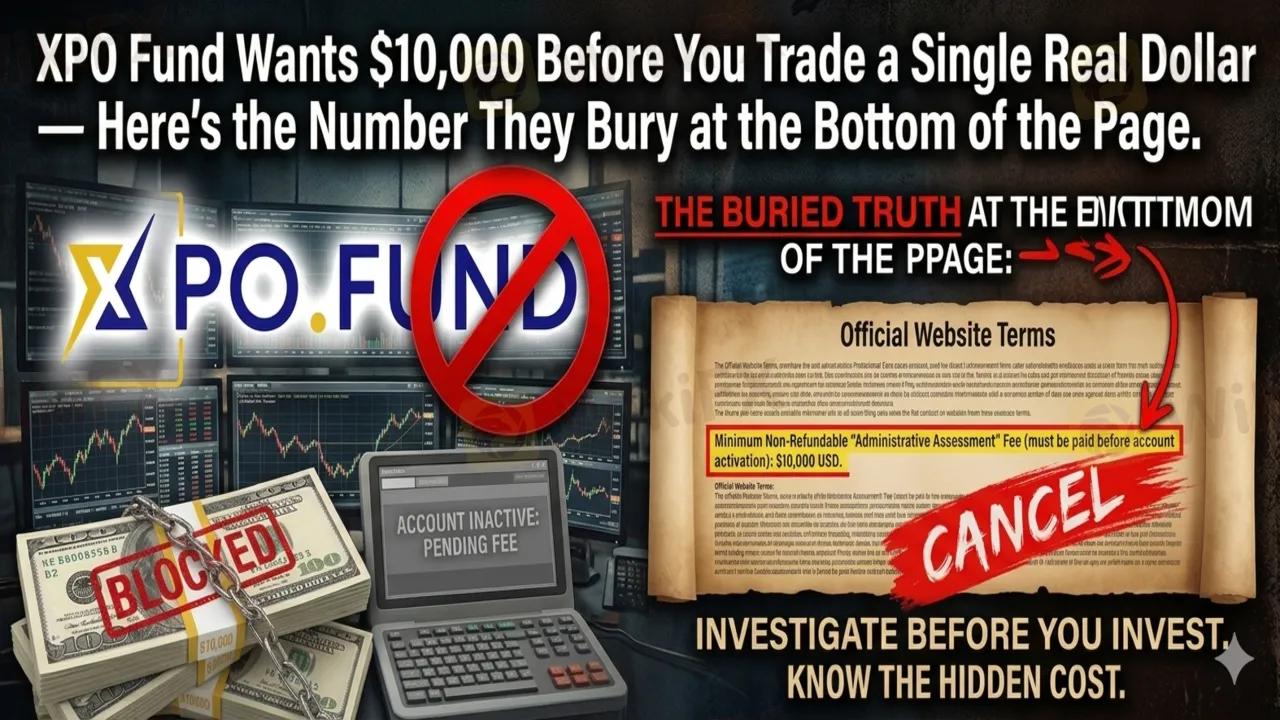
If you have spent even a week inside trading communities lately, you already know the pitch by heart. Pass a quick “challenge,” get handed a funded account worth tens of thousands of dollars, and keep up to 80% of everything you make. No risking your own savings, no slow grind of building capital from scratch — just skill, a small fee, and a fast track to the big leagues. It is the exact dream every new trader is secretly chasing, and an entire industry has sprung up to sell it.
XPO Fund is one of the louder voices selling that story right now. Its website is slick, its plans sound generous, and its marketing leans hard on words like “industry's lowest fee” and “fast payouts.” But before you reach for your card, there is one number sitting quietly on this firm's profile — a number it would rather you scroll past — that every experienced trader would beg you to look at first. And no, it is not the profit split.
Let's pull XPO Fund apart piece by piece: what it actually is, who is really behind it, what the offer looks like in detail, and why doing your homework here matters more than almost anywhere else in this business.
First Things First: What Even Is XPO Fund?
Here is the thing a lot of beginners get wrong from the start — XPO Fund is not a normal forex broker. It is what the industry calls a proprietary trading firm, or “prop firm” for short. The difference is huge, and understanding it is the foundation for everything that follows.
A traditional broker gives you an account, you deposit your own money, and you trade it. Your profits and your losses are entirely yours. A prop firm works on a completely different model. You do not (at least at first) trade your own money or even the firm's real money. Instead, you pay a fee to take an evaluation — usually called a “challenge.” During this challenge you trade a demo (practice) account and must hit a specific profit target while obeying strict risk rules, such as never losing more than a set percentage in a single day. If you pass every stage, the firm says it will promote you to a “funded” account, where you supposedly trade larger sums and split the profits with them.
That business model is not illegal, and it is not automatically a scam. Genuinely reputable prop firms do exist and do pay their traders. But — and this is the part newcomers must internalize — the model is also a magnet for bad actors. Why? Because a dishonest firm can simply collect evaluation fees from thousands of hopeful beginners, design the rules so almost nobody ever passes, and walk away having paid out next to nothing. The fee is guaranteed income for the firm; your payout is a maybe. When the company holding all that fee money has no regulator watching over it, the temptation to play dirty is enormous.
That is the lens you need to keep on while reading the rest of this review.
The Shiny Offer XPO Fund Puts in the Window
According to data compiled on WikiFX, here is how XPO Fund packages its product. The firm runs four named plans, each with a different buy-in:
| Plan | Minimum Capital |
| Xeno Glide | $10,000 |
| Xeno Slide | $25,000 |
| Xeno Ride | $100,000 |
| Xeno Fly | $200,000 |
Across all plans, the firm advertises the same headline perks: an 80% profit share to the trader, a built-in safety framework of a 5% maximum daily loss and an 8% maximum total loss, and a three-stage evaluation before you reach live status.
Take the entry-level Xeno Glide plan as the example XPO Fund itself details. It runs across three steps — two on demo, one live:
- Stage 1 (Demo): 60 days, minimum 5 trading days, a $1,000 profit target, a $500 maximum daily loss, and an $800 maximum overall loss. A one-time $90 fee applies here.
- Stage 2 (Demo): the same parameters and targets, still on a practice account.
- Final Stage (Live): unlimited duration, with profit sharing of 80% calculated every 30 days.
Leverage across the Glide plan is listed at up to 1:100, and the firm routes all trading through its own in-house software called “XPO Prop Trader” — notably not the industry-standard MetaTrader 4 or MetaTrader 5.
A couple of beginner translations before we go further. Leverage of 1:100 means you can control a position worth up to one hundred times the capital actually backing your account. It multiplies your gains, but it multiplies your losses just as fast — leverage is a power tool, not a magic wand. A profit split is simply the slice of trading profits you keep versus what the firm pockets; an 80/20 split in your favor sounds great, but it is actually a fairly ordinary headline number across the prop industry, so do not let it dazzle you. And the evaluation/challenge is, as we covered, the paid test you must pass before any of that profit split becomes relevant.
On paper, none of this looks outrageous. The fees are modest, the risk rules are clearly stated, and the firm even claims it refunds your challenge fee on your first profit withdrawal. So what is the problem?
Now, the Number They Bury — and Why It Should Stop You Cold
Here it is, the figure XPO Fund does not put in its marketing: on WikiFX, the firm carries an overall score of roughly 1.34 out of 10.
That is not a mediocre rating. That is close to the floor. And it is driven by one devastating fact — XPO Fund holds no valid forex regulatory license of any kind. Its regulation index, its license index, and its risk-control index all sit at a flat 0.00.
For a beginner, the word “unregulated” can feel like abstract jargon, so let's make it painfully concrete. A regulator is a government-backed financial watchdog — bodies like the United Kingdom's Financial Conduct Authority (FCA), Australia's Securities and Investments Commission (ASIC), or the Cyprus Securities and Exchange Commission (CySEC). These authorities force the firms they oversee to do specific, protective things: keep client money in segregated accounts (separate from the company's own cash, so it cannot simply be spent), maintain minimum capital reserves, submit to audits, and answer to an external body when a customer complains. A regulated firm that misbehaves can be fined, suspended, or shut down, and you have a formal channel to escalate a dispute.
An unregulated firm offers you none of that. There is no segregation requirement, no audit, no external complaints process, and no authority with the power to compel the company to return your money. If your deposit vanishes, your realistic options shrink to writing angry forum posts. That is the practical meaning of a 0.00 regulation index, and it is why XPO Fund sits where it does on the WikiFX scale.
The Red Flags Stacking Up Behind the Score
The missing license is the headline, but it is far from the only warning sign on XPO Fund's profile.
A home address that does not add up. The firm is registered to the Virgin Islands under the corporate name Xeno Portfolio Ltd. Yet its listed contact address points somewhere entirely different — Bonovo Road, Fomboni, on the island of Mohéli, in the Comoros Union. Both locations are classic offshore jurisdictions, places chosen specifically because they impose little to no meaningful financial oversight. When a firm's registration country and its operational address sit in two separate offshore zones, and neither is a serious regulatory environment, that is a textbook signal to slow down. Legitimate, well-run firms generally want you to know exactly where they are and who is accountable.
A steep price of admission. The smallest plan, Xeno Glide, asks for a $10,000 commitment. That is a serious chunk of capital to entrust to a company with no regulator standing behind it. The higher tiers climb to $200,000. Always ask yourself: am I comfortable handing this sum to an entity that no authority can force to pay me back?
No mainstream trading platform. Reputable brokers and prop firms overwhelmingly run on MetaTrader 4, MetaTrader 5, or cTrader — platforms whose pricing and trade execution can be independently scrutinized. XPO Fund instead funnels everyone through its own proprietary “XPO Prop Trader” software. A closed, in-house platform makes it far harder for an outsider to verify whether prices and fills are honest, which removes another layer of trust.
Independent services flag it too. This is not just WikiFX raising an eyebrow. Independent scam-detection tools that score websites on fraud risk have rated the xpo.fund domain very poorly, tagging it as suspicious and high-risk based on dozens of trust signals. When multiple unrelated sources converge on the same concern, the concern is worth taking seriously.
To be fair and balanced: XPO Fund does provide demo accounts, offers a tiered ladder of plans, publishes clear risk parameters, and advertises a refundable first-stage fee. Those are not nothing. But weigh them honestly — they are conveniences and marketing, and not one of them replaces the single thing that actually protects your money: a real regulator.
A Beginner's Survival Checklist for Any Prop Firm
Because XPO Fund is far from the only firm running this playbook, keep this short checklist handy for evaluating any prop firm:
- Is it regulated, and by whom? “Regulated” by an obscure offshore body is not the same as regulated by the FCA or ASIC. Verify the specific authority.
- Are the challenge rules achievable, or designed to trip you up? Impossible targets exist purely to harvest failed-evaluation fees.
- Is there a real, documented history of payouts? Promises are cheap; proof of withdrawals is what counts.
- Does it use a transparent, mainstream platform? Closed proprietary software hides more than it reveals.
- What do independent reviews and risk scores say? One bad review is noise; a pattern is a signal.
If a firm fails several of these — as XPO Fund does — the safest move is simply to walk away. There is no shortage of opportunities in this market, and protecting your capital always beats chasing the flashiest offer.
The Bottom Line on XPO Fund
XPO Fund sells the precise dream new traders are most eager to buy: rapid funding, large accounts, and a generous-sounding split. But strip away the marketing and you are left with an unregulated firm, registered through opaque offshore arrangements, demanding a five-figure buy-in, running on closed software, and earning one of the lowest scores WikiFX can assign. For a beginner, that is not a borderline case — it is the exact profile you are taught to avoid.
The single most valuable habit you can build in this industry is verifying a firm before you fund it, never after the money is gone. So do not take XPO Fund's marketing at face value, and please do not just take my word for it either. Open the WikiFX app or website, type in the name of any broker or prop firm, and within seconds you can see its true regulatory status, its license details (or lack of them), real user complaints, exposure records, and an overall risk score — all gathered in one place. That five-minute check is the cheapest, smartest insurance your trading capital will ever buy.
Stay sharp, verify first, and trade safe.
Download the WikiFX App for more such revelations about forex brokers.

More Inisghtful Articles for You
Review 2026: Examining the Latest Withdrawal, Slippage and Spread Complaints Allegedly Held One Trader's €25,000 Hostage

Read more

The 6 Best ECN Brokers for 2026: Who Really Delivers Raw Spreads and Institutional-Grade Execution
Every broker with a marketing budget now slaps the letters "ECN" on its homepage. Few of them actually deliver what those letters promise. For a serious trader — a scalper, a day trader, an algo trader, anyone whose edge lives or dies on execution quality — the gap between a true ECN broker and a market maker wearing an ECN costume can quietly cost you hundreds of pips a year in slippage, requotes, and inflated spreads. So we cut through the marketing, looked at the brokers that genuinely offer raw pricing and deep liquidity, and cross-checked every one of them on WikiFX. Here are the six ECN accounts that actually earn the label in 2026 — ranked. First, a short primer, because understanding ECN is what lets you judge these brokers properly.
FX Novus vs VCG Markets:Two Brokers, Two Very Different Kinds of Risk — Which One Is the Lesser Evil
If you have been shopping around for a forex broker and landed on FX Novus and VCG Markets, you have stumbled onto a genuinely instructive pair. On the surface they look like cousins: both are relatively young, both wave around multi-asset trading and tight spreads, and both operate from the kind of offshore corners of the world that should make any beginner slow down. But dig into the data on WikiFX and the two part ways sharply. One carries active, screaming red flags. The other is merely standing in a yellow zone. Neither is what a cautious newcomer would call "safe" — but understanding how they differ is exactly the kind of lesson that protects your money. Let's put them head to head, decode the jargon along the way, and reach an honest verdict.
Deposited at New Frontier, Then Locked Out—Funds Never Came Back - The Real Story of a Trader
There are few feelings in trading more sickening than this one: you funded your account, you walked away confident your money was safe, and when you came back to check on it, the platform calmly informed you that your login details were wrong. Not your trades — your very identity, locked out. And on the other side of that login screen sits a balance you can no longer touch and a support team that has gone silent. That is the heart of a complaint filed against New Frontier on WikiFX. One trader reported depositing 40,500 pesos, returning to log in with the exact email and password they had registered, and being told the data was "incorrect" — which, in their words, meant their earnings had simply been taken. Customer service, they said, did not react. Let's look closely at this broker, what makes its profile so unsettling, and why verification here is not optional.
Headway Review 2026: Examining the Latest Withdrawal, Slippage and Spread Complaints
Did your profits disappear just as you tried to withdraw funds from your Headway account? Have you been manipulated in the name of a forex bonus challenge by receiving a negligible sum compared to what was promised? Did you face capital losses due to abnormal spreads and slippages? Your issues resonate with others who have complained about the broker online. In this Headway review article, we have investigated these complaints while providing our firm view on the broker’s regulatory oversight.
WikiFX Broker
Latest News
The Hidden Risks of Margin Calls and How to Trade Trends Safely
 WikiFX
LONG ASIA Review 2026: Withdrawal Complaints and Unverified Regulation
WikiFXT4Trade Review 2026: Official Warnings and Withdrawal Risks
WikiFXPay a 17% Tax First, Then You Can Withdraw" — How Nixse Allegedly Held One Trader's €25,000 Hostage
WikiFXTotalFX Dangles 1:1000 Leverage and a $0 Minimum Deposit - But Is Its Regulation Strong?
WikiFXXPO Fund Wants $10,000 Before You Trade a Single Real Dollar — Read This Stunning Revelation
WikiFXA Single TikTok Ad Cost Him RM100,000
WikiFXHow to Read Market Reversals Through Price Action and Indicators
WikiFXLONG ASIA Review: Broker Complaints, Regulation Gaps, and Withdrawal Alarms
WikiFXHow Proprietary Trading and Artificial Volume Move Prices
WikiFXRate Calc

