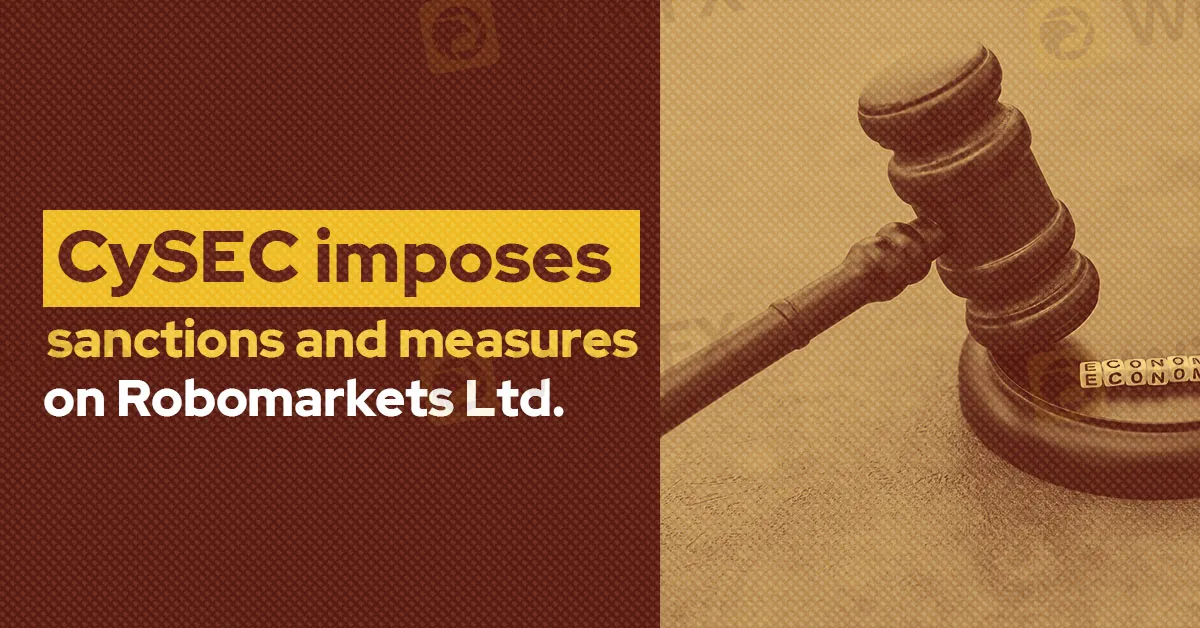
CySEC imposes sanctions and measures on Robomarkets Ltd
Abstract:The CySEC decided to sanction Robomaket and forbid it from offering non-monetary rewards. This move underscores the growing efforts of financial regulators to ensure the integrity and security of trading platforms and safeguard the interests of traders.
About Robomarkets
Established in 2012, RoboMarkets Ltd (ex. RoboForex (CY) Ltd) is a European broker offering investors access to over 12,000 trading instruments across 6 asset classes including stocks, indices, commodities, metals, forex, and cryptocurrencies through popular trading platforms such as MetaTrader4 and MetaTrader5. RoboMarkets offers a wide range of market instruments across various asset classes. Traders have access to over 12,000 instruments, allowing them to diversify their trading portfolio.

Is It Legit?
RoboMarkets is a regulated broker. It is regulated by CySEC with license number 191/13. WikiFX has given this broker a score of 4.89/10.

The Appeal of Non-Monetary Rewards
To attract and retain users, many online trading platforms, including Robomarket, have adopted strategies that go beyond traditional incentives. Non-monetary rewards such as electronic gadgets, luxury vacations, and other enticing gifts have been offered to traders based on their trading volumes, frequency, and achievements. These rewards, while alluring, have raised concerns among regulatory bodies regarding their potential impact on traders' decision-making processes and the overall fairness of the trading environment.
The Announcement
The Cyprus Securities and Exchange Commission (referred to as 'CySEC') has issued a public notice to communicate its recent decision regarding CIF Robomarkets Ltd (identified by LEI 213800DO1R3D5F7LH118), hereinafter referred to as the 'Company'. The decision stems from the Company's non-compliance with Article 42 of Regulation (EU) 600/2014, specifically outlined in paragraph 5 of DI 87-09, during a specified time period. This non-compliance pertains to the Company's engagement in activities aimed at bypassing the requirement specified in paragraph 4(1)(d) of DI 87-09. The non-compliance was centered around the Company's actions via its website and affiliated social platforms, where it offered its clientele non-monetary rewards.

CySEC, invoking its authority as outlined in Article 71(6) (b) of the Investment Services and Activities and Regulated Markets Law of 2017, has taken the decision to direct the Company to discontinue any involvement in providing non-monetary rewards to its retail clients. These clients are recipients of investment services related to contracts for differences (CFDs). The non-monetary rewards that are in question here include race tickets and branded merchandise.
It is noteworthy that CySEC's decision underscores the importance of adhering to regulatory standards in the investment services sector. The directive for the Company to cease offering non-monetary rewards aims to ensure fair and transparent practices within the industry and maintain the integrity of investment services extended to retail clients engaging in CFDs. This step taken by CySEC reaffirms its commitment to upholding regulatory guidelines and safeguarding the interests of investors and market participants alike.
Conclusion
The CySEC's decision to sanction Robomarket sends a clear message to the online trading industry that regulatory bodies are actively monitoring and addressing potential risks associated with non-monetary rewards. This move aligns with global efforts to enhance transparency, fairness, and accountability within financial markets.
As the online trading landscape continues to evolve, it is likely that other regulatory bodies will take similar actions to ensure that trading platforms prioritize the well-being of traders over short-term incentives. Market participants, including both traders and platform providers, will need to adapt to these changing regulatory dynamics while maintaining a strong focus on ethical and responsible trading practices.


Read more

Wundersys vs tradgrip: Two Offshore Newcomers Go Head to Head — and Neither Brings Home a Trophy
Some broker comparisons end with a confident "go with this one." This is not one of them — and that honesty is exactly what makes it worth reading. Wundersys and tradgrip are two young, offshore-registered brokers that keep popping up in front of beginner traders, often through aggressive online marketing. Both promise the usual buffet: tight spreads, generous leverage, multiple account tiers. And both, according to WikiFX, sit near the very bottom of the safety scale. So instead of crowning a champion, this comparison is really about something more useful: learning to read the warning signs, understanding the small differences that still matter, and knowing why "the better of two risky options" is still a conversation about risk.
The 6 Lowest-Commission Forex Brokers South Asian Traders Are Flocking To in 2026
If you trade forex from India, Pakistan, Bangladesh, Sri Lanka, or Nepal, you already know the quiet truth that eats into every trader's results: it is not just the market that decides whether you profit — it is the cost of getting in and out of each trade. Shave a couple of dollars off your commission on every lot, multiply it across hundreds of trades a year, and you are looking at the difference between a strategy that works and one that bleeds out slowly. South Asian traders are some of the most cost-conscious in the world, and rightly so. So we pulled the data on the brokers most often recommended for the region, cross-checked every name on WikiFX, and ranked them by the one number that matters most here: what they actually charge you to trade. Before the list, one quick lesson that will make this whole ranking click.

XPO Fund Wants $10,000 Before You Trade a Single Real Dollar — Read This Stunning Revelation
If you have spent even a week inside trading communities lately, you already know the pitch by heart. Pass a quick "challenge," get handed a funded account worth tens of thousands of dollars, and keep up to 80% of everything you make. No risking your own savings, no slow grind of building capital from scratch — just skill, a small fee, and a fast track to the big leagues. It is the exact dream every new trader is secretly chasing, and an entire industry has sprung up to sell it. XPO Fund is one of the louder voices selling that story right now. Its website is slick, its plans sound generous, and its marketing leans hard on words like "industry's lowest fee" and "fast payouts." But before you reach for your card, there is one number sitting quietly on this firm's profile — a number it would rather you scroll past — that every experienced trader would beg you to look at first. And no, it is not the profit split. Let's pull XPO Fund apart piece by piece: what it actually is, who is real
The 6 Best ECN Brokers for 2026: Who Really Delivers Raw Spreads and Institutional-Grade Execution
Every broker with a marketing budget now slaps the letters "ECN" on its homepage. Few of them actually deliver what those letters promise. For a serious trader — a scalper, a day trader, an algo trader, anyone whose edge lives or dies on execution quality — the gap between a true ECN broker and a market maker wearing an ECN costume can quietly cost you hundreds of pips a year in slippage, requotes, and inflated spreads. So we cut through the marketing, looked at the brokers that genuinely offer raw pricing and deep liquidity, and cross-checked every one of them on WikiFX. Here are the six ECN accounts that actually earn the label in 2026 — ranked. First, a short primer, because understanding ECN is what lets you judge these brokers properly.
WikiFX Broker
Latest News
How to Read Market Reversals Through Price Action and Indicators
 WikiFX
A Single TikTok Ad Cost Him RM100,000
WikiFXLONG ASIA Review: Broker Complaints, Regulation Gaps, and Withdrawal Alarms
WikiFXHow Proprietary Trading and Artificial Volume Move Prices
WikiFXCrude Jumps Amid Structural FX Shifts
WikiFXAximTrade Review: Regulation Warnings and Broker Withdrawal Complaints
WikiFXHow the Long Shadow Trap Ruins Reversal Trades
WikiFXAsian FX Markets Modernise As Crude Oil Surges
WikiFXInstitutional FX Volumes Edge Higher in May 2026
WikiFXKANAK CAPITAL MARKETS Review 2026: Official Warnings and Withdrawal Risks
WikiFXRate Calc

