EUR looking to continue its bullish trend ahead of FOMC and ECB meeting
Abstract:The Euro is steady going into the European session last week and is looking to notch up a fourth straight monthly gain after making a 20-year low last September.

The Euro is steady going into the European session last week and is looking to notch up a fourth straight monthly gain after making a 20-year low last September.
While The US Dollar losing ground across the board has aided the rally thanks to perceptions that the Federal Reserve might be less aggressive in its tightening regime.
The move up for EUR/USD has also received some tailwinds from the European Central Bank (ECB) stepping up its fight against inflation. In addition, with employment data to come out of the USA softer data may support a more dovish Federal reserve.
In the previous few days and weeks, the EUR has seen some strong momentum on the back of growth data that has seen the region avoid a recession. Crucially, the GDP of the Eurozone grew by 0.1% which beat an expected 0.1% retraction for the quarter. A general weakening of the USD has also supported a bounce of the EUR as money has moved away from the safety of the greenback and into other assets.
Technical Analysis
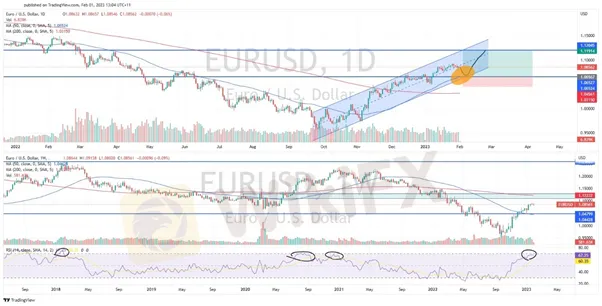
When it comes to the long-term analysis, the price has mostly ranged between 1.04 and 1.25 except when the price bottomed last year. The price is currently showing some weakness and has so far been unable to break through 1.09 and has sold down on candlesticks that are testing the 1.09 level. Therefore, it would not be surprising to see the price retrace to the previous support level at 1.06 before another move to the upside.
On the daily price chart, the price is showing a strong upward channel/trend. This channel shows how the bottom of the channel fall along an important area of market structure. This zone acts as the 50-day moving average, the recent support level and the bottom of the channel. This bolsters this region as a zone for ana entry should the price retrace. With a target of 1.12 this represents a risk reward of 2.5.
Ultimately the trend of the EUR will most likely be dictated by the movements of the Federal reserve and the ECB. However, should the macroeconomic factors permit, the EUR could very well continue its run.


Read more
Perry Warjiyo Resigns: Why the Rupiah Moved Above Rp18,000 per US Dollar
Perry Warjiyo resigned as Bank Indonesia governor, Destry Damayanti became acting governor, and the rupiah traded above Rp18,000. Here is what forex traders should monitor next.
MT4 White Label Cost in 2026: What Brokers Must Budget Beyond the Platform Fee
The visible fee in an MT4 white label proposal is rarely the real cost of operating it. For an existing broker, the decision is not simply whether an MT4 white label platform is “cheap” or “expensive.” The real question is whether the commercial model remains viable after integration, support, data, client migration, compliance, and exit costs are included. That is why an MT4 white label cost review should be built as a 24- to 36-month operating case. It should compare three credible choices: 1. Keep the present MT4 setup and improve its weakest controls. 2. Replace the MT4 white label provider but retain the client proposition. 3. Migrate selected clients or products to another platform while running MT4 in parallel. This guide explains how to build that case without relying on headline prices or generic vendor claims.

Best White Label Trading Platform 2026
The decision to switch white label providers or migrate to a modern white label trading platform is no longer a luxury for growth-minded brokers—it's a strategic necessity for survival in 2026. The convergence of technological stagnation, regulatory evolution, and shifting client expectations has created a perfect storm.

Why Is My Forex Withdrawal Still Pending? 7 Broker Excuses Traders Keep Hearing
Withdrawal delays are precisely the complaint we keep receiving on WikIFX, a veteran in the forex regulation inquiry space. While some users receive withdrawal access initially and find rejections on their applications later, some fail to receive a single approval. Some delays usually result from genuine compliance requirements that brokers need to adhere to. However, in many cases, traders have accused the broker of repeated excuses as part of its alleged strategy to deny a seamless fund release. A pending withdrawal cannot be an outright indicator of fraudulent activity. Financial institutions, including forex brokerage entities, need to abide by the anti-money laundering (AML) and Know Your Customer (KYC) regulations. However, as the monitoring process stretches beyond weeks or months, traders become frustrated and raise questions over the broker’s reliability.
WikiFX Broker
Latest News
OtetMarkets Review: Traders Report Frozen Funds and Withdrawal Blocks , Score Sits at 2.00
 WikiFX
Is Octa Safe for Malaysian Traders? Deep Dive into Octa's Regulatory Status
WikiFXPocket Broker Review: Is Your Deposit Safe?
WikiFXReview 2026: Dollars Markets Regulation, Withdrawal Complaints, and Platform Risks
WikiFXCapital Guard Liquidated: $17.4m Raised, Most Funds Gone
WikiFXSingapore Dollar Holds Tight Range as FOMC Looms
WikiFXHow a 'Legitimate' Investment Became a RM67.5 Million Ponzi Scheme That Scammed 206 Investors
WikiFXRupee Hits Two-Week High as RBI Defends 97 Mark
WikiFXForexMart Review: Profit Canceled, Principal Withheld, and a Broker Warning Traders Cannot Ignore
WikiFXTitan Capital Markets Review 2026: Complaints, Withdrawals, and Severe Risk Signals
WikiFXRate Calc

