WikiFX report: TradeFinex aims to minimise global infra investment deficit
Abstract:TradeFinex facilitates peer-to-peer financing between governments, corporations, buyers, and suppliers, allowing for more effective capital allocation and project deployment without putting the government's purse under strain.
In many under-developed and developing countries, demand for infrastructure and other government services is on the rise. But many of these countries are grappling with the challenge of delivering increased investment due to constrained fiscal budgets. This often forces their respective governments to focus on prioritising infrastructure investments in favour of projects that can deliver increased economic growth and social benefit.
And this often hurts human-centric developments.
“Infrastructure prioritisation is often an informal process and there is no standard process or approach at either the state or the central government level,” says Sameer Dharap, Co-founder of XinFin Fintech. “This prioritisation leads to delays and implementation of projects that may not necessarily drive the economic growth. The current global infrastructure deficit is estimated to be US$5 trillion, and governments and institutions around the world are struggling to get financing for their infrastructure boost.”
This is where Singapore-based startup XinFin fits in. Founded in January 2017 by a group of entrepreneurs Dharap, Peter Yeo, Jack Xu, Atul Khekade, Ritesh Kakkad, and Karan Bharadwaj, XinFin aims to minimise inefficiencies in trade and financing using a blockchain-powered P2P marketplace, called TradeFinex.
Expert speak (Part I): The biggest disruption in blockchains and cryptocurrencies is yet to come
“TradeFinexs primary objective is to minimise global infrastructure deficit by enabling P2P financing between governments, corporations, buyers and suppliers, and to make efficient use of capital and deploy projects without burdening the government treasury, ” says Co-founder Dharap. “This platform will help buyers secure capital at globally competitive rates, give suppliers visibility on global tenders and customer base. Finally, it gives financiers real-time visibility on their investments using digitisation and IoT integration of their assets.”
In essence, TradeFinex enables buyers, sellers and financiers to trade and finance projects that banking institutions are unable to take up. This applies specifically to critical public infrastructure projects that governments need to undertake for economic wellbeing of their citizens.
XinFin team
“Governments, infrastructure investors, project owners and sponsors need to rethink the financing model they choose for infrastructure investments. We can no longer depend on government exchequer for financing of various projects. This is where the TradeFinex platform assumes significance,” he notes.
Built on the blockchain technology, TradeFinex enables low cost funding for global infrastructure projects. TradeFinexs XDC tokens, built using the XDC01 standard, act as underlying payment and settlement for cross-border P2P trade and settlement activities undertaken on the marketplace. These tokens can be traded against fiat currencies or other crypto-currencies and will act as an underlying settlement mechanism.
By using XDC tokens, which can be purchased on the listed exchanges, individuals, corporates, communities and governments can get access to low cost capital. Anyone holding XDC tokens can become a financier on the platform. According to Dharap, TradeFinex will essentially become a joint-label/white-label platform that uses underlying liquidity in XDC market to lend globally.
At the time of contracting, the buyer and financier will agree on the lending rate. The interest charged will be the income for the financier. XinFin has allocated up to 25 per cent of XDC tokens to financiers as a bounty/cashback for financing infrastructure projects. The upside in the price of token, if any, will be further upside for the investors financing real world infrastructure projects using TradeFinex platform.
“An investor can finance a project partially along with a pool of investors. XinFins underlying smartcontracts will support this. As the value of the project to be financed goes up, this feature will be required by financiers,” Dharap points out.
USP
While there are other marketplaces to connect buyers, suppliers, governments and financiers, TradeFinex is different and is more transparent, claims Dharap .
“Contracting life-cycle can be classified in four phases — discovery, negotiations, contracting and execution. Traditional marketplace platforms perform only phase I and II of this life-cycle, where the beneficiary can post projects and negotiate to get best techno-commercial details. Other two phases are still offline and subject to numerous inefficiencies in terms of payment disbursement, collection and contracting. They are paper-based and disjoint IT systems makes it further inefficient and time consuming. Traditional platform either allows financing or procurement at a time and user needs to switch to another platform for the other service,” he tells e27.
XinFin Co-founder Sameer Dharap
“We are a marketplace powered by blockchain that allows users to execute all four phases of contracting life-cycle including contracting, and make global payments and settlements using underlying currency on the same platform. Beneficiaries can post their projects and negotiate with suppliers/financiers on the same platform. Using our underlying smart contracts, parties can execute legally binding digital smart contracts with integrated global settlement layer. This builds efficiency in the system and cross-border execution is seamless,” Dharap adds further.
XinFin is mainly targeting Asia Pacific, Africa and other countries where access to low-cost capital is usually a challenge.
Initially, TradeFinex will only undertake small and medium-size projects of national infrastructure importance backed by government security. Participation of governments and leading corporates will get preference. Individual projects will be evaluated on case to case basis. Beneficiaries can post projects on TradeFinex platform and reach out to global financiers for funding and global suppliers for procurement.
XinFins blockchain platform also offers integrated wallet solutions to enable real-time payment and settlement across the globe. Built on the XDC protocol, the wallet services can be utilised by individuals, corporates, and financial institutions to facilitate cross-border real-time payments for trade, financing and remittances.
TradeFinex can be used with existing laws of the land and payment rails, or in an approved jurisdiction using underlying XDC tokens.
Dharap claims the startup has already received confirmed participation requests of the various worlds renowned institutions and governments. “We have been working in various sectors like energy, travel, aviation and fintech. We will be working closely with the working group of the Indias central bank RBI to develop blockchain infrastructure and applications for banking and financial institutions,” he concludes.

Read more
Errante Review 2026: Users Claim a Poor Trading Experience. What Does Our Investigation Reveal?
Errante, a Seychelles-based brokerage entity, is facing serious trading allegations from users globally. Users claim to have earned profits legitimately using their strategies. However, on the Errante login dashboard, many users reported an automatic deduction of earned profits. At the same time, withdrawal issues allegedly haunt many traders here. While investigating, we also found complaints concerning trade order manipulations by the broker. In this Errante review, we have examined these allegations and given an overview of its regulatory status.

Monisha Chakraborty Appointed as RB Executive Director: What Does This Mean for India's FX Market?
The Reserve Bank of India has appointed Monisha Chakraborty as Executive Director with effect from 3 August 2026; she will oversee the Foreign Exchange Department and the Financial Markets Regulation Department. Chakraborty is a career central banker with over three decades of experience in Supervision, Foreign Exchange, and Government and Bank Accounts, and previously served as Banking Ombudsman. This report explains the significance of the new RBI Executive Director appointment for forex regulation India, the scope of the Foreign Exchange Department and the Financial Markets Regulation Department, and what authorised persons, banks, and forex market participants should monitor as the new ED takes charge.
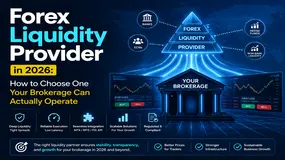
Forex Liquidity Provider in 2026: How to Choose One Your Brokerage Can Actually Operate
A forex liquidity provider decision now shapes the broker's spreads, fills, slippage, hedging cost, regulatory exposure, and exit options long after the platform is chosen. This 2026 guide explains what a forex LP actually delivers versus what the marketing claim says, how tier-1 banks, prime of prime, and multi-LP aggregators differ in practice, and how execution models (DMA, ECN, STP) change the broker's daily operating reality. It also walks through due diligence on credit, technology, reporting, governance, and exit, and shows how a 2026 broker can combine a primary LP with secondary routing without losing control of the client experience. Use the decision matrix, integration timeline, and operational tests to compare an fx liquidity provider before contract signature, not after a market event.
LMAX Group Review 2026: Users Report Disturbing Withdrawal Issues - Is the Broker Still Reliable?
Did LMAX Group deny you withdrawals citing frozen funds at the wallet service provider’s end? Have you been so exhausted by the endless withdrawal hassles that you have begun to stop investing in the platform? Has this UK-based liquidity provider even questioned your fund ownership status when you requested withdrawals? You are not alone! Many users have complained about these issues while sharing their LMAX Group reviews.
WikiFX Broker
Latest News
57 Booked in Pune Forex Scam Probe: The Fake Trading App Checklist Every Indian Investor Needs
 WikiFX
Accused of a RM123 Million Crypto Scam, He Fled to Malaysia and Claimed He Was Robbed
WikiFXAfrica's 10 Strongest Currencies in July 2026: Naira Absent
WikiFXU.S. and Japan Stand Ready for Further Coordinated Yen Intervention, Treasury Warns
WikiFXYen Retreats After Coordinated Intervention
WikiFXRinggit Flat Near RM4.09 After US Factory Data Surprise
WikiFXHF Market Review – A 1.76 Score, an Unverified CYSEC Licence, and a Frozen Account
WikiFXSri Lanka Rupee Slides 7.9% in H1 2026 as Bank Steps In
WikiFXMarket, Limit, and Stop Orders in Forex Explained Simply
WikiFXApple Faces Lawsuit Over Fake Crypto App Exposing $1.8 Million Theft
WikiFXRate Calc

