Trive Under Fire: Employees Demand Withheld Salaries
Abstract:Trive, a Netherlands-based leading CFD broker across forex, stocks, indices and commodities, is facing ire from its employees on the unpaid salary crisis that has haunted them for four months starting from November 2025. Upset over such a long delay, employees have been using social media platforms to express their frustration. Read on for more revelation.

Trive, a Netherlands-based leading CFD broker across forex, stocks, indices and commodities, is facing ire from its employees on the unpaid salary crisis that has haunted them for four months starting from November 2025. Upset over such a long delay, employees have been using social media platforms to express their frustration.
Employees Asked to Remove Salary Delay Posts on Social Media
As soon as the employee posts criticizing the company over the failure to pay their salaries made rounds, the companys HR department got into action. It reportedly requested these employees to take posts down within 48 hours of them going viral. Employees express irony over the corporate ethics at Trive, which allegedly considers it wrong to speak about the lack of payment, according to a post. However, the employee expressed concerns over the withheld earned wages leading to the repossession of the car and the potential eviction being considered normal by the company. An employee, in a sarcastic tone, hit out at the HR management, saying that such crisis management would help them get a raise.
The Settlement Process Kicks Off at Trive
According to the rumors, the company‘s Head Office has acknowledged the settlement request raised by the employees. According to them, they requested the wages they legally earned and were promised in writing in January. They do not ask for a bonus or payout, the employee statement added. However, the post says it as a familiar script from the company, saying that the payment is in process, waiting for final confirmation. This, according to the post, has been on for weeks and months. The post dismissed the pending salaries as having anything to do with the liquidity issue. Rather, it’s a choice, the post added.
A Settlement Note from the Company
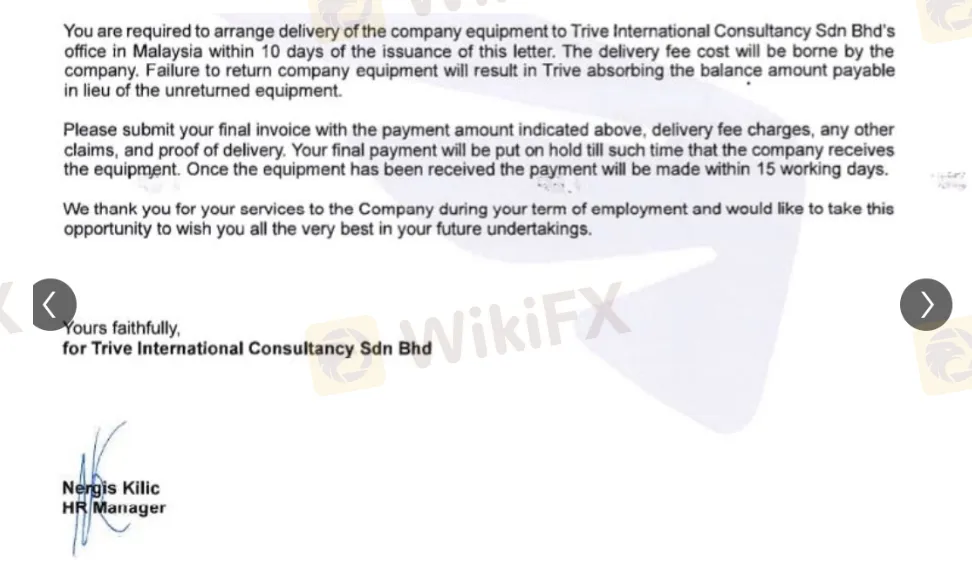
Meanwhile, while investigating the case, we also stumbled upon a note from the company‘s HR manager asking employees to return equipment to Trive International Consultancy Sdn BHD’s office in Malaysia within 10 days of the letter issuance date. While the delivery charges incurred on equipment would be borne by the company, failure to provide this to it would result in the absorption of the balance amount payable in lieu of the unreturned equipment. The issued letter requested the submission of a final invoice with the payment amount and delivery charges. According to the letter, the final amount would be put on hold until the company obtains the equipment. Within 15 days of the receipt of the equipment, the company will issue the payment to the employee.
Social Posts Read a Cautionary Tone for Clients & Traders
An employee expressed that if the brokerage house cannot or will not settle its staff salary, how can it make its clients & traders‘ capital secure on its platform? If the company takes five months to confirm employees’ payment settlement, how long will it take to process clients withdrawals?
Multiple Withdrawal-related Complaints Give Credence to Concerns Expressed for Trives Traders
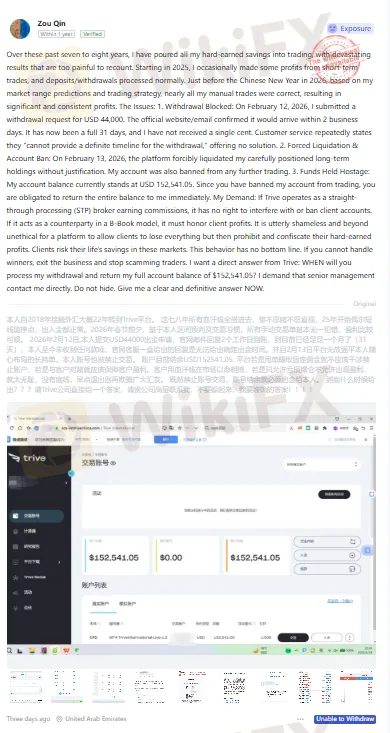
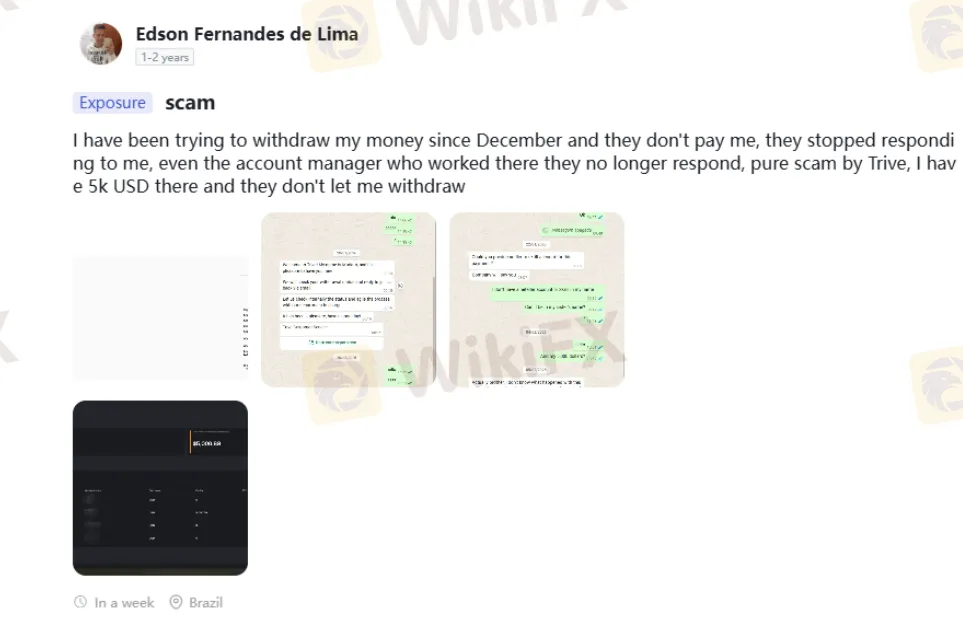
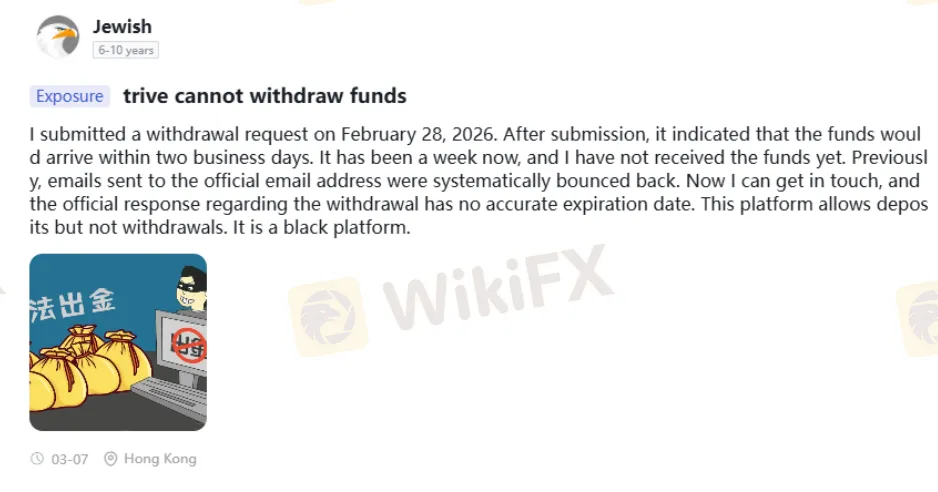
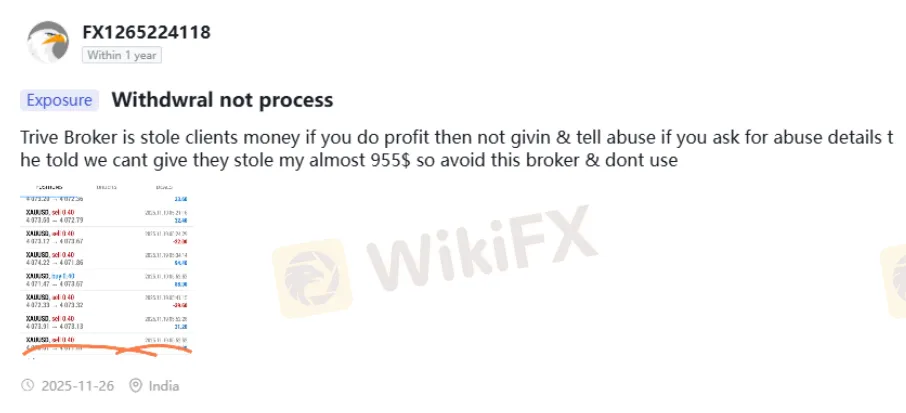
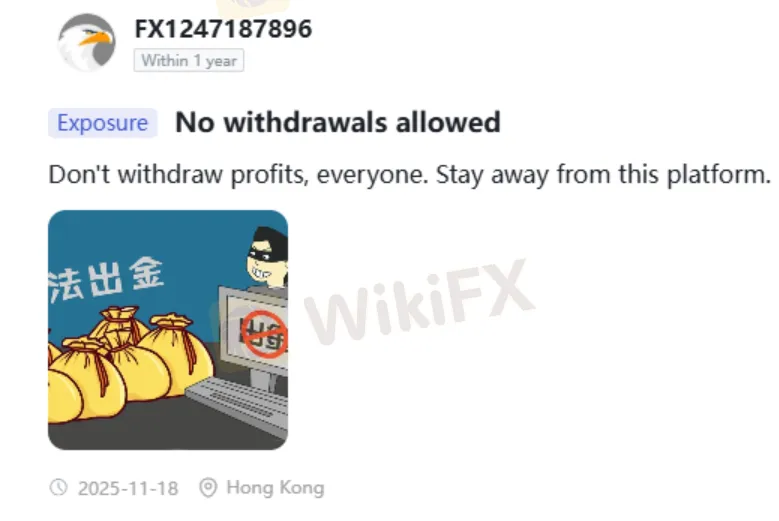
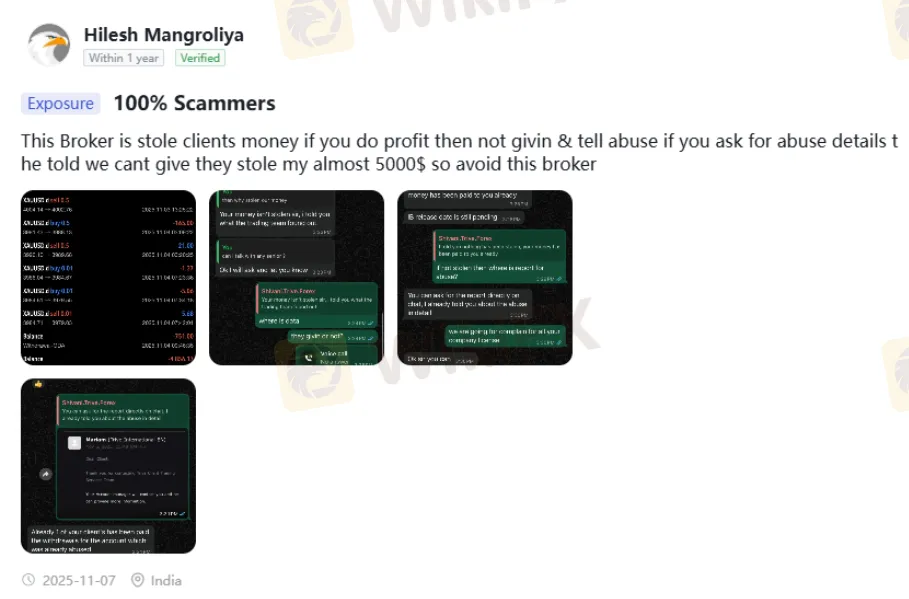
The doubts expressed by employees' posts over the inability to pay traders seem to be taking effect. On WikiFX, a leading forex regulation inquiry app, there have been many withdrawal complaints against Trive since the last four-five months. The broker officials reported having told traders about withdrawals in two-three business days. However, exposure reports reveal a massive delay, even lasting beyond a month. Here are some withdrawal denial complaints that have surfaced recently.
Trives Operational Presence
Trive Investment B.V. offers investment services through several wholly owned subsidiaries worldwide, including the United States, Europe, Africa, Australia, Indonesia, the Middle East, and Southeast Asia. These companies are licensed by reputable regulators globally. These include the Australian Securities and Investments Commission (ASIC) in Australia, the Financial Industry Regulation Authority (FINRA) in the US, the Commodity Futures Trading Regulatory Agency (BAPPEBTI) in Indonesia, the Financial Services Commission (FSC) in Mauritius and the British Virgin Islands, and the Financial Sector Conduct Authority (FSCA) in South Africa.
For more updates on forex brokers, including their regulatary status, download the new WikiFX app crafted for a more seamless experience. Scan the QR code below to start experiencing it.


Read more

Same Currency Pair, But Different Prices on Two Brokers? The Reason May Shock You!
Forex traders often wonder why the same currency pair, for instance, EUR/USD, shows 1.17450 on one broker but 1.17455 on another. This difference creates suspicion among traders, often leading to wrong calls and losses. Calm your nerves first by understanding that small price variations are normal and are a reflection of the global forex market’s operation. The forex market is decentralized with no single exchange or official price for any currency pair. That is some revelation for new forex traders. So, what’s the methodology for price determination? It is derived from an expanded network of financial institutions, banks, liquidity providers and brokers globally. So, as a forex trader, you must understand the price structure thoroughly to stay out of unnecessary chaos and continue to reap rewards.
VITTAVERSE Review 2026: The Broker Deleted My Profits Citing Rule Violation. But Where is the Proof?
Whether it’s South Asia, Western Asia, Europe or America, users all over are basically asking this: Why is VITTAVERSE cancelling my profits without providing any evidence? While they may be user allegations, a large volume of such complaints creates suspicion, if not affirmation, about the broker’s alleged involvement in profit cancellations. Users also complained about massive withdrawal delays in the name of ‘Account Review’ or ‘Account Upgrade’. This VITTAVERSE review article closely examines user allegations, including those concerning profit deletions, by the Seychelles-based brokerage firm. To give you a fair idea of its legitimacy, we have also provided a regulatory overview of the broker.

Ninja Trader Review 2026: Should You Trade with This Broker?
This NinjaTrader review provides a detailed examination of NinjaTrader regulation, licensing coverage, the NinjaTrader broker profile, and overall standing based on information available on WikiFX.

GRD Review 2026: Should You Trade with This Broker?
This GRD review provides a detailed examination of the GRD broker, its regulatory framework, licensing coverage, GRD regulation, and overall standing based on information available on WikiFX.
WikiFX Broker
Latest News
WHITEFOREX Review 2026: I Am Not the Only Victim of Its Profit Seizure Activity; Users Say This!
 WikiFX
Vonway Forex Review: No Regulation, Withdrawal Complaints, and a Broker Warning
WikiFXFinalto Review 2026: Regulation, Trading Environment, and Platform Access Risks
WikiFXReview 2026: TRADING 212 Regulation, Clone Warning, and Withdrawal Complaint
WikiFXReview 2026: BOLD PRIME Complaints, Regulation Warnings, and Withdrawal Risk
WikiFXReview 2026: EMIRAX MARKETS Regulation, Withdrawal Complaints, and Trading Risks
WikiFXPolymarket Under Fire as Wall Street Watchdog Launches Investigation
WikiFXRoboMarkets Review 2026: Regulation, Complaints, and Execution Quality
WikiFXMazi Finance Review 2026: Unregulated Status, Withdrawal Complaints, and Risk Signals
WikiFX⚽💱 World Cup · Forex Predict & Win Event
WikiFXRate Calc

