Deposited at New Frontier, Then Locked Out—Funds Never Came Back - The Real Story of a Trader
Abstract:There are few feelings in trading more sickening than this one: you funded your account, you walked away confident your money was safe, and when you came back to check on it, the platform calmly informed you that your login details were wrong. Not your trades — your very identity, locked out. And on the other side of that login screen sits a balance you can no longer touch and a support team that has gone silent. That is the heart of a complaint filed against New Frontier on WikiFX. One trader reported depositing 40,500 pesos, returning to log in with the exact email and password they had registered, and being told the data was "incorrect" — which, in their words, meant their earnings had simply been taken. Customer service, they said, did not react. Let's look closely at this broker, what makes its profile so unsettling, and why verification here is not optional.
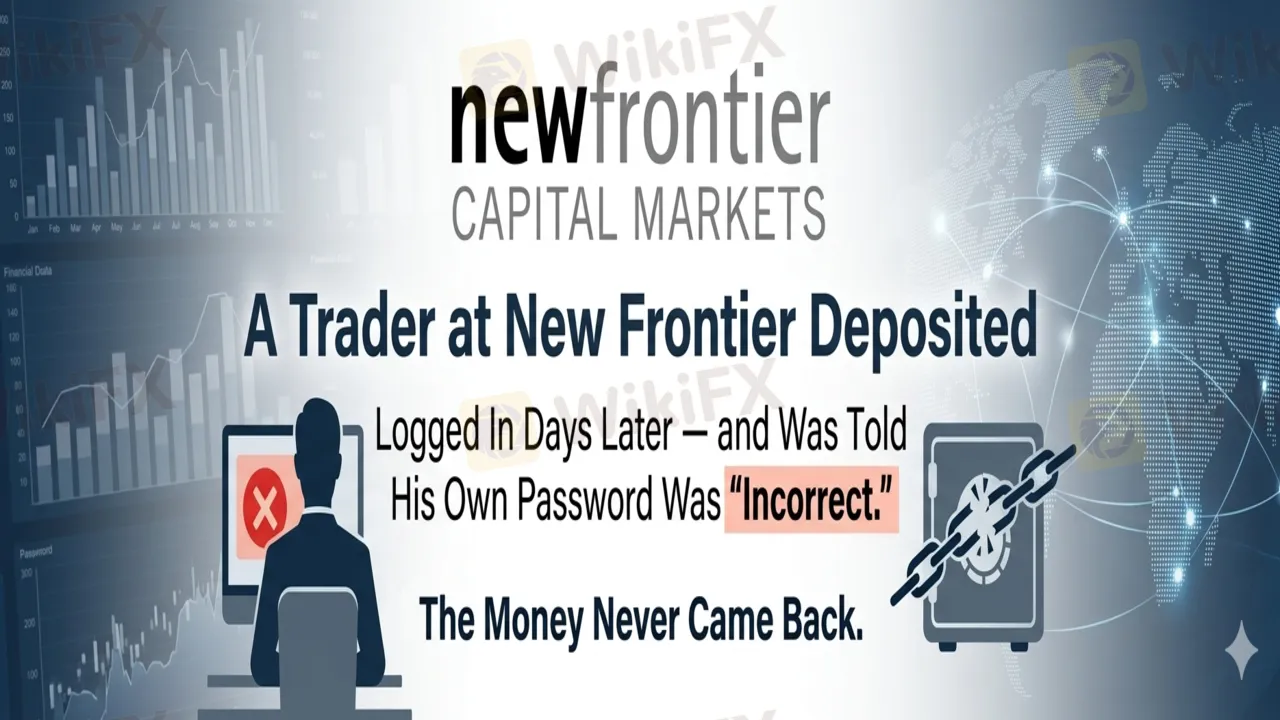
There are few feelings in trading more sickening than this one: you funded your account, you walked away confident your money was safe, and when you came back to check on it, the platform calmly informed you that your login details were wrong. Not your trades — your very identity, locked out. And on the other side of that login screen sits a balance you can no longer touch and a support team that has gone silent.
That is the heart of a complaint filed against New Frontier on WikiFX. One trader reported depositing 40,500 pesos, returning to log in with the exact email and password they had registered, and being told the data was “incorrect” — which, in their words, meant their earnings had simply been taken. Customer service, they said, did not react. Let's look closely at this broker, what makes its profile so unsettling, and why verification here is not optional.
Who — or What — Is New Frontier?
This is where New Frontier gets genuinely confusing, and that confusion is itself part of the warning.
On one hand, New Frontier Capital Markets, LLC presents itself as a legitimate, United-States-based firm. It is registered as an LLC in Illinois, lists a Chicago business address, advertises a U.S. toll-free phone line, and even appears in some industry broker directories describing itself as a full-service agricultural-commodity brokerage offering commodity hedging, managed futures, and insurance products. On paper, that sounds like a serious, established operation — not your typical fly-by-night offshore forex shop.
On the other hand, WikiFX data tells a far more troubling story. The broker carries a WikiFX score of just 1.58 out of 10. Its regulation index, license index, and risk-control index all sit at 0.00. WikiFX explicitly notes that the company holds no valid regulatory license for forex and CFD trading from any major authority — not the National Futures Association (NFA), not the Commodity Futures Trading Commission (CFTC), not the FCA or ASIC. And perhaps most jarring of all, WikiFX flags that New Frontier's official website, nfcmarkets.com, is currently inaccessible.
That gap — between a respectable-sounding “U.S. commodity brokerage” image and a profile showing no verifiable forex regulation, a dead website, and a locked-out client — is exactly the kind of contradiction that should stop a careful trader cold.
A Quick Beginner's Translation
Because New Frontier wraps itself in some advanced-sounding terminology, let's decode it, since these terms trip up almost every newcomer.
Commodity hedging is the practice of using financial contracts to lock in prices and protect against adverse price moves — for example, a farmer locking in a selling price for next season's corn. Managed futures means handing your capital to a professional manager who trades futures contracts on your behalf. Futures themselves are standardized contracts to buy or sell an asset at a set price on a future date.
Here is the critical point a beginner needs to grasp: in the United States, offering managed futures and acting as a commodity trading intermediary are heavily regulated activities. Firms doing this legitimately are generally required to register with the CFTC and become members of the NFA — the bodies that license, audit, and police commodity and futures professionals in America. So when a firm markets U.S.-style managed-futures and commodity services, yet a third-party database shows no valid regulatory license on file, that mismatch is not a small technicality. It is precisely the discrepancy that separates a trustworthy operator from a risky one, and it is exactly what you are supposed to verify before investing.
The Complaint, in the Trader's Own Experience
The single exposure report on New Frontier's WikiFX profile is short, but every detail in it is a recognized danger sign.
The trader, based in Mexico, described depositing 40,500 pesos. When they later attempted to log in using the credentials they had personally registered, the platform rejected them, claiming the information was incorrect. From the trader's perspective, being locked out of their own funded account meant their money — their “earnings” — had effectively been stolen. And when they turned to customer service for help, they got no response.
Strip away the specifics and you are left with a chillingly common sequence: deposit accepted, account access lost, support unresponsive. Whether caused by outright fraud, a collapsing operation, or chaotic mismanagement, the practical outcome for the trader is identical — their money is on the wrong side of a door they can no longer open.
Why a Dead Website Is Such a Loud Alarm
It is easy to underestimate this one, so let's be clear about why WikiFX flagging NFC Markets as inaccessible matters so much.
For any active brokerage, the website is the front door, the trading portal, the support hub, and the legal-disclosure center all at once. A legitimate, operating broker guards its website uptime obsessively, because every minute it is down is a client who cannot trade or — more importantly — cannot withdraw. When a firm's official website goes dark while it is still listed as soliciting clients, the possibilities are all bad: the operation may have folded, abandoned its clients, rebranded to escape its reputation, or simply stopped caring whether existing customers can access their capital. None of those scenarios is one you want your deposit caught inside of. A broker you cannot even load in a browser is a broker you certainly cannot rely on to return your funds.
The Red Flags, Counted Up
Pulling New Frontier's WikiFX profile together, the warning signs stack uncomfortably high:
- A near-bottom score of 1.58 out of 10, with regulation, license, and risk-control indices all at 0.00.
- No valid regulatory license for forex or CFD trading on file with any major authority, despite marketing U.S.-style managed-futures and commodity services that normally demand CFTC/NFA oversight.
- An inaccessible official website, flagged directly by WikiFX.
- A documented exposure complaint describing a locked-out account, inaccessible funds, and unresponsive support.
- Scattered, multiple addresses across several U.S. cities, and undisclosed basics like minimum deposit and trading platform — a level of opacity uncharacteristic of well-run, regulated firms.
In fairness, the picture is not uniformly black. New Frontier does appear in at least one mainstream industry directory as a registered U.S. agricultural-commodity brokerage, which distinguishes it from the purely anonymous offshore operations that plague this space. But that nuance does not cancel the concerns — it sharpens the lesson. A firm can carry a legitimate-looking corporate shell and still leave a retail client locked out of their funds with no recourse and a website that will not even load. The respectable veneer is precisely why you must verify rather than assume.
What to Do If You Are Ever Locked Out
If you ever find yourself on the wrong side of that login screen, act methodically:
- Document everything immediately. Screenshot your balance, deposit receipts, every email and chat with support, and the exact error messages. Evidence is your strongest asset.
- Stop sending money. Do not pay any “reactivation,” “verification,” or “unlock” fee. As with the withdrawal-tax trap, paying more never reopens the door — it only deepens the loss.
- Contact your payment provider. If you funded by card, ask your bank about a chargeback or dispute. Time limits apply, so move fast.
- Report it. File with your local financial regulator and law-enforcement, and lodge an exposure report so others are warned.
- Verify before the next deposit. Make checking a platform's regulatory status a non-negotiable habit going forward.
The Bottom Line on New Frontier
New Frontier sits in an uneasy middle ground that is, in its own way, more instructive than an obvious scam. It wears the clothes of a serious U.S. commodity brokerage, yet its WikiFX profile shows no valid forex regulation, a website that has gone dark, a near-bottom risk score, and a real trader reporting that their deposit vanished behind a login they could no longer use. For a beginner, the takeaway is not “this is definitely a fraud” — it is something more useful: a respectable name and a U.S. address mean nothing until you independently confirm the regulation and can actually reach your money.
That confirmation is exactly what WikiFX is built to give you in seconds. Before you wire a peso, a dollar, or a euro to any broker — no matter how established it sounds — open the WikiFX app or website, search the firm by name, and review its real regulatory status, license records, exposure complaints, and overall risk score in one place. The trader in this story funded first and discovered the problems later. Flip that order, and you flip your odds.
Check the license, test a withdrawal, and never trust a balance you cannot actually reach. Verify first, and trade safe.
Note: This article reflects a user complaint and broker data compiled on WikiFX and other public sources, and does not constitute a definitive legal finding. If you believe you have been affected by a broker-related issue, document everything and consider reporting it through official regulatory and law-enforcement channels.
Download the WikiFX App for the latest broker investigation reports, smart trading strategies & breaking news.

More Insightful Articles for You
Review 2026: Examining the Latest Withdrawal, Slippage and Spread Complaints Allegedly Held One Trader's €25,000 Hostage vs XTB — The Battle Of Two Very Different Broker Philosophies

Read more
FX Novus vs VCG Markets:Two Brokers, Two Very Different Kinds of Risk — Which One Is the Lesser Evil
If you have been shopping around for a forex broker and landed on FX Novus and VCG Markets, you have stumbled onto a genuinely instructive pair. On the surface they look like cousins: both are relatively young, both wave around multi-asset trading and tight spreads, and both operate from the kind of offshore corners of the world that should make any beginner slow down. But dig into the data on WikiFX and the two part ways sharply. One carries active, screaming red flags. The other is merely standing in a yellow zone. Neither is what a cautious newcomer would call "safe" — but understanding how they differ is exactly the kind of lesson that protects your money. Let's put them head to head, decode the jargon along the way, and reach an honest verdict.
Headway Review 2026: Examining the Latest Withdrawal, Slippage and Spread Complaints
Did your profits disappear just as you tried to withdraw funds from your Headway account? Have you been manipulated in the name of a forex bonus challenge by receiving a negligible sum compared to what was promised? Did you face capital losses due to abnormal spreads and slippages? Your issues resonate with others who have complained about the broker online. In this Headway review article, we have investigated these complaints while providing our firm view on the broker’s regulatory oversight.
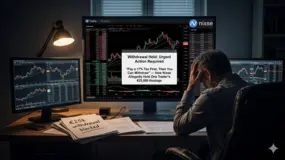
Pay a 17% Tax First, Then You Can Withdraw" — How Nixse Allegedly Held One Trader's €25,000 Hostage
Imagine logging into your trading account and seeing a balance of €25,860. You started with €12,450, you traded carefully, and now you want to pull out a modest €5,000 — money that, on paper, is sitting right there waiting for you. Then the message arrives: before you can withdraw a single euro, you must first pay a "stock market flat tax" of 17% on all your earnings. That is more than €4,400, demanded upfront, with no invoice, no official document, no legal basis whatsoever. You refuse. Your account is promptly frozen. That is not a hypothetical. According to a complaint filed on WikiFX, it is exactly what one French trader says happened to them with Nixse — and it is a textbook example of one of the oldest, ugliest tricks in the online trading world. Let's unpack what Nixse is, what users are reporting, and why the warning signs around this broker are flashing bright red.
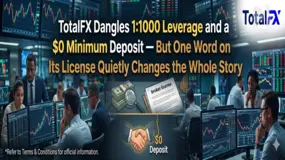
TotalFX Dangles 1:1000 Leverage and a $0 Minimum Deposit - But Is Its Regulation Strong?
On the surface, TotalFX reads like a brand-new trader's wish list come to life. No minimum deposit, so you can start with almost nothing. Leverage cranked all the way up to a jaw-dropping 1:1000. Spreads advertised from 0.0 pips. Both MetaTrader 5 and cTrader available. Copy trading baked right in. Tick, tick, tick, tick. If you were building a checklist of "things that make a broker look beginner-friendly," TotalFX would seem to hit nearly every box. But how strong is its regulatory background? Let's find out!
WikiFX Broker
Latest News
BONUS Review 2025: Is This Forex Broker Safe?
 WikiFX
Trading.com Secures MiCA Licence in Cyprus as Crypto Access Becomes Part of Its EU Strategy
WikiFXThe Hidden Risks of Margin Calls and How to Trade Trends Safely
WikiFXT4Trade Review 2026: Official Warnings and Withdrawal Risks
WikiFXLONG ASIA Review 2026: Withdrawal Complaints and Unverified Regulation
WikiFXTotalFX Dangles 1:1000 Leverage and a $0 Minimum Deposit - But Is Its Regulation Strong?
WikiFXPay a 17% Tax First, Then You Can Withdraw" — How Nixse Allegedly Held One Trader's €25,000 Hostage
WikiFXHow to Read Market Reversals Through Price Action and Indicators
WikiFXA Single TikTok Ad Cost Him RM100,000
WikiFXLONG ASIA Review: Broker Complaints, Regulation Gaps, and Withdrawal Alarms
WikiFXRate Calc

