Kwakol Markets reportedly disables clients’ accounts and blocks withdrawal requests.
Abstract:In recent weeks, a wave of discontent has swept across social media platforms in Nigeria as investors voiced their frustrations over alleged account disabling and withdrawal issues with an investment platform called Kwakol Markets.
Introduction
In recent weeks, a wave of discontent has swept across social media platforms in Nigeria as investors voiced their frustrations over alleged account disabling and withdrawal issues with an investment platform called Kwakol Markets.
Account Disabling and Blocked Withdrawals
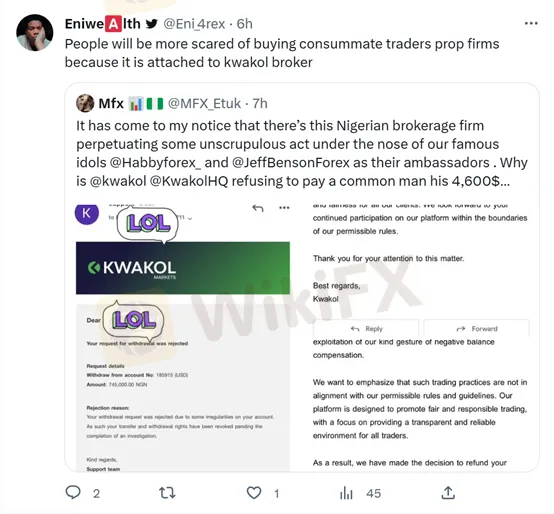
Kwakol Markets, a well-known forex broker in Nigeria, has come under fire after several clients reported having their accounts disabled and their withdrawal requests blocked. The affected investors took to Twitter to share their experiences, detailing the frustrations they faced in trying to access their funds. The disabling of accounts without apparent cause or explanation has left many investors feeling betrayed and concerned about the safety of their investments.

Kwakol Markets on WikiFX
Several alerts have been raised if you check the Kwakol Markets on WikiFX. Kwakol has been given a score of 4.00/10 by WikiFX. And recently WikiFX has received a lot of complaints against this broker within three months. Please be aware of the potential risk.

Consummate: Withdrawal Woes Continue
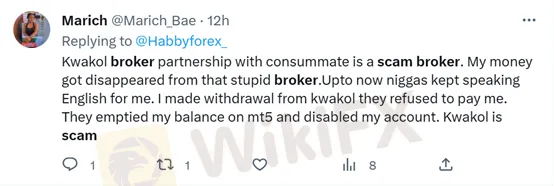
Interestingly, it has been discovered that Kwakol Markets has a partnership with another investment platform called Consummate, which is also grappling with similar withdrawal issues. Users of Consummate have reported difficulties in withdrawing their funds, effectively leaving them stranded with their investments locked within the platform. This has further fueled speculation about the legitimacy and trustworthiness of both Kwakol Markets and Consummate.

As we know so far, Kwakol has also partnered with two gurus who are well known on local social media platforms. They are @Habbyforex_ and @JeffBensonForex.


The Impact on Investors
The repercussions of these reported issues are significant, as numerous investors find themselves unable to access their hard-earned money and the accounts have been disabled by this broker. Many individuals believed this broker is getting involved in a scam. The lack of transparency and the failure to facilitate withdrawals erode trust and confidence in these platforms, ultimately hurting investors and undermining the broader investment landscape in Nigeria.
While the exact reasons for the disabling of accounts and blocked withdrawals remain unclear, some potential explanations have emerged. As we know so far, this broker is not regulated by any regulatory institution. This is a serious red flag for us when concerned about its reliability.

There is More
In May of this year, on Facebook, Kwakol Markets was reported to have refused to let client withdraw $81,000 and suspended users' accounts. See below.

Conclusion
The reports of account disabling and blocked withdrawals from Kwakol Markets and Consummate have caused significant distress among investors in Nigeria. The inability to access funds and the subsequent loss of trust in these platforms highlight the urgent need for enhanced regulation and oversight in the investment sector. Investors should exercise caution and thoroughly research any investment platform before committing to their funds. It is crucial for regulatory bodies to investigate these allegations promptly and take appropriate action to safeguard the interests of investors and maintain the integrity of the Nigerian investment landscape.


Read more

Wundersys vs tradgrip: Two Offshore Newcomers Go Head to Head — and Neither Brings Home a Trophy
Some broker comparisons end with a confident "go with this one." This is not one of them — and that honesty is exactly what makes it worth reading. Wundersys and tradgrip are two young, offshore-registered brokers that keep popping up in front of beginner traders, often through aggressive online marketing. Both promise the usual buffet: tight spreads, generous leverage, multiple account tiers. And both, according to WikiFX, sit near the very bottom of the safety scale. So instead of crowning a champion, this comparison is really about something more useful: learning to read the warning signs, understanding the small differences that still matter, and knowing why "the better of two risky options" is still a conversation about risk.
The 6 Lowest-Commission Forex Brokers South Asian Traders Are Flocking To in 2026
If you trade forex from India, Pakistan, Bangladesh, Sri Lanka, or Nepal, you already know the quiet truth that eats into every trader's results: it is not just the market that decides whether you profit — it is the cost of getting in and out of each trade. Shave a couple of dollars off your commission on every lot, multiply it across hundreds of trades a year, and you are looking at the difference between a strategy that works and one that bleeds out slowly. South Asian traders are some of the most cost-conscious in the world, and rightly so. So we pulled the data on the brokers most often recommended for the region, cross-checked every name on WikiFX, and ranked them by the one number that matters most here: what they actually charge you to trade. Before the list, one quick lesson that will make this whole ranking click.

XPO Fund Wants $10,000 Before You Trade a Single Real Dollar — Read This Stunning Revelation
If you have spent even a week inside trading communities lately, you already know the pitch by heart. Pass a quick "challenge," get handed a funded account worth tens of thousands of dollars, and keep up to 80% of everything you make. No risking your own savings, no slow grind of building capital from scratch — just skill, a small fee, and a fast track to the big leagues. It is the exact dream every new trader is secretly chasing, and an entire industry has sprung up to sell it. XPO Fund is one of the louder voices selling that story right now. Its website is slick, its plans sound generous, and its marketing leans hard on words like "industry's lowest fee" and "fast payouts." But before you reach for your card, there is one number sitting quietly on this firm's profile — a number it would rather you scroll past — that every experienced trader would beg you to look at first. And no, it is not the profit split. Let's pull XPO Fund apart piece by piece: what it actually is, who is real

The 6 Best ECN Brokers for 2026: Who Really Delivers Raw Spreads and Institutional-Grade Execution
Every broker with a marketing budget now slaps the letters "ECN" on its homepage. Few of them actually deliver what those letters promise. For a serious trader — a scalper, a day trader, an algo trader, anyone whose edge lives or dies on execution quality — the gap between a true ECN broker and a market maker wearing an ECN costume can quietly cost you hundreds of pips a year in slippage, requotes, and inflated spreads. So we cut through the marketing, looked at the brokers that genuinely offer raw pricing and deep liquidity, and cross-checked every one of them on WikiFX. Here are the six ECN accounts that actually earn the label in 2026 — ranked. First, a short primer, because understanding ECN is what lets you judge these brokers properly.
WikiFX Broker
Latest News
How to Read Market Reversals Through Price Action and Indicators
 WikiFX
A Single TikTok Ad Cost Him RM100,000
WikiFXLONG ASIA Review: Broker Complaints, Regulation Gaps, and Withdrawal Alarms
WikiFXHow Proprietary Trading and Artificial Volume Move Prices
WikiFXCrude Jumps Amid Structural FX Shifts
WikiFXAximTrade Review: Regulation Warnings and Broker Withdrawal Complaints
WikiFXHow the Long Shadow Trap Ruins Reversal Trades
WikiFXAsian FX Markets Modernise As Crude Oil Surges
WikiFXInstitutional FX Volumes Edge Higher in May 2026
WikiFXKANAK CAPITAL MARKETS Review 2026: Official Warnings and Withdrawal Risks
WikiFXRate Calc

