What is the Ichimoku Cloud technical analysis indicator?
Abstract:Ichimoku cloud is a type of technical analysis method that is often simply called Ichimoku. It is based on Japanese candlestick charting to predict future price movements.

Ichimoku cloud is a type of technical analysis method that is often simply called Ichimoku. It is based on Japanese candlestick charting to predict future price movements.
Only in the 1960s did Ichimoku came to the attention of the public when a Japanese journalist named Ichimoku Sanjin, also known as Goichi Hosoda, released it publicly after three decades perfecting it.
The idea behind the Ichimoku Cloud Strategy is to use a moving-average based trend method to indicate where a stock is likely headed next.
In addition to price action, Ichimoku uses time as another element, and because greater data points are used, it is generally regarded as providing a clearer picture than Japanese Candlesticks.
How to Calculate the Ichimoku Cloud
The highs and lows are the highest and lowest prices seen during the period—for example, the highest and lowest prices seen over the last nine days in the case of the conversion line. Adding the Ichimoku Cloud indicator to your chart will do the calculations for you, but if you want to calculate it by hand, here are the steps:
• Calculate the Conversion Line and the Base Line.
• Calculate Leading Span A based on the prior calculations. Once calculated, this data point is plotted 26 periods into the future.
• Calculate Leading Span B. Plot this data point 26 periods into the future.
• For the Lagging Span, plot the closing price 26 periods into the past on the chart.
• The difference between Leading Span A and Leading Span B is colored in to create the cloud.
• When Leading Span A is above Leading Span B, color the cloud green. When Leading Span A is below Leading Span B, color the cloud red.
• The above steps will create one data point. To create the lines, as each period comes to an end, go through the steps again to create new data points for that period. Connect the data points to each other to create the lines and cloud appearance.
Components of the Cloud
Several elements make up the Ichimoku Cloud. The elements consist of the following five moving averages:
1. Tenkan-Sen
The first component of the Ichimoku Cloud is the Tenkan-Sen, often represented by a red line on the chart. It is a moving average that is calculated by taking the average of the high and the low for the last nine periods. The market is deemed to be trending if the Tenkan-Sen is moving up or down. However, if the line moves horizontally, it indicates a ranging market. It is calculated as follows:
Tenkan-Sen = (9-Period Highest High + 9-Period Lowest Low) / 2
2. Kijun-Sen
The Kijun-Sen is a support/resistance line that acts as an indicator of price movements in the future. It is usually represented by a blue line. The Kijun-Sen is similar to the Tenkan-Sen, but takes a longer time frame into consideration, usually 26 periods compared to Tenkan-Sens nine periods. It measured by taking the average of the highs and lows for the last 26 periods. When plotted on a chart, the Kijun-sen typically lags behind the Tenkan-sen since the former comprises longer periods than the latter.
Kijun-Sen= (26-Period High + 26-Period Low) / 2
3. Senkou Span A
Senkou Span is the average of the highs and lows of Tenkan-Sen and Kijun-Sen and is plotted 26 periods to the right. On a chart, the Senkou span A is represented by an orange line. If the security price is above the Senkou span A (orange line), the top and the bottom lines become the first and second support levels, respectively. Conversely, when the price moves below the Senkou span A, the bottom and the top lines become first and second resistance levels, respectively.
Senkou Span A = (Tenkan-Sen + Kijun Sen) / 2
4. Senkou Span B
It is calculated by taking the average of the high and low of the past 52 periods and plotting it 26 points to the right.
Senkou Span B = (52-Period High+ 52-Period Low) / 2
5. Chikou Span
The Chikou Span, also known as the lagging span, is represented by a green line. It is formed by taking the current price and shifting it back 26 periods to the left. If the Chikou span crosses the price from the bottom-up, it demonstrates a buy signal. However, if the line crosses the price from the top-down, it is a sell signal.
Ichimoku Cloud Signals
The cloud provides the trend direction, and it also indicates support and resistance levels. It is formed by the two Senkou Span lines, A and B. The trend is dependent on the location of price vis-a-vis the cloud. For example, when the price is above the cloud, the trend is up, while the trend is down when the price is below the cloud. If the price is in the Ichimoku Cloud, the trend is flat or undetermined.
The strength of the trend can also be influenced by the position of Senkou span A and B. For example, when A moves above B, the trend is stronger in the bottom-up direction, while the opposite is true when Senkou span B moves above Senkou Span A.

When the Tenkan-Sen line moves above the Kijun-Sen line, this is a buy signal. Ideally, the two lines and the security price should be above the Ichimoku Cloud. On the other hand, when the Tenkan line (red line) intersects and goes below the Kijun-Sen line, it yields a sell signal. The two components and the price should also be located below the cloud. Traders may use other indicators like the Relative Strength Index to complement the Ichimoku Cloud indicator with the goal of maximizing their risk-adjusted returns.
Limitations of the Cloud
One of the downsides of the Ichimoku Cloud is that it is based on historical data. Historical tendencies may not repeat in the future as traders may expect.
Like any technical indicator, the Ichimoku Cloud may produce false signals. Also, depending on the time frame the indicator is applied to, it may not account for larger trends.


Read more

Pakistan Forex Reserves Reach $22.5 Billion: Why a Stable USD/PKR Snapshot is Not Yet a Trend
Pakistan forex reserves stood at $22.506 billion on 13 August 2026, while the SBP dashboard showed a USD/PKR mark to market rate of 277.5713 on 20 August. This article separates the SBP forex reserves facts from predictions about the Pakistan rupee and the forex market Pakistan.

Multi-Asset Liquidity Solution in 2026: Expand Instruments Without Fragmenting Execution
A multi-asset liquidity solution can help a broker support FX, CFDs, commodities, and indices through a more unified operating model. But adding asset classes can also create fragmented symbols, pricing, routing, margin rules, records, and client messages if controls are not designed first. This 2026 guide explains how a multi asset liquidity provider, forex CFD liquidity setup, commodity liquidity provider, and indices liquidity provider fit into a broker-owned execution service. It outlines the due-diligence questions, shared-control model, cost drivers, and 90-day implementation plan that help teams expand without making the execution chain harder to explain. The aim is not to promise deeper liquidity or better trading outcomes. It is to create evidence that a broker can supervise market access, trace order events, reconcile costs, and communicate consistently to the relevant clients when conditions are difficult.

XAU/USD Hits $4,500: Washington Bought Bonds—and Gold Exploded
Gold surged above $4,500 after the US Treasury expanded its purchases of longer-dated government bonds, pushing yields and the dollar lower. But this was not debt forgiveness or Federal Reserve money printing—it was a liquidity operation that exposed a much bigger fear: America may be finding it increasingly difficult to live with market-driven interest rates.
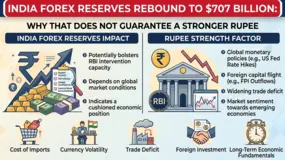
India Forex Reserves Rebound to $707 Billion: Why That Does Not Guarantee a Stronger Rupee
India forex reserves rose by $14.136 billion to $707.002 billion in the week ended 7 August 2026. This explainer separates RBI forex-reserve facts from rupee predictions, explains the role of foreign currency assets and gold, and gives forex-market readers a practical checklist before treating one headline as a trading signal.
WikiFX Broker
Latest News
Exness Review 2026 for India: RBI Alert, Regulation, Login and Forex Risk
 WikiFX
18.3 Million Malaysians Participated in National Anti-Scam Campaign
WikiFXXM Review 2026 for India: RBI Alert, Regulation, Login and Forex Risk
WikiFXFXGM Review: A KNF Warning and Withdrawal Complaints to Check Before You Deposit
WikiFXAustralia dollar on longest weekly winning streak since 2020
WikiFXReview 2026: FBS Complaints, Regulation, and Withdrawal Risk Signals
WikiFXRoboForex Review: Regulation Alarms Hit a Broker Facing Profit-Wipe Complaints
WikiFXThree Losses in a Row? Rebuild Clear Decisions, Not Revenge
WikiFXTraders Home Review: Is Your Deposit Safe?
WikiFXA Tiny USDT Transfer Could Put Your Crypto Wallet Under Scrutiny
WikiFXRate Calc

