CHFJPY sees potential bottom and short-term reversal
Abstract:The JPY had seen some renewed strength after the Bank of Japan finally intervened late in 2022 to widen its target band on its 10-year band to -0.5-0.5% from -0.25-0.25%. This was seen as an overall positive catalyst for the currency and a sign that the Bank may be ready to increase rates.

The JPY had seen some renewed strength after the Bank of Japan finally intervened late in 2022 to widen its target band on its 10-year band to -0.5-0.5% from -0.25-0.25%. This was seen as an overall positive catalyst for the currency and a sign that the Bank may be ready to increase rates.
The question that remains is will the market trust the BOJ and continue buying the JPY or is the buying just an opportunity for shorters to enter. Whilst potential trades exist on most of the JPY pairs, the most promising trade is on the CHFJPY.

Technical Analysis
The weekly price chart shows an interesting pattern forming. The price initially sold down quite heavily when the BOJ announced its intervention. The price sold down aggressively but has not been able to pass through the 139.00 level. This support level acts as both the 50-week moving average and a long-term support level. This explains the initial price rejection. The bounce was emphasised by the candlestick and the length of its wick. The body of the candle is very small and the wick long, highlighting how buyers immediately soaked up the selling potentially creating a pivot point.
The daily chart is less encouraging, it still shows the price in a down trend. Although, there was a strong day of buying, the price has been unable to break through the 142 level. The last few days of trading have shown the price to be selling down consistently after it has opened. Moving forward if the price can break out above the 142 level, it may indicate that the price will be ready for its next move higher. In the short term, a target near the top of the weekly trend line near 145/146. From a longer-term perspective, a significant reversal may see a potential target of 150.


Read more
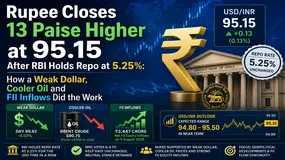
Rupee Ends 13 Paise Up at 95.15 After RBI Holds Repo at 5.25%: The Effect of a Weak USD, Cooler Oil
The Indian rupee settled at 95.15 against the US dollar on 5 August 2026, gaining 13 paise after the Reserve Bank of India's Monetary Policy Committee voted 6-0 to keep the repo rate unchanged at 5.25 percent for the third time in a row in FY27. The rupee had opened 46 paise higher, rallied to an intraday strongest of 94.89 ahead of the policy decision, and then drifted back as RBI Governor Sanjay Malhotra noted that the currency 'has not appreciated as intended despite the high flows from foreign shores.' A weak dollar index, a sharp pullback in Brent crude from above USD 100 in July, and net FII equity inflows of Rs 2,447 crore on Tuesday combined to support the rupee. USD-INR is expected to trade in a 94.80-95.50 band in the near term.

Errante Review 2026: Users Claim a Poor Trading Experience. What Does Our Investigation Reveal?
Errante, a Seychelles-based brokerage entity, is facing serious trading allegations from users globally. Users claim to have earned profits legitimately using their strategies. However, on the Errante login dashboard, many users reported an automatic deduction of earned profits. At the same time, withdrawal issues allegedly haunt many traders here. While investigating, we also found complaints concerning trade order manipulations by the broker. In this Errante review, we have examined these allegations and given an overview of its regulatory status.

Monisha Chakraborty Appointed as RB Executive Director: What Does This Mean for India's FX Market?
The Reserve Bank of India has appointed Monisha Chakraborty as Executive Director with effect from 3 August 2026; she will oversee the Foreign Exchange Department and the Financial Markets Regulation Department. Chakraborty is a career central banker with over three decades of experience in Supervision, Foreign Exchange, and Government and Bank Accounts, and previously served as Banking Ombudsman. This report explains the significance of the new RBI Executive Director appointment for forex regulation India, the scope of the Foreign Exchange Department and the Financial Markets Regulation Department, and what authorised persons, banks, and forex market participants should monitor as the new ED takes charge.

Forex Liquidity Provider in 2026: How to Choose One Your Brokerage Can Actually Operate
A forex liquidity provider decision now shapes the broker's spreads, fills, slippage, hedging cost, regulatory exposure, and exit options long after the platform is chosen. This 2026 guide explains what a forex LP actually delivers versus what the marketing claim says, how tier-1 banks, prime of prime, and multi-LP aggregators differ in practice, and how execution models (DMA, ECN, STP) change the broker's daily operating reality. It also walks through due diligence on credit, technology, reporting, governance, and exit, and shows how a 2026 broker can combine a primary LP with secondary routing without losing control of the client experience. Use the decision matrix, integration timeline, and operational tests to compare an fx liquidity provider before contract signature, not after a market event.
WikiFX Broker
Latest News
Why You Can’t Generalise Forex Regulation Across Africa
 WikiFX
XM Opens Gold Trading Through the Weekend with GOLD24-7
WikiFXShe Loses RM622,320 After Falling for a Fake Online Stock Investment Scheme
WikiFXATFX Broker Review 2026: Regulated but Is It Really Safe for Traders?
WikiFXForex CRM Software in 2026: How to Choose the Operational Backbone Your Brokerage Can Actually Run o
WikiFXG4Trade Review 2026: Unverified Regulation and Withdrawal Concerns
WikiFXIs Gold Still a Safe Haven in 2026?
WikiFXRinggit Gains vs Majors, Slips vs Dollar in Recurring Trend
WikiFXCourt Ends 28-Year Sh185.5m Battle Against CBK
WikiFXSTMARKET Review: A Cambodia SERC License and a $3,250 Withdrawal That Went Missing
WikiFXRate Calc

