WIKIFX REPORT: T. Rowe Price plans to launch investment adviser subsidiary
Abstract:T. Rowe Price Group Inc. plans to put six funds into a new investment adviser subsidiary set to launch in 2022, a move executives said will help the company continue to generate excess returns for clients for years to come.
T. Rowe Price Group Inc. plans to put six funds into a new investment adviser subsidiary set to launch in 2022, a move executives said will help the company continue to generate excess returns for clients for years to come.
The move will split the Baltimore-based money manager's investment-research organization, T. Rowe Price Associates, into two. The company will seek approval from the U.S. Securities and Exchange Commission for a new subsidiary, called T. Rowe Price Investment Management, in the second half of 2021.
Both entities will operate as separate divisions under the T. Rowe Price umbrella, said Robert Sharps, head of investments and group chief investment officer. They will occupy separate spaces and not share investment resources or research with each other. The groups will share the company's distribution, human resources, legal and back-office functions. Incentive structures will also remain the same for employees.
T. Rowe Price Investment Management, or TRPIM, will launch with six of the company's current funds totaling more than $167 billion in assets under management. T. Rowe Price has $1.3 trillion assets total as of Oct. 31.
More than 100 employees will move to TRPIM, including portfolio managers and analysts. The funds that will be managed by TRPIM are:
U.S. Capital Appreciation,
U.S. Mid-Cap Growth Equity
U.S. Small-Cap Core Equity
U.S. Small-Cap Value Equity
U.S. Smaller Companies Equity
U.S. High Yield Bond Strategies
T. Rowe Price, known for its long-term approaches to everything from investment to executive succession planning, has been preparing for the subsidiary for a while. The company ramped up hiring of analysts during the past two years and will continue adding people in 2021. A spokesman said T. Rowe Price will have added 25 net new analysts by the time TRPIM launches.
“We recognize that this is a change for our clients, and in keeping with our custom of carefully communicating major investment and leadership shifts well in advance, well take the next 18 months to fine-tune and execute our operating plans while working with our clients to help them prepare for the changes,” CEO William J. Stromberg said in a statement. “A cross-functional team has been hard at work putting everything in place to ensure a smooth transition.”
Stephon Jackson, currently associate head of U.S. equity, will become head of TRPIM. David Giroux, who oversees the U.S. Capital Appreciation fund, will be chief investment officer of TRPIM.
While the announcement was big enough for T. Rowe Price to host its first-ever investor call with analysts, executives said much will remain unchanged. There will be no impact on fees or pricing, Sharps said. The company will also continue to report all of its financial results in one place, rather than breaking out its results for each subsidiary.
RECOMMENDED
Salesforce puts half of Salesforce West up for lease

Popular restaurant closes to make way for new development

H Mart seeks large expansion of first San Francisco store

T. Rowe Price will “generate new capacity” be able to keep more funds open because there will be less overlap of holdings and the subsidiaries won't share liquidity, Sharps said. Currently, 10 of the firm's U.S. equity strategies are closed to new investors.
“It's simply arithmetic,” Sharps said.
Sharps also said having two separate research teams will help with “idea generation.”
Jackson said the move will help preserve T. Rowe Price's ability to produce “alpha” — returns that exceed a fund's benchmark — “for decades to come.” Outsized returns have led to 2% organic growth in T. Rowe Price's assets under management over the past five years, he said. Like Sharps, he also expressed a need for more innovation because the number of companies with market capitalizations of at least $9 billion has declined by a third.
“The universe of investable securities is shrinking,” Jackson said.
Eric Veiel, co-head of global equity and head of U.S. equity, said T. Rowe Price as a whole will also be able to own more shares of individual stocks. The SEC has limits on how much equity investors can own before they are no longer considered “passive.” The regulations on occasion prevented T. Rowe Price's portfolio manager from taking larger positions in companies even if they thought they would be great investments.
“We can own more of certain securities,” Veiel said. “Those investment decisions would be reached independently and autonomously, but now our portfolio managers would be able to own more of those certain securities if they choose to do so, obviously keeping within each individual strategy's risk management framework.”
Some asset managers have shifted to operating under boutique or affiliates models. Legg Mason, before it was acquired by Franklin Templeton, operated under such a model with all of its affiliates like Western Asset Management and Clarion Partners operating autonomously.
Sharps said he doesn't think T. Rowe Price's announcement validates the affiliate model.
“We're still one T. Rowe Price,” Sharps said. “It is the same compensation model, the same culture and the same key tenants...I don't think any way, shape or form this is the formation of a standalone boutique. I think this is the replication of something we already do in [T. Rowe Price Associates] and really should serve to extend our ability to generate alpha and deliver excellent investment performance over time by continuing to do much of what we have done in the past.”
TRPIM will operate from offices in Baltimore, New York, San Francisco, D.C. and Philadelphia.

Read more
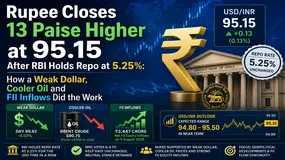
Rupee Ends 13 Paise Up at 95.15 After RBI Holds Repo at 5.25%: The Effect of a Weak USD, Cooler Oil
The Indian rupee settled at 95.15 against the US dollar on 5 August 2026, gaining 13 paise after the Reserve Bank of India's Monetary Policy Committee voted 6-0 to keep the repo rate unchanged at 5.25 percent for the third time in a row in FY27. The rupee had opened 46 paise higher, rallied to an intraday strongest of 94.89 ahead of the policy decision, and then drifted back as RBI Governor Sanjay Malhotra noted that the currency 'has not appreciated as intended despite the high flows from foreign shores.' A weak dollar index, a sharp pullback in Brent crude from above USD 100 in July, and net FII equity inflows of Rs 2,447 crore on Tuesday combined to support the rupee. USD-INR is expected to trade in a 94.80-95.50 band in the near term.
Errante Review 2026: Users Claim a Poor Trading Experience. What Does Our Investigation Reveal?
Errante, a Seychelles-based brokerage entity, is facing serious trading allegations from users globally. Users claim to have earned profits legitimately using their strategies. However, on the Errante login dashboard, many users reported an automatic deduction of earned profits. At the same time, withdrawal issues allegedly haunt many traders here. While investigating, we also found complaints concerning trade order manipulations by the broker. In this Errante review, we have examined these allegations and given an overview of its regulatory status.

Monisha Chakraborty Appointed as RB Executive Director: What Does This Mean for India's FX Market?
The Reserve Bank of India has appointed Monisha Chakraborty as Executive Director with effect from 3 August 2026; she will oversee the Foreign Exchange Department and the Financial Markets Regulation Department. Chakraborty is a career central banker with over three decades of experience in Supervision, Foreign Exchange, and Government and Bank Accounts, and previously served as Banking Ombudsman. This report explains the significance of the new RBI Executive Director appointment for forex regulation India, the scope of the Foreign Exchange Department and the Financial Markets Regulation Department, and what authorised persons, banks, and forex market participants should monitor as the new ED takes charge.
Forex Liquidity Provider in 2026: How to Choose One Your Brokerage Can Actually Operate
A forex liquidity provider decision now shapes the broker's spreads, fills, slippage, hedging cost, regulatory exposure, and exit options long after the platform is chosen. This 2026 guide explains what a forex LP actually delivers versus what the marketing claim says, how tier-1 banks, prime of prime, and multi-LP aggregators differ in practice, and how execution models (DMA, ECN, STP) change the broker's daily operating reality. It also walks through due diligence on credit, technology, reporting, governance, and exit, and shows how a 2026 broker can combine a primary LP with secondary routing without losing control of the client experience. Use the decision matrix, integration timeline, and operational tests to compare an fx liquidity provider before contract signature, not after a market event.
WikiFX Broker
Latest News
Apple Faces Lawsuit Over Fake Crypto App Exposing $1.8 Million Theft
 WikiFX
Trump Memecoin Faces SEC Scrutiny After Nearly One Million Investors Suffer Heavy Losses
WikiFX"They Want to See Your Face": Inside ATFX Cambodia's Rise
WikiFXSpread Cheating: The Invisible Trading Cost That Could Be Working Against You
WikiFXLevels Review: No Regulation and Mounting Withdrawal Complaints – What Traders Need to Know
WikiFXLQH MARKETS Review: Multiple Traders Report Withdrawals Blocked and Accounts Terminated
WikiFXBorn2trade Adds Copy Trading to 1:5000 Leverage Platform
WikiFXPILOTFX Review: What Traders Should Know Before Depositing
WikiFXLMAX Group Review 2026: Users Report Disturbing Withdrawal Issues - Is the Broker Still Reliable?
WikiFXTrade24Seven Review: What Traders Should Know Before Depositing
WikiFXRate Calc

