Grand Markets-Some important Details about This Broker
Abstract:Grand Markets is a regulated global online trading platform that offers CFD trading services for multiple asset classes, including forex, cryptocurrencies, commodities, and stock indices. The platform supports MetaTrader 4 (MT4) on both desktop and mobile devices, making it suitable for traders seeking low-cost and multi-functional platforms, particularly for high-frequency forex trading and novice traders getting started.
| Review Summary | Grand Markets Review Summary |
| Year Founded | 2015 |
| Registered Country/Region | Australia |
| Regulation | ASIC (Australia), FSC, AOFA (Offshore regulation) |
| Market Instruments | Forex, indices, gold, crude oil, cryptocurrencies, and commodities |
| Account Types | ECN / Standard Account / Cent Account |
| Demo Account | Available |
| Leverage | Up to 1:1000 |
| Spreads | ECN: EUR/USD from 0.1, Gold from 10; Standard: EUR/USD from 1.7, Gold from 28 |
| Trading Platforms | MT4 / MT5 / Grand Markets App |
| Minimum Deposit | $10 |
| Customer Support | 24/7 support, live chat, contact form |
| Regional Restrictions | United States, New Zealand, Iran, North Korea (DPRK), Brazil, United Kingdom, Russia, Belarus |
Grand Markets Information
Grand Markets is a regulated global online trading platform that offers CFD trading across multiple asset classes, including forex, stock indices, cryptocurrencies, and commodities. The platform supports MetaTrader 4 (MT4), MetaTrader 5 (MT5), and the Grand Markets App on both desktop and mobile devices. It is suitable for traders seeking a low-cost and versatile trading platform, particularly for high-frequency forex trading and beginners getting started.
Pros and Cons
| Pros | Cons |
| Regulated by ASIC | |
| MT4 available | Regional restrictions |
| Demo accounts available | Offshore regulation risks |
| 24/7 multilingual customer support | |
| Low minimum deposit |
Is Grand Markets Legit?
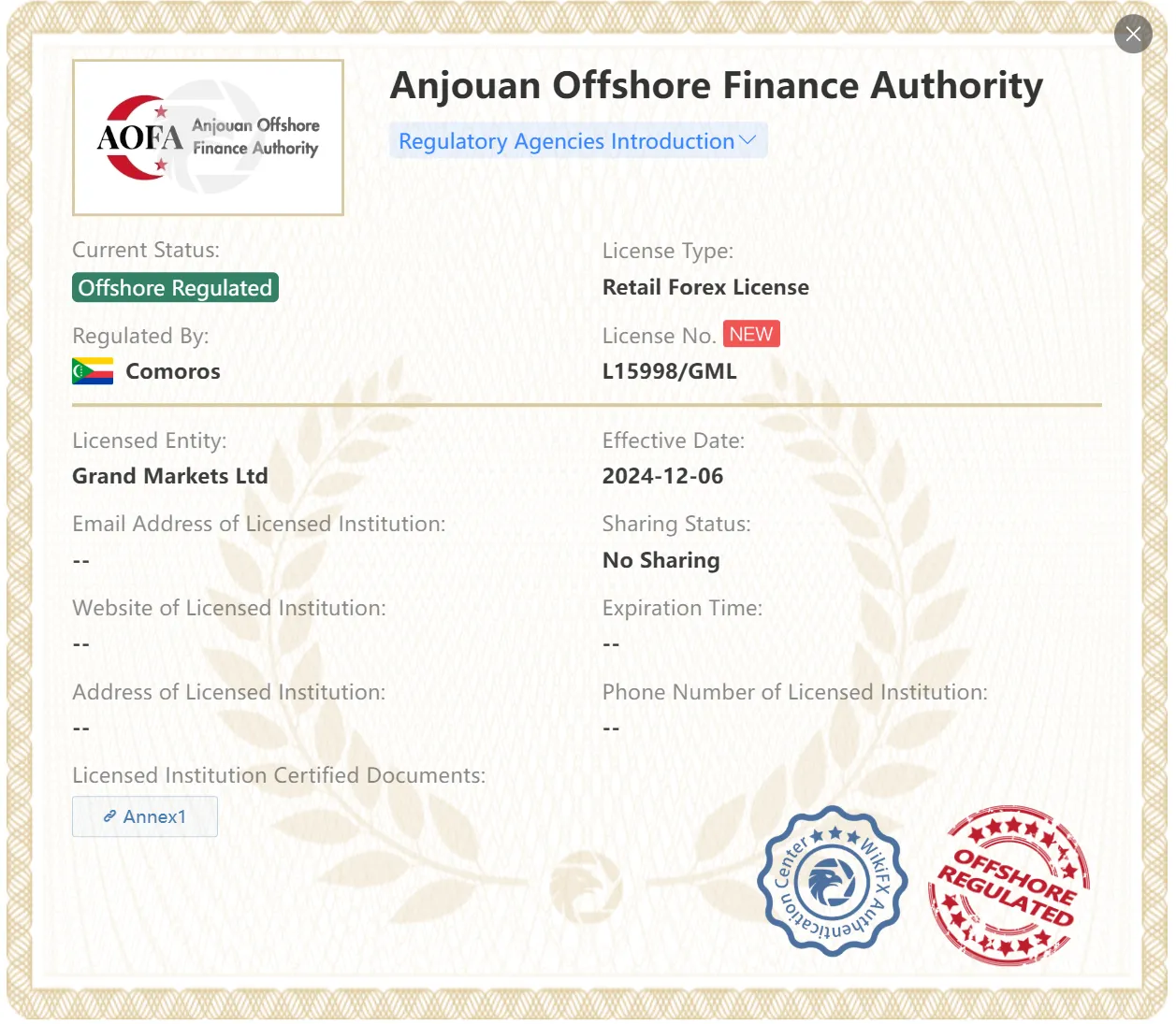
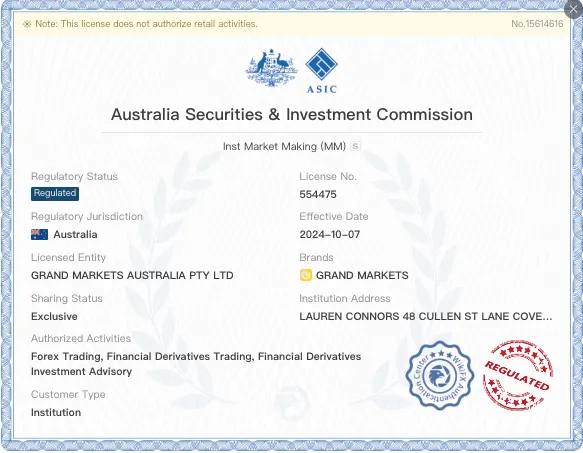
This broker is regulated by the Australian Securities and Investments Commission (ASIC), the Financial Services Commission of Mauritius (FSC), and the Anjouan Offshore Financial Authority (AOFA) of the Comoros.
What Can I Trade on Grand Markets?
The platform offers over 50 CFD trading instruments, including forex (more than 50 currency pairs), commodities, cryptocurrencies, and stock indices.
| Tradable Instruments | Supported |
| Forex | ✔ |
| Commodities | ✔ |
| Stock indices | ✔ |
| Cryptocurrencies | ✔ |
| Options | ❌ |
| ETFs | ❌ |
| Bonds | ❌ |
| Mutual Funds | ❌ |
Account Type & Fees
| Account Type | Standard | ECN | Cent |
| Minimum Deposit | $10 | ||
| Average Spread | 1.7 pips | From 0.0 pips | 1.6 pips |
| Commission | 0 | Up to $7 per lot | 0 |
The Standard account offers an average spread of 1.6 pips on major currency pairs (such as EUR/USD), while the ECN account provides spreads as low as 0 pips. Only the ECN account charges a commission of up to $7 per lot. Most instruments (such as major currency pairs and cryptocurrencies) are swap-free, with no overnight interest charged.
Leverage
The platform offers a maximum leverage of 1:1000, applicable to all account types. However, exotic currency pairs (such as USDCNH) use fixed margin requirements, which are not affected by leverage adjustments.
Trading Platform
| Trading Platform | Supported | Available Devices | Suitable For |
|---|---|---|---|
| MT4 | ✔ | Desktop & Mobile | Beginners |
| MT5 | ✔ | / | Experienced Traders |
| Grand Markets App | ✔ | Mobile Devices | Beginners / Experienced Traders |
Deposit and Withdrawal
Deposits support both global and local payment methods (such as USDT, credit cards, and bank transfers), with funds credited to accounts instantly (platform processing time is usually within minutes).
For withdrawals, funds typically arrive in your bank account within 1–3 business days (depending on the region and bank). Withdrawals require one-time password (OTP) verification and follow PCI DSS compliance standards with segregated client fund protection. No handling fees are charged, and refunds are supported via the original payment method.

Read more
Score Capital Markets Ltd 2026 Review: Gateway or Trap?
Comprehensive 2026 review of Score Capital Markets Ltd forex broker (scorecm.com): An in-depth analysis of offshore regulatory risks, WikiFX safety scores, trading conditions, and South Asian investor security.
Client Saved via WikiFX Exposure ! Is slay4x Considered a Safe Broker or a Scam in Q4 2026?
Is slay4x Considered a Safe Broker or Suspected of Being a Scam in Q4 2026? Read our detailed analysis on withdrawal delays, regulatory risks, and South Asian trader reviews.

RBI Opens a Daily Dollar Window for Indian Oil, HPCL and BPCL — and Rewrites the Hedging Rules
The Reserve Bank of India will sell dollars directly to Indian Oil, HPCL and BPCL every day from Monday, 12 October, covering what its two Saturday releases called the "entire daily dollar requirements" of the three state-run refiners. The window runs until further notice, with the dollars routed through designated banks. It landed with the rupee near 97 to the dollar. Monday's open told a different story. The currency strengthened about 1%, quoted at 95.76 by The Economic Times and 95.83 by Upstox, while bank stocks slipped.
Versus Trade Review 2026: Trade Report Shows Mixed User Feedback
Versus Trade, a UK-based brokerage company, receives a mix of positive and negative feedback from users worldwide. Some appreciated the pace at which deposits and withdrawals are processed, others claimed withdrawal delays and profit cancellations on the trading platform. This Versus Trade review evaluates both sides while also giving a regulatory overview of the broker.
WikiFX Broker
Latest News
U.S. Dollar Pulls Back From Yearly Highs: Analysis For EUR/USD, GBP/USD, USD/CAD, USD/JPY
 WikiFX
The Dollar Surges as Gold Slides. Could a Turning Point Be Near?
WikiFXFirst Light News: Earnings & US CPI in Focus
WikiFXNPBFX Broker Review: Regulated but Is It Safe for Traders?
WikiFXED Files Charge Sheet in Nexa Evergreen Investment Case Involving Rs 2,676 Crore
WikiFXFirst Light News: Chip Rout Rattles Equities as Q3 Earnings Season Kicks Off
WikiFXConsumer prices rose at 3.7% annual rate in September as gas costs skyrocket
WikiFXClient Saved via WikiFX Exposure ! Is slay4x Considered a Safe Broker or a Scam in Q4 2026?
WikiFXScore Capital Markets Ltd 2026 Review: Gateway or Trap?
WikiFXRetiree Loses RM118,000 Through Fake Stock Investment Website
WikiFXRate Calc
