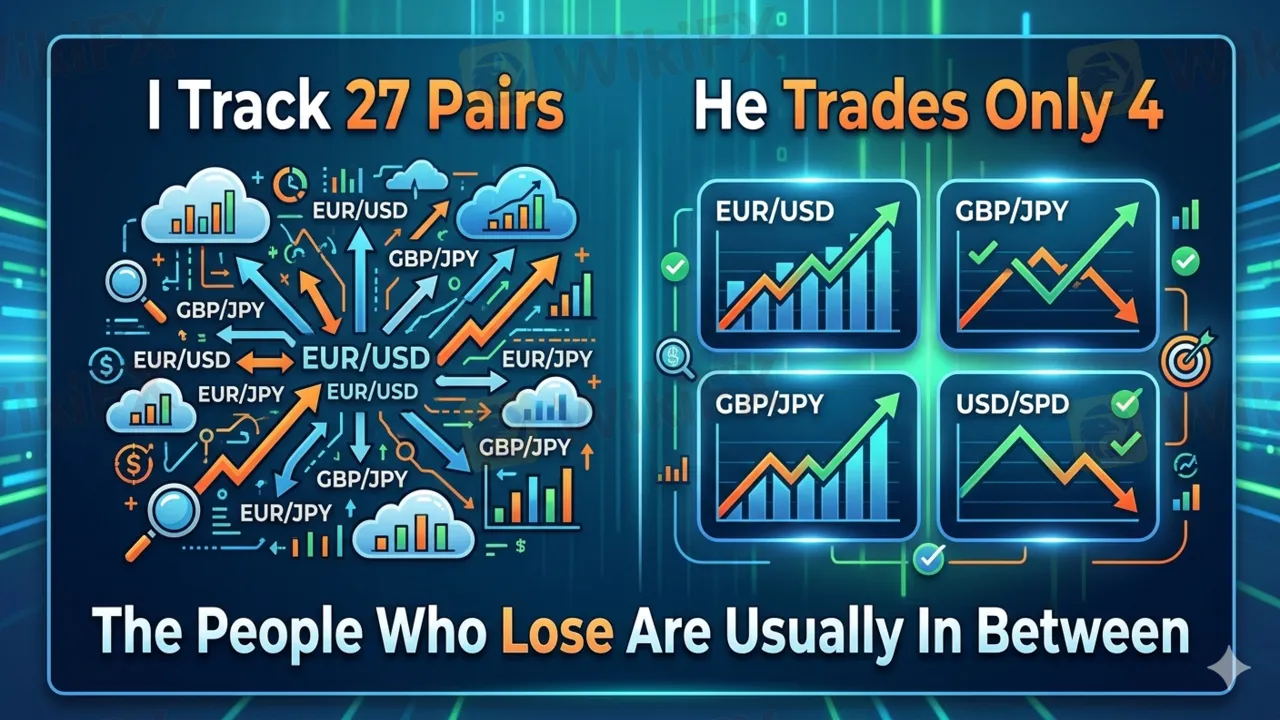
I Track 27 Pairs, He Trades Only 4 - And the People Who Lose Are Usually in Between

Abstract:If you open a random forex beginner’s trading platform, the screen will almost certainly show just one chart: EURUSD (the euro against the US dollar). It is nearly everyone’s default starting point - the most heavily traded pair in the world, with tight spreads and endless tutorials. Choosing it as your first pair is not a mistake. But the surprising part comes from a different scene. When you ask a group of traders who have actually traded for several years - and survived - which pairs they trade, you get answers that differ wildly. Some watch only 4 pairs, with a list that does not change for years. Others track 27 or 28, fitting nearly every major and cross pair into their system.
If you open a random forex beginner‘s trading platform, the screen will almost certainly show just one chart: EURUSD (the euro against the US dollar). It is nearly everyone’s default starting point - the most heavily traded pair in the world, with tight spreads and endless tutorials. Choosing it as your first pair is not a mistake.
But the surprising part comes from a different scene.
When you ask a group of traders who have actually traded for several years - and survived - which pairs they trade, you get answers that differ wildly. Some watch only 4 pairs, with a list that does not change for years. Others track 27 or 28, fitting nearly every major and cross pair into their system.
And here is the most counterintuitive part: both types of traders can be consistently profitable.
So is fewer better, or more? The answer is not in the number itself, but in a variable most beginners overlook. The people who never figure it out tend to get stuck in an awkward middle ground - neither broad enough nor focused enough.

Why would anyone track twenty or thirty pairs at once?
Intuitively, “trading 27 pairs” sounds like scattered attention, grabbing at everything. But once you understand the variable of trading frequency, the approach makes complete sense.
The key question is: how many valid signals does a strategy produce per month?
A low-frequency swing trading strategy (swing trading means holding positions for several days or even weeks, aiming for larger point targets) usually has strict filter conditions. The upside of strict filters is high signal quality; the cost is that signals are rare. Such a strategy, applied to a single pair, might trigger only two or three opportunities per month on average.
Now do some simple arithmetic. A trader watching only 4 pairs, with 3 signals per pair per month, gets roughly 12 trades a month, a bit over a hundred a year. Sounds like plenty? Yet for judging whether a strategy actually works, that sample size is dangerously small.
Trading results carry inherent randomness. The profit and loss of a few dozen trades can easily be dominated by luck - a winning streak might just be a good run, a losing streak does not necessarily mean the strategy is broken. With too small a sample, you genuinely cannot tell whether you hold a real edge (a statistical advantage that wins out over the long run) or are simply flipping coins.
This is the real motivation of those who “trade 27 pairs.” Applying the same rules to 27 or 28 pairs scales monthly trade count up to seventy or eighty or more, accumulating a large enough sample over a year. With a large enough sample, the strategys true statistical edge surfaces, and the equity curve is not drowned out by short-term noise.
So “trading 27 pairs” is not greed at its core - it is a diversification approach that trades instrument count for trade sample. The premise is that the strategy itself is mechanical and replicable, usually run through an EA (Expert Advisor, a program that automatically executes a strategy) to watch that many markets at once, because one person can hardly monitor dozens of charts without error.
The reverse holds too. A trader running a high-frequency or intraday strategy already gets plenty of signals every day, and does not need to spread across pairs to build a sample. They should instead narrow their range, concentrating on the few pairs with the best liquidity and tightest spreads - commonly EURUSD, GBPUSD (the British pound against the US dollar), AUDUSD (the Australian dollar against the US dollar), plus gold XAUUSD. Too many pairs become a burden for an intraday trader: too much to watch, easy to overtrade, easy to hesitate between similar charts.
In one sentence: the number of pairs should match your trading frequency, not signal professionalism by being larger.

Why are not all pairs “equally tradable”?
Beginners often hold an illusion: since the strategy rules are fixed, surely the effect is roughly the same on any pair?
It is not. A consensus repeatedly raised in the trader community is that even with identical rules, different pairs have very different “feel.”
One of the most frequently named “difficult” pairs is NZDUSD (the New Zealand dollar against the US dollar). Many traders describe their feelings about it with almost the same words: choppy, annoying, “clean on paper, annoying in execution.” More than one trader says they eventually removed the kiwi pair from their strategy entirely.
This collective dislike has objective reasons behind it:
- First, relatively low liquidity. New Zealand is a small economy, and the kiwis share of global forex trading is far below the euro, dollar, or yen. Low liquidity means price action is sometimes less smooth, more prone to irregular jumps.
- Second, smaller volatility range. The points (pip, the smallest standard increment in a forex quote) the kiwi pair can move in a day are usually fewer than more volatile pairs. If your strategy depends on a certain amount of price room to reach its take-profit target, then on a pair that “does not move” much, the available profit room is compressed and the risk-reward ratio worsens.
- Third, high sensitivity to news. Rate decisions from the Reserve Bank of New Zealand (RBNZ), Global Dairy Trade (GDT) auction prices, and the kiwis linkage to commodity sentiment and risk appetite all make it jump. For a strategy that relies on technical patterns and mechanical execution, having its rhythm repeatedly disrupted by fundamental news is very troublesome.
An interesting contrast is AUDUSD (the Australian dollar against the US dollar). The Aussie and the kiwi are both commodity currencies and often move in close correlation, so intuitively you would expect them to be equally strategy-friendly. But many traders report exactly the opposite - AUDUSD has better liquidity and smoother movement, and is often one of their most stable pairs, while NZDUSD has to be cut.
This contrast offers an important reminder: do not assume two pairs are equally friendly to your strategy just because they “look alike.” High correlation does not equal equal tradability. Every pair should be tested with its own data.
So how should you choose for yourself?
Bringing the discussion down to earth, here are some principles you can use directly:
- Determine the strategy type first, then decide the number of pairs. Do not fixate on “how many pairs should I trade” right away. First be clear whether your strategy is low or high frequency, how long you hold, and how often each pair produces a signal. It is the strategy type that decides whether you need breadth or focus - the order cannot be reversed.
- Validate one by one, not as a bundle. When applying a strategy to candidate pairs, look at each ones performance individually. Overall profitability may mask a few pairs that drag for the long term. Here, walk-forward analysis (cutting historical data into segments, optimizing on an earlier segment and testing on the next, rolling forward) is more robust than a single long-period backtest and better exposes overfitting.
- Allow pairs to be removed, and allow them to be paused. A mature strategy does not have to “swallow” every pair. If the data keeps telling you a pair does not fit, cutting it is not failure - it is discipline.
- Do not ignore spreads and holding costs. The more obscure the cross or exotic pair, the higher the spread and overnight interest tend to be. For high-frequency strategies, a high spread can directly eat into already thin profits.
- Control the hidden risk from correlation. When you simultaneously hold same-direction positions in several highly correlated pairs (such as multiple Aussie pairs), you think you are diversifying, but you may actually be betting repeatedly on the same risk.
One last thing: choose the right platform before choosing the right pairs
All the earlier discussion about pairs, samples, and walk-forward testing rests on one unspoken premise - that your funds are held with a properly regulated broker.
This point must be singled out and emphasized, because it is more fundamental and more critical than any choice of pair.
You can spend months polishing a beautiful multi-pair system and validate every pair clearly. But if the broker carrying all of this has problems itself - questionable regulatory credentials, withdrawal difficulties, manipulated quotes - then even the finest strategy is meaningless, because what you face is not market risk but platform risk. That risk cannot be hedged with technical analysis or money management.
So systematic trading should follow this order: first confirm the broker is effectively regulated by a credible authority, check its license status and track record, and only then discuss which pairs to trade.
For this part of the homework, rather than checking each regulator‘s official site one by one, it helps to use a dedicated broker-lookup tool - a platform like WikiFX, for instance, where you can check a broker’s regulatory licenses, ratings, and user complaint records in one place, turning scattered due diligence into something you can finish in minutes. The tool just helps you get the information faster; the final judgment is still yours to make.
Margin forex trading carries high leverage and extremely high risk, and may result in the total loss of your capital. It is not suitable for all investors. The pair preferences and strategy ideas discussed in this article are experiential discussions and general knowledge from the trader community, for reference only, and do not constitute any investment or trading advice. Before making any trading decision, readers should fully assess their own risk tolerance and, as a priority, verify the regulatory credentials of their chosen broker.
Adapted and rewritten from public discussion on Reddit (r/Forex) - original thread: “For those who managed to turn full time successfully”
Explore the latest forex updates, first on the WikiFX app. Download Now!

Some More Interesting Articles for You
The 7 Lowest-Spread Forex Brokers for Indian & Pakistani Traders in 2026 (Tested, Ranked & Reality)
naqdi Exposure Report 2026: Are Traders Facing Long Pending target="_blank" kwlink="6384064000816950219725">target="_blank" kwlink="6389991234023143758451">Withdrawals?


Read more

Kudotrade Review 2026: Reported Slippage & Trade Execution Issues You Should Know
Did you lose capital due to persistent slippage on the Mauritius-based Kudotrade platform? Did your trade fail to receive the tight spreads advertised by the broker? Did you receive the wrong trade signal from the broker's affiliated service provider? Did you fail to receive your funds despite multiple withdrawal requests? You are not alone! These issues have allegedly attracted significant attention on broker review platforms such as WikiFX. In this Kudotrade review, we will examine several such complaints and evaluate the broker's regulatory scenario.

RBI's Record $136-Billion NRI Deposit Campaign: Closed Early, Windfall and Risks for Traders
The Reserve Bank of India's special FCNR (B) deposit window pulled in a record $136 billion in just 10 weeks, forcing the central bank to shut it down on August 31 – a full month early. The flood of dollars lifted India's forex reserves to a fresh peak of $740.8 billion and left the banking system awash in ₹9.7 trillion of surplus liquidity, the highest in four years. For Indian retail traders, the ripple effects on the rupee, stocks and interest rates are already visible and will persist for years.

Proxtrend LTD Review for India After Japan’s 20 June 2025 Warning
Japan’s Kanto Local Finance Bureau issued an unregistered-business warning concerning Proxtrend Ltd on 20 June 2025. The notice concerns online solicitation of over-the-counter derivatives. This Proxtrend LTD review, checked on 11 September 2026, examines that dated warning alongside the broker’s corporate disclosures and the separate rules relevant to residents of India. The warning is not a new September announcement or an Indian regulatory finding.
EASY TRADING ONLINE Review 2026: Withdrawal & Account Block Complaints
Did your funds fail to reach your account despite being approved by EASY TRADING ONLINE, an Australia-based brokerage entity? Have you been subject to months of withdrawal delays despite being compliant with norms? Did your trading account suddenly become invalid upon a withdrawal request? All of these complaints have come up on broker review platforms such as WikiFX. This EASY TRADING ONLINE review studies multiple user complaints while also updating its existing regulatory status.
WikiFX Broker
Latest News
UK Chancellor Healey: Economy demonstrates welcome resilience despite global uncertainty
WikiFXUnited States Dollar Index holds onto gains above 99 ahead of US CPI data
WikiFXRBI's Record $136-Billion NRI Deposit Campaign: Closed Early, Windfall and Risks for Traders
WikiFXSilver Forecast: XAG/USD rebound capped as bearish bias holds
WikiFXKudotrade Review 2026: Reported Slippage & Trade Execution Issues You Should Know
WikiFX11.09.26 Daily Forecast
WikiFXProp Firm FTMO to Acquire OANDA with $422 Million
WikiFXCMC Markets Extends US Share Trading Into Overnight Session
WikiFXBritish Pound holds steady above 1.3500 ahead of US CPI inflation release
WikiFXEUR/JPY Price Forecast: Softens to near 179.00, bearish bias remains intact below 100-day SMA
WikiFXRate Calc

