FCA-Regulated Forex Brokers Are Declining — 31 Platforms to Avoid

Abstract:As of December 1, 2025, a total of 105 companies in the United Kingdom held CFD licences.

Sometimes, a single number can hit harder than ten collapse stories.
According to the latest data from the FCA, as of December 1, 2025, there are 105 companies in the UK holding CFD licences. That sounds like a decent number, right? But heres the catch, only 74 of them are actually authorised to serve retail clients.
So what about the remaining 31? Their licences are real, and their FCA registration numbers can be verified. However, they are explicitly restricted from providing trading services to retail investors.
Why do retail traders care so much about FCA regulation? Because it is one of the toughest regulatory frameworks in the world. Holding an FCA licence is like getting into University Malaya (UM), and being allowed to serve retail clients is like being admitted into one of the top programs within UM. On top of that, the FCA is backed by the FSCS, which offers compensation of up to £50,000 per person. That represents real financial protection.
But heres the problem, some firms may have been admitted to UM, yet they are not actually allowed to teach your course.
An FCA licence is like a ticket, but it doesnt guarantee you a seat in business class.
The FCA categorises clients into three groups: retail clients, professional clients, and eligible counterparties. Retail clients sit in the front row and receive the highest level of protection, including negative balance protection, fund segregation, complaint channels, and compensation schemes.
However, your seat is not determined by what you claim to be, it is determined by what the firms licence allows.
To put it simply, not all FCA licences are equal. Some require only €50,000 in capital and allow firms to provide advisory services without holding client funds. Others require €125,000 and can execute trades but cannot act as market makers. Full licences require €730,000 in capital and allow firms to provide comprehensive services, including market making and custody of funds.
There is also a category of licences that appears legitimate on the surface but includes a critical line in the details: “For professional clients and eligible counterparties only. Not permitted to serve retail clients.”
That single line is effectively a “No Entry” sign for retail traders.
Yet many platforms do not highlight this. Instead, they prominently display their FCA registration number on their website, encourage you to tick a box declaring yourself a “professional client” during onboarding, or redirect your funds to offshore entities in places like Vanuatu, Belize, or Seychelles — jurisdictions where regulatory oversight may be minimal.
You think youve entered a UK-regulated institution, but in reality, you may not even have stepped through the door.
Even the FCA has taken notice of this phenomenon, introducing the term “halo firms” to describe companies that use their licences as a façade while conducting business through unregulated entities. Like a polished mirror, they reflect credibility but conceal the truth.
If you ask which case retail traders should remember in recent years, one example stands out: HTFX.
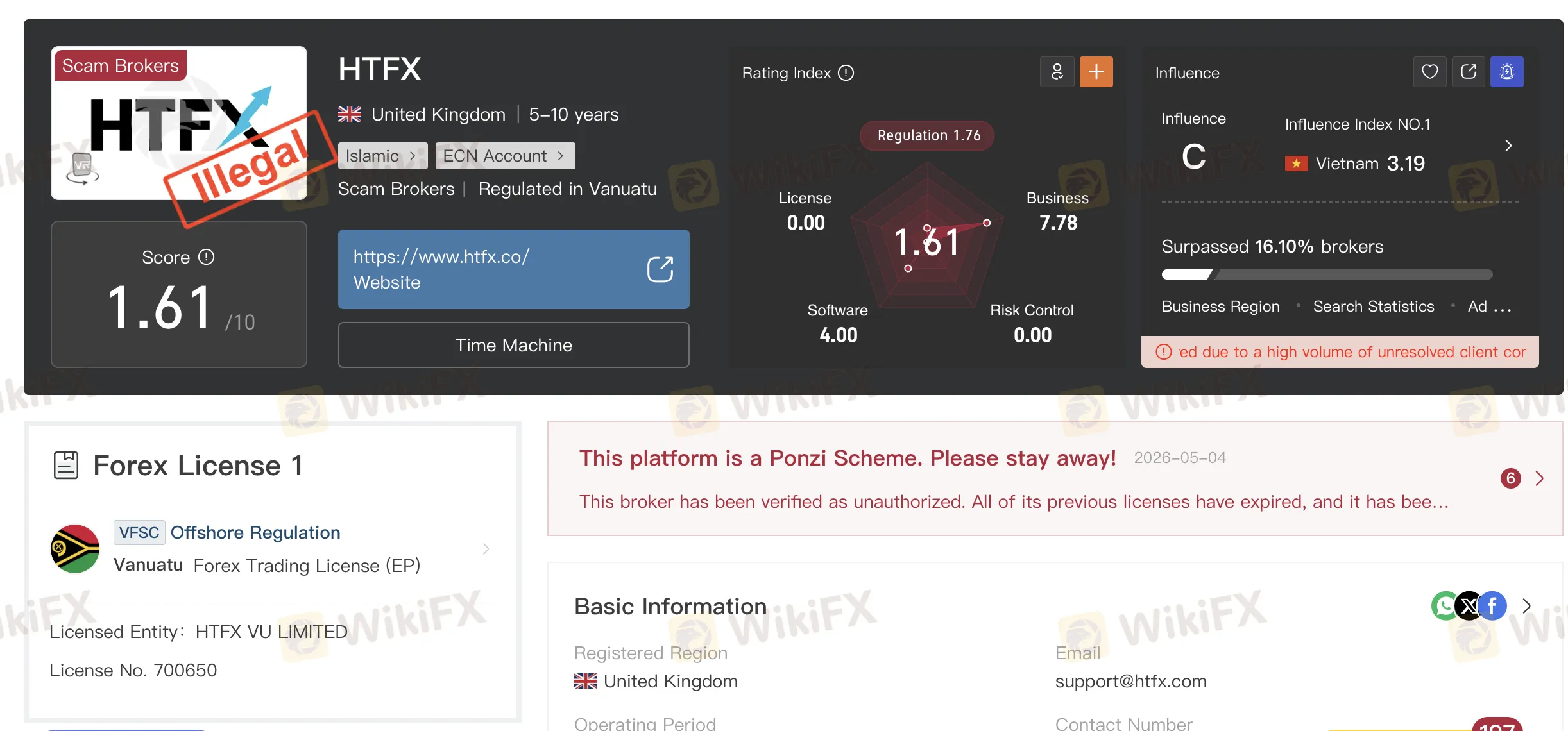
It once appeared to be a perfectly legitimate platform. Its FCA registration could be verified, and its website prominently featured words like “regulated,” “compliant,” and “secure.”
But a closer look at the FCA details revealed the critical limitation — it was authorised only for professional clients and eligible counterparties.
In plain terms, it was not meant for retail traders.
So where did retail funds actually go? The answer was buried in the client agreement — HTFX VU Limited, registered in Vanuatu. Regulation in such jurisdictions is often minimal, with no strict requirements for fund segregation, financial disclosure, or investor compensation.
Most people never look that deeply. They see the three letters “FCA” and proceed with confidence.
Then reality unfolds.
In the second half of 2025, withdrawal delays began. Customer support became unresponsive. Communication channels fell silent. By October, MT4 and MT5 services were disrupted, and the website gradually disappeared. On January 7, 2026, HTFX Limited formally applied to cancel its FCA licence, while its Cyprus licence was also relinquished. Today, the website is inaccessible, support channels are gone, and client funds have effectively vanished.
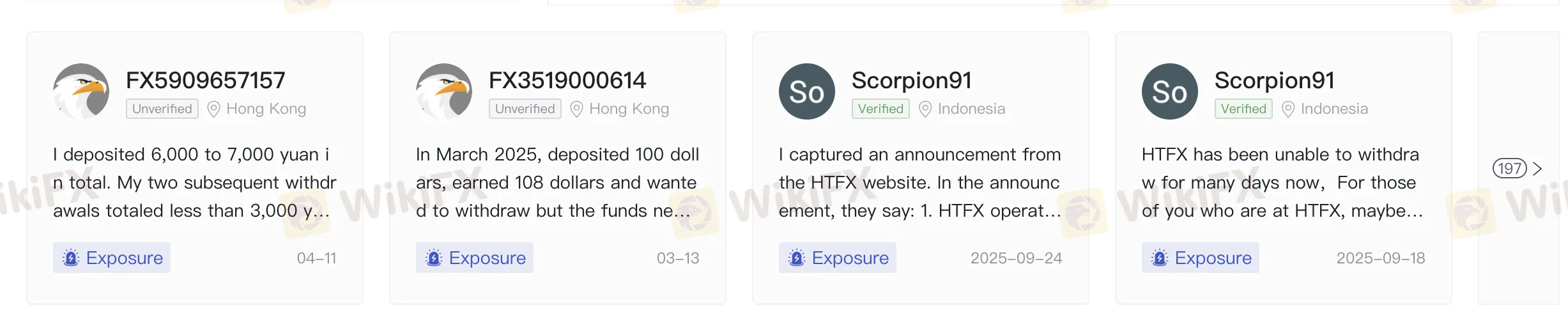
On WikiFX, there are nearly 200 exposure reports related to HTFX, most of them posted within recent months. Its classification as a high-risk platform is well supported by these reports.
For many investors, the journey from trust to loss was triggered by nothing more than the illusion of an “FCA halo.”
Some believe HTFX never intended to operate long-term. Others think it simply collapsed under pressure. Regardless of the cause, retail investors ultimately bore the cost.
You might wonder whether only problematic firms abandon FCA licences. The answer is no.
In recent years, even legitimate brokers have voluntarily surrendered their FCA licences. There are two main reasons.
First, the cost is extremely high. FCA compliance requirements are rigorous, covering everything from fund segregation to reporting and marketing practices, often costing millions of pounds annually to maintain.
Second, the regulatory environment is strict. Retail leverage is capped at 30:1, which many traders find restrictive, leading them to seek offshore alternatives.
As a result, a peculiar trend has emerged. Some firms retain FCA licences for branding purposes while directing retail clients to offshore entities with looser regulations. What you see is a UK-based company, but what you engage with is an offshore operation.
This may not always be illegal, but it creates a grey area — and for retail traders, it becomes a hidden risk.
Avoiding this risk does not require legal expertise or financial analysis. Three simple steps can make a significant difference.
First, verify the licence type. Check whether the firm is authorised to serve retail clients, not just whether it holds an FCA licence.
Second, verify the contracting entity. Look at the company name in your account agreement and confirm where it is registered.
Third, review user feedback and exposure reports. Often, early warning signs appear long before major issues become widely known.
Spending just a few minutes on these checks can protect far more than your account balance — it can protect your financial stability.
In conclusion, the FCA is a strong shield, but not everyone is allowed to use it.
A valid regulatory number does not guarantee that you are trading under that protection. For retail traders, understanding whether a firm is authorised to serve retail clients is crucial.
That is the seat you need to be in.
The story of HTFX serves as a reminder. The platform has disappeared, leaving behind only unresolved withdrawal issues and unanswered questions.
Investing is often described as a process of monetising knowledge. In reality, in the trading world, it is often a process shaped by information asymmetry.
If you cannot break out of that information gap, you may eventually become part of it.
So the next time someone presents an FCA registration number as proof of trust, consider asking one simple question: are retail clients actually allowed on this platform?
Disclaimer: This article is for informational purposes only and does not constitute investment advice.


Read more
Pepperstone Review 2026: Massive Deposit & Withdrawal Complaints Against This Regulated Broker
Have you experienced issues with Pepperstone deposit & withdrawal processing? From your experience, do you feel that the Australia-based forex broker causes losses to its clients? Did the brokerage entity freeze your account and give you a margin call? All these trading allegations have been rampant on broker review platforms such as WikiFX. This Pepperstone review article takes a close look at the user complaints, especially in 2026. Additionally, we have given an overview of the regulatory framework under which the brokerage entity operates.

Wundersys vs tradgrip: Two Offshore Newcomers Go Head to Head — and Neither Brings Home a Trophy
Some broker comparisons end with a confident "go with this one." This is not one of them — and that honesty is exactly what makes it worth reading. Wundersys and tradgrip are two young, offshore-registered brokers that keep popping up in front of beginner traders, often through aggressive online marketing. Both promise the usual buffet: tight spreads, generous leverage, multiple account tiers. And both, according to WikiFX, sit near the very bottom of the safety scale. So instead of crowning a champion, this comparison is really about something more useful: learning to read the warning signs, understanding the small differences that still matter, and knowing why "the better of two risky options" is still a conversation about risk.
The 6 Lowest-Commission Forex Brokers South Asian Traders Are Flocking To in 2026
If you trade forex from India, Pakistan, Bangladesh, Sri Lanka, or Nepal, you already know the quiet truth that eats into every trader's results: it is not just the market that decides whether you profit — it is the cost of getting in and out of each trade. Shave a couple of dollars off your commission on every lot, multiply it across hundreds of trades a year, and you are looking at the difference between a strategy that works and one that bleeds out slowly. South Asian traders are some of the most cost-conscious in the world, and rightly so. So we pulled the data on the brokers most often recommended for the region, cross-checked every name on WikiFX, and ranked them by the one number that matters most here: what they actually charge you to trade. Before the list, one quick lesson that will make this whole ranking click.

XPO Fund Wants $10,000 Before You Trade a Single Real Dollar — Read This Stunning Revelation
If you have spent even a week inside trading communities lately, you already know the pitch by heart. Pass a quick "challenge," get handed a funded account worth tens of thousands of dollars, and keep up to 80% of everything you make. No risking your own savings, no slow grind of building capital from scratch — just skill, a small fee, and a fast track to the big leagues. It is the exact dream every new trader is secretly chasing, and an entire industry has sprung up to sell it. XPO Fund is one of the louder voices selling that story right now. Its website is slick, its plans sound generous, and its marketing leans hard on words like "industry's lowest fee" and "fast payouts." But before you reach for your card, there is one number sitting quietly on this firm's profile — a number it would rather you scroll past — that every experienced trader would beg you to look at first. And no, it is not the profit split. Let's pull XPO Fund apart piece by piece: what it actually is, who is real
WikiFX Broker
Latest News
Why Sunk Costs Trap Traders in Losing Positions
WikiFXHidden Traps Built Into Your First Forex Trading Plan
WikiFXIFA Review: KYC Withdrawal Blockade Meets an Unauthorized Broker Warning
WikiFXSageFX Review 2026: Should You Trade with This Broker?
WikiFXEasyEquities Review 2026: Should You Trade with This Broker?
WikiFXQuotex Review 2026: Blocked Withdrawals and Regulatory Warnings
WikiFXXPO Fund Wants $10,000 Before You Trade a Single Real Dollar — Read This Stunning Revelation
WikiFXBalancing Chart Volatility With Account Limits in Stop Loss Placement
WikiFXHTFX Review 2026: Withdrawal Complaints, Offshore Regulation, and Account Access Risks
WikiFXThe Dunning-Kruger Trap: How Beginner Forex Traders Can Overcome Overconfidence and Manage Risk
WikiFXRate Calc

