Fed Chair Powell says more action may be needed to fend off lasting economic damage - Business Insider

Abstract:"While the economic response has been both timely and appropriately large, it may not be the final chapter," Powell said.
The economic recovery from the coronavirus pandemic may be a slow one, Federal Reserve Chair Jerome Powell said in a Wednesday event for the Peterson Institute for International Economics.He added that more fiscal support could be necessary to avoid long-term economic damage.“While the economic response has been both timely and appropriately large, it may not be the final chapter, given that the path ahead is both highly uncertain and subject to significant downside risks,” Powell said.Visit Business Insider's homepage for more stories.
Federal Reserve Chair Jerome Powell cautioned on Wednesday that the US economic recovery from the fallout of the coronavirus would likely be slow and require more fiscal stimulus.The recovery “may take some time to gather momentum, and the passage of time can turn liquidity problems into solvency problems,” Powell said in an event for the Peterson Institute for International Economics.He continued: “Additional fiscal support could be costly but worth it if it helps avoid long-term economic damage and leaves us with a stronger recovery.”Powell's remarks came two months into the worst economic downturn since the Great Depression. In April, the US economy lost a record 20.5 million jobs and saw the unemployment rate spike to 14.7%.
Long stretches of unemployment can leave families in greater debt, Powell said. And losing thousands of small and medium-sized businesses “would destroy the life's work and family legacy of many business and community leaders and limit the strength of the recovery when it comes,” he said.Read more: A real-estate investor who generates $342,000 of annual cash flow shares his unique spin on a popular investment strategy that's helped land him 114 unitsPowell cheered the actions of the government so far, noting how swiftly different groups had acted to send relief to Americans. The Federal Open Market Committee slashed interest rates to zero in March and has since gone beyond its 2008 playbook with emergency lending and buying programs to support the economy.Congress has allocated nearly $3 trillion in funding to support small businesses, American households, and more.
Still, there could be more to come. “While the economic response has been both timely and appropriately large, it may not be the final chapter, given that the path ahead is both highly uncertain and subject to significant downside risks,” Powell said.Read more: BTIG says buy these 25 under-the-radar stocks that been neglected for years, because they're tempting M&A targets with big upsideHouse Democrats on Tuesday proposed an additional $3 trillion coronavirus relief bill. The Fed also took another unprecedented step this week when it began buying corporate bond exchange-traded funds.When the crisis subsides, the central bank will “put these emergency tools away,” Powell said. Still, he reaffirmed the central bank's “whatever it takes” approach to provide support until the crisis has passed and the economic recovery is underway.
Read more
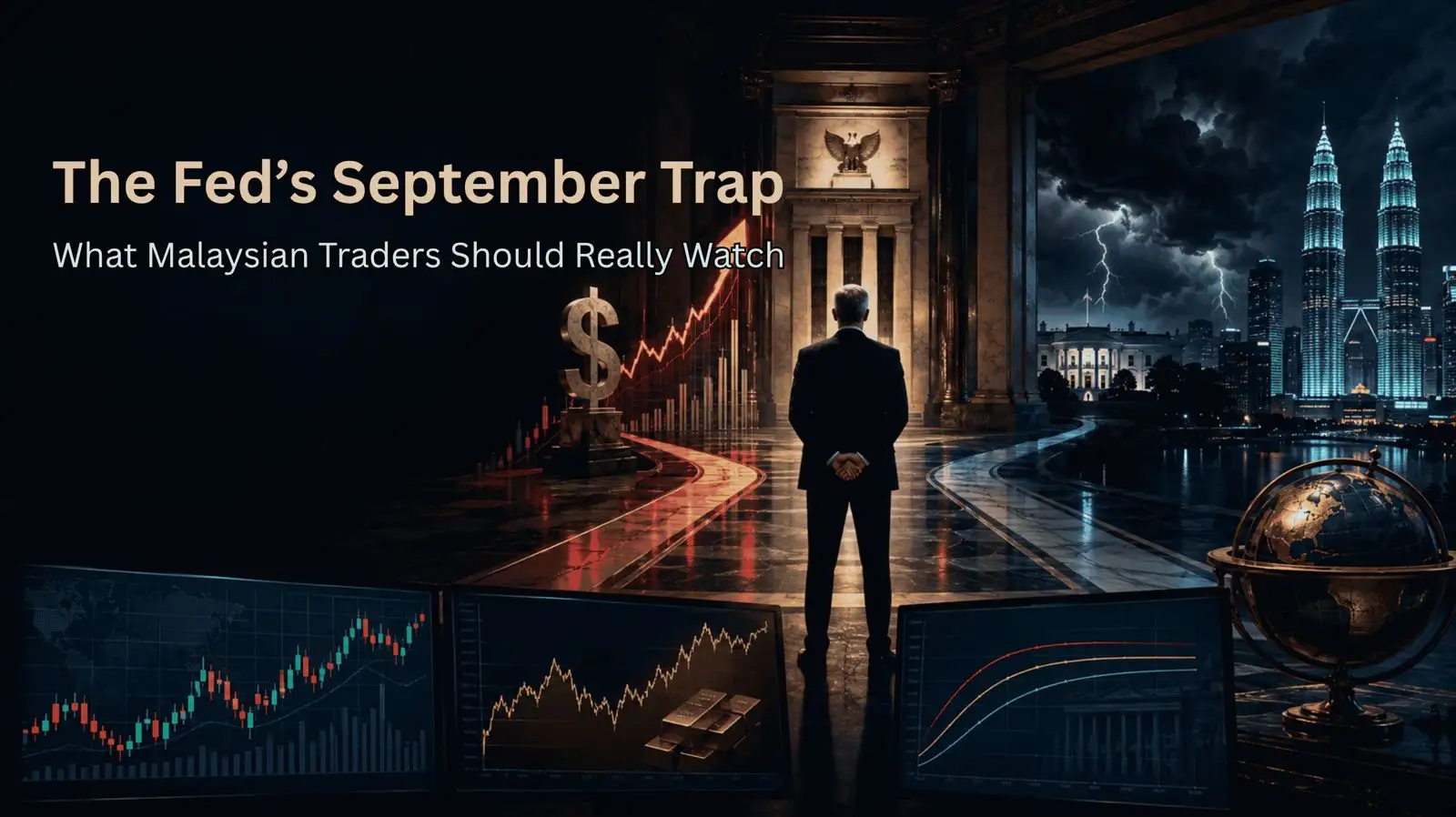
Fed September Hike: What Malaysian Traders Should Watch
Fed hike expectations are rising after Warsh’s hawkish speech. Here is what it could mean for USD/MYR, gold and forex trading risks in Malaysia.
FOMC Minutes Today: 3 USD and Gold Scenarios Traders Should Prepare For
The Fed releases the July FOMC minutes on 19 August 2026. Here are three USD and gold scenarios, confirmation signals, and a practical risk checklist for traders.
US July CPI Could Take a Fed Rate Hike Off the Table
Goldman Sachs expects inflation to remain manageable as America’s labour market loses momentum. For Malaysian investors, the result could influence the US dollar, ringgit, gold and Bursa sentiment.
Indian Stocks Take a Beating, Sensex Falls by Over 600 Points Today: Check Out Why
Indian stock markets witnessed a sharp low in the early trading hours on Monday. While the Sensex fell by more than 600 points, Nifty slumped under 23,200. The fall in the stock market today is the investors’ reaction to the escalating tensions in the Middle East, a surge in crude oil prices and weakness across markets worldwide. At around 9:30 a.m. on June 8, 2026, the BSE Sensex dropped by 627.47 points to 73,615.87, recording a fall of 0.85%. At the same time, the Nifty declined by 195.40 points to 23,171.30, registering a 0.84% fall. The selloff was broad based, with most sectoral indices slipping into red. Nifty IT, Nifty Realty, Nifty Auto and Nifty Metal slipped by 1.61%, 1.68%, 1.21% and 1.31%, respectively. Even the Nifty Midcap 100 and Nifty Smallcap 100 declined by 0.73% and 0.63%, respectively. As far as Sensex stocks are concerned, only State Bank of India, Axis Bank, Power Grid Corporation of India and Sun Pharmaceutical Industries were found to be green. Among the one
WikiFX Broker
Latest News
Silver Forecast: XAG/USD rebound capped as bearish bias holds
WikiFXUK Chancellor Healey: Economy demonstrates welcome resilience despite global uncertainty
WikiFX11.09.26 Daily Forecast
WikiFXCMC Markets Extends US Share Trading Into Overnight Session
WikiFXProp Firm FTMO to Acquire OANDA with $422 Million
WikiFXKudotrade Review 2026: Reported Slippage & Trade Execution Issues You Should Know
WikiFXRBI's Record $136-Billion NRI Deposit Campaign: Closed Early, Windfall and Risks for Traders
WikiFXUnited States Dollar Index holds onto gains above 99 ahead of US CPI data
WikiFXBritish Pound holds steady above 1.3500 ahead of US CPI inflation release
WikiFXWhat is Synthetic Indices in Prop Trading | Why Is It Risky?
WikiFXRate Calc

