US July CPI Could Take a Fed Rate Hike Off the Table

Abstract:Goldman Sachs expects inflation to remain manageable as America’s labour market loses momentum. For Malaysian investors, the result could influence the US dollar, ringgit, gold and Bursa sentiment.
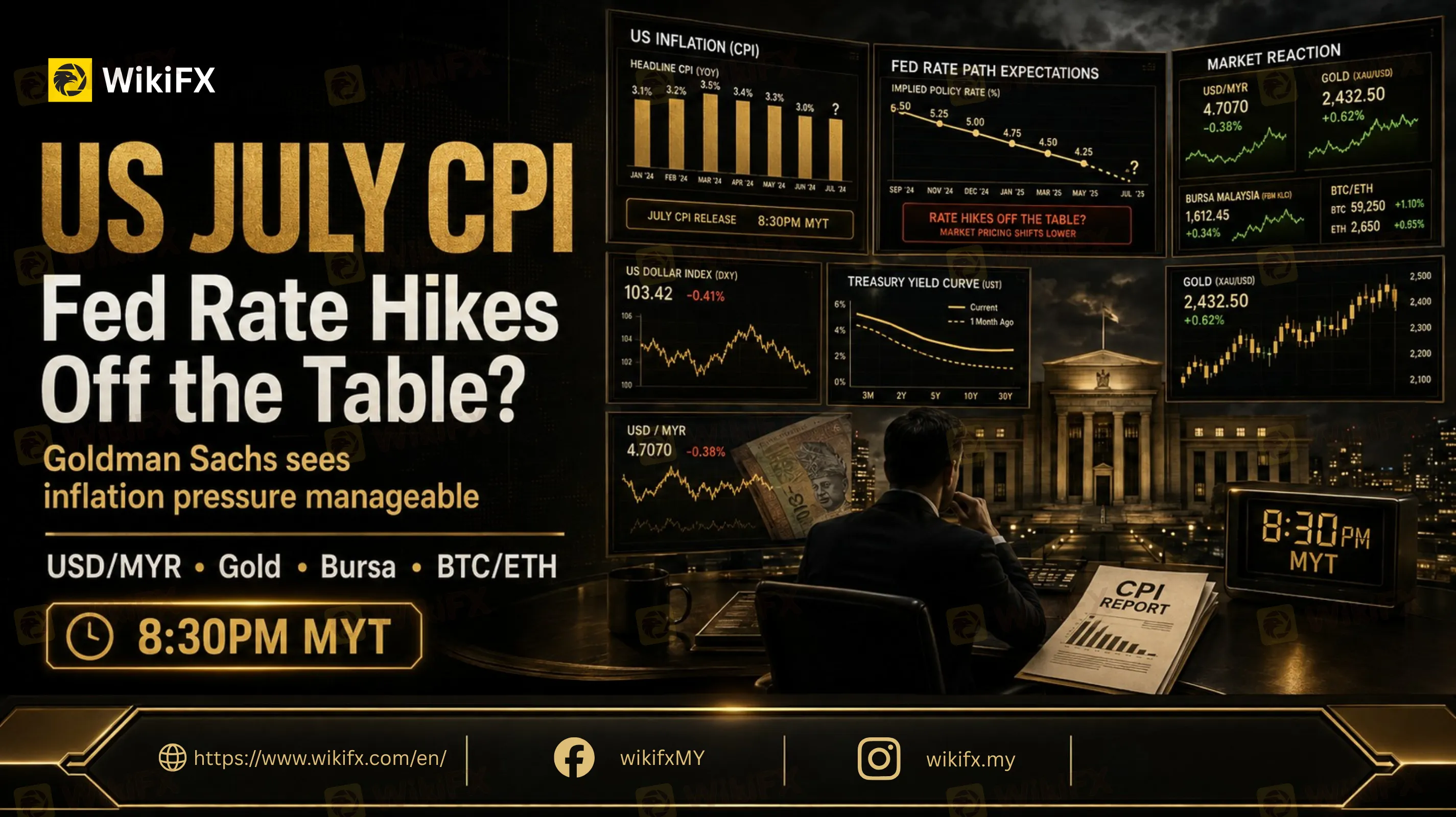
The US July Consumer Price Index may do more than move Wall Street for a few hours. It could decide whether the Federal Reserve seriously considers another interest-rate increase at its September meeting—or keeps policy unchanged while waiting for inflation to cool.
Goldman Sachs economists expect a relatively moderate monthly reading, supported by softer shelter inflation, fading tariff effects and less intense wage pressure. The banks broader policy view is that the Fed will probably keep interest rates unchanged for the rest of 2026 rather than raise them again.
That forecast now has additional support from a surprisingly weak US jobs report. But investors should not mistake a softer economy for an automatic green light to buy every risk asset. Inflation remains above the Feds target, oil prices remain unpredictable, and several policymakers have already shown that they are prepared to tighten policy again.
Why the US July CPI matters more than usual
The US Bureau of Labor Statistics is scheduled to release the July CPI report at 8:30 a.m. Eastern Time on August 12—8:30 p.m. in Malaysia. Junes report showed headline CPI falling 0.4% month on month, while core CPI, which excludes food and energy, was unchanged. Annual headline and core inflation stood at 3.5% and 2.6%, respectively. The official June CPI report described the headline decline as the largest monthly fall since April 2020.
Economists generally expect July to be less dramatic. Public forecasts vary, particularly because energy prices were volatile during the month, but Goldman Sachs has been among the more optimistic institutions on underlying inflation.
The distinction between headline and core inflation matters. Headline CPI captures what households actually experience, including fuel and food. Core inflation tries to identify the more persistent trend by removing those volatile categories.
A moderate headline figure could reassure markets. However, the Fed will probably focus more closely on shelter and services prices, where persistent inflation would be harder to dismiss as a temporary energy or tariff shock.
Goldman sees inflation pressure gradually losing force
Goldman‘s case against further rate increases rests on the idea that much of 2026’s inflation overshoot came from temporary or supply-driven forces rather than an overheating domestic economy.
Tariffs can raise prices when importers pass additional costs to consumers, but their month-to-month effect should eventually fade once the higher price level is absorbed. Oil shocks can work in a similar way unless they spread into wages, services and inflation expectations.
Goldman also sees more favourable underlying signals. The bank has pointed to wage growth running below the rate it considers consistent with sustained 2% inflation, while leading indicators for rent growth remain subdued. Its economists consequently expect inflation to move closer to 2% in 2027 if the economy avoids further supply shocks. Goldman Sachs Research describes rate increases as unlikely, although not impossible.
Still, inflation has not been defeated. The Fed‘s July Monetary Policy Report said core Personal Consumption Expenditures inflation—the central bank’s longstanding preferred underlying gauge—was 3.4% in May. By comparison, the Dallas Fed‘s trimmed-mean measure was considerably lower at 2.4%, illustrating how different inflation gauges can tell different stories. The Federal Reserve’s July report also warned that trimmed-mean measures can sometimes react too slowly when the distribution of price changes shifts.
This debate has become more relevant under Fed Chair Kevin Warsh, who took office in May 2026 and has questioned whether traditional core PCE always gives policymakers the clearest view of underlying inflation.
The jobs report changed the balance of risks
The latest labour data strengthened the argument for patience.
US nonfarm payroll employment fell by 23,000 in July. May and June were also revised down by a combined 103,000 jobs. The unemployment rate remained broadly stable at 4.1%, but labour-force participation has declined by 0.7 percentage point since January. The official July employment report also showed employment declines in local-government education and retail trade.
The headline was weak, but it does not prove that the US is entering a recession. Local-government education alone lost 50,000 positions, while healthcare continued adding jobs. The BLS itself described both payroll employment and unemployment as having “changed little”.
Nevertheless, the combination of negative payroll growth and large downward revisions is difficult for the Fed to ignore. Higher interest rates work partly by reducing borrowing, investment and hiring. Raising rates into a rapidly weakening labour market could turn a controlled slowdown into something more damaging.
That is why a merely “acceptable” CPI report may now be enough to keep the Fed on hold.
A rate hike is still a live risk
The Fed maintained its target range at 3.50%–3.75% on July 29, but the decision was not unanimous. Three policymakers preferred a 25-basis-point increase, while the official statement said inflation remained elevated relative to the 2% goal. The July FOMC statement therefore makes one point clear: the rate-hike debate has not disappeared.
The bullish case rests on core inflation remaining contained while employment weakens. That combination would reduce the need for further tightening and could lower US Treasury yields.
The main counterargument is that one soft CPI report may not establish a trend. A renewed oil shock, stronger services inflation or rising inflation expectations could quickly revive the case for higher rates.
Goldmans no-hike forecast is therefore a baseline, not a certainty.
What this means for the ringgit and Malaysian investors
For Malaysian investors, the first transmission channel is the US dollar.
A softer CPI reading that reduces expectations for Fed tightening would usually remove some support from US yields and the dollar. All else being equal, that could ease pressure on the ringgit. But USD/MYR will also depend on oil prices, China‘s economic outlook, global risk appetite and Bank Negara Malaysia’s policy stance.
Bursa Malaysia could receive a sentiment boost if lower US yields encourage investors to take more exposure to emerging markets. Rate-sensitive growth stocks may benefit, while exporters could face a mixed outcome if the ringgit strengthens.
Gold may also react sharply. Lower real yields and a softer dollar are normally supportive, but the response will depend on whether investors interpret weak US data as benign disinflation or a warning of deeper economic trouble.
Cryptocurrency and US technology shares could initially welcome a dovish repricing. However, both are vulnerable to sudden reversals if the CPI exceeds expectations or if markets have already priced in too much good news.
What to watch next
The most constructive outcome would be moderate core inflation, continued cooling in shelter costs and no broad acceleration across services. That would support Goldmans view that further rate increases are unnecessary.
A hotter core reading would produce a very different debate, especially after three Fed officials voted for a hike in July.
For Malaysian investors, the important signal will not be the CPI headline alone. Watch the reaction in US two-year Treasury yields, the dollar, USD/MYR and Fed rate expectations. Those markets will reveal whether July CPI genuinely changed the policy outlook—or merely created another evening of volatility.
This article is for general information and does not constitute personalised financial advice.

Read more
Indian Stocks Take a Beating, Sensex Falls by Over 600 Points Today: Check Out Why
Indian stock markets witnessed a sharp low in the early trading hours on Monday. While the Sensex fell by more than 600 points, Nifty slumped under 23,200. The fall in the stock market today is the investors’ reaction to the escalating tensions in the Middle East, a surge in crude oil prices and weakness across markets worldwide. At around 9:30 a.m. on June 8, 2026, the BSE Sensex dropped by 627.47 points to 73,615.87, recording a fall of 0.85%. At the same time, the Nifty declined by 195.40 points to 23,171.30, registering a 0.84% fall. The selloff was broad based, with most sectoral indices slipping into red. Nifty IT, Nifty Realty, Nifty Auto and Nifty Metal slipped by 1.61%, 1.68%, 1.21% and 1.31%, respectively. Even the Nifty Midcap 100 and Nifty Smallcap 100 declined by 0.73% and 0.63%, respectively. As far as Sensex stocks are concerned, only State Bank of India, Axis Bank, Power Grid Corporation of India and Sun Pharmaceutical Industries were found to be green. Among the one

Treasury vs. Fed: Bessent leads Trump's Campaign to Reshape US Monetary Policy
A power struggle over the future of the Federal Reserve is intensifying as Treasury Secretary nominee Scott Bessent spearheads a process to select the next Fed Chair, aiming to align the central bank more closely with the White House's economic agenda.

Fed Rate Cut Calls, Would NFP Tilt The Odds?
The latest data for the U.S. ISM Manufacturing PMI, released on August 1, 2024, shows a decline to 46.8, down from 48.5 in June. This marks the sixth consecutive month of contraction (a reading below 50) and remains well below the historical average of 52.88. On July, the Bank of Canada (BoC) announced a 25-basis-point cut in its benchmark interest rate, reducing it to 4.5%. This was the second consecutive rate cut, following a similar move in June. The latest ADP Nonfarm Employment Change for..

Fed Pressured: Will CPI Data Fuels Calls for Rate Cuts?
The U.S Producer Price Index (PPI) for June showed a month-over-month increase of 0.2%, which was slightly above market expectations of 0.1%. The Reserve Bank of New Zealand (RBNZ) recently kept its Official Cash Rate (OCR) unchanged at 5.50% during its last meeting on July 2024, which was consistent with market expectations. As of June 2024, the U.S. Consumer Price Index (CPI) showed a modest increase of 3.0% year-over-year, weaker than market expectation and previous reading of 3.1% and 3.3%..
WikiFX Broker
Latest News
VG Markets Review: A Real FSCA Licence, But Why Only a 4.47 Score?
WikiFXStoneX Agrees to Acquire Brazil FX Bank Banco Travelex
WikiFXTenTrade Review 2026: Complaints, Withdrawals, and Risk Signals
WikiFXTriumphFX Review: Revoked Licence and TFX Token Losses Warrant Caution
WikiFXMalaysian Doctor Loses RM558,000 to Forex-Crypto Scam
WikiFXadmiral Review 2026: Clone Warnings, Withheld Profits, and Withdrawal Risks
WikiFXReview 2026: GFS Withdrawal Complaints, Regulation Gaps, and Broker Risk Signals
WikiFXPlus500 Joins Bahamas Forex and CFD Industry Association
WikiFXGold Climbs Toward $4,400 as September Fed Hike Odds Tumble
WikiFXValbury Review 2026: An A+++ Rating Is a Starting Point - Not a Reason to Skip the Money-Path Check
WikiFXRate Calc

