India Forex Reserves Rebound to $707 Billion: Why That Does Not Guarantee a Stronger Rupee

Abstract:India forex reserves rose by $14.136 billion to $707.002 billion in the week ended 7 August 2026. This explainer separates RBI forex-reserve facts from rupee predictions, explains the role of foreign currency assets and gold, and gives forex-market readers a practical checklist before treating one headline as a trading signal.
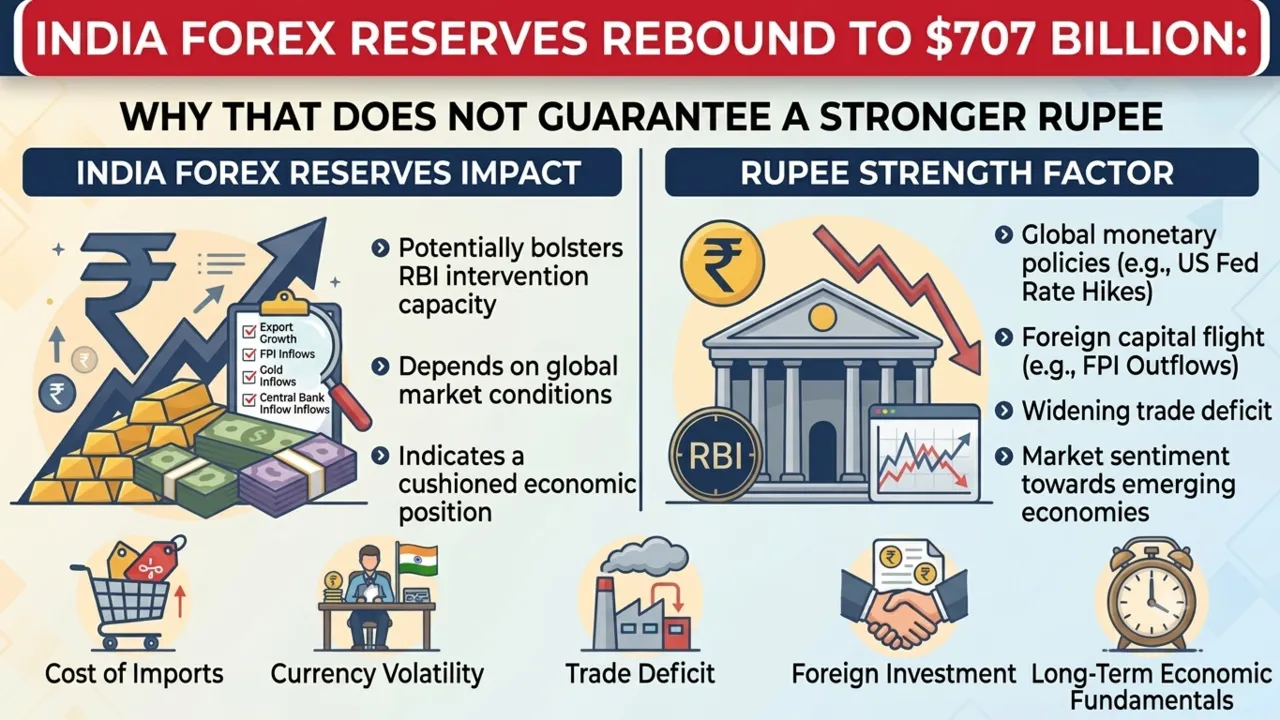
A $14 billion weekly rise in India's forex reserves makes a powerful headline. But the first disciplined question for an Indian rupee or forex-market reader is not whether the rupee will rise tomorrow. It is: what moved inside the reserve total, and what does a central-bank buffer actually tell us about the next market session?
Key Takeaways
What the data says: India's foreign-exchange reserves rose by $14.136 billion to $707.002 billion in the week ended 7 August 2026. Foreign currency assets rose by $9.946 billion to $574.625 billion and gold reserves by $3.995 billion to $108.738 billion. A larger buffer can improve resilience, but it does not guarantee a one-way move in the Indian rupee.
India Forex Reserves: The Figures Behind Today's Headline
| Component | Week ended 7 August 2026 | How to interpret it |
| Total reserves | $707.002 billion | A stock of external assets, not a daily exchange-rate target. |
| Foreign currency assets | $574.625 billion | The largest component; dollar reporting can also reflect moves in other reserve currencies. |
| Gold reserves | $108.738 billion | Their USD value can change with gold prices as well as quantity. |
The figures were reported from RBI data by Akashvani News. Readers who want to follow the underlying release route can also consult the RBI's Weekly Statistical Supplement portal. The reporting period matters: these data are for the week ended 7 August, not a live intraday reading of the currency market.
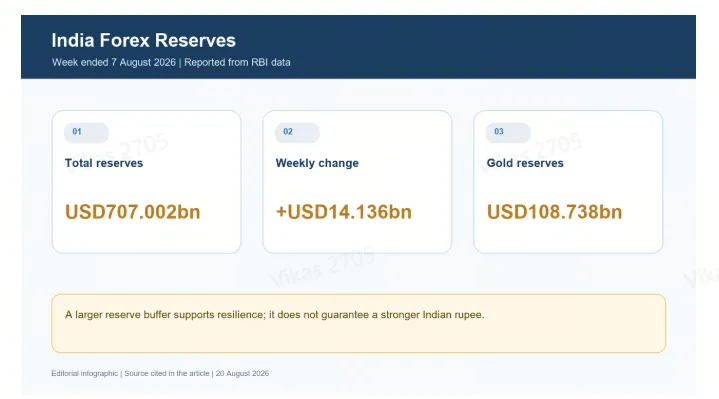
Figure 1. India forex-reserve snapshot for the week ended 7 August 2026. A reserve change is not a forecast for the Indian rupee.
Why the Reserve Total can Change Sharply
Foreign-exchange reserves are not a single pile of US dollars. They include foreign currency assets, gold, Special Drawing Rights and the reserve position in the IMF. The reported weekly move therefore has more than one possible driver: valuation changes in non-dollar reserve currencies, gold-price movement, market transactions, foreign flows and other balance-sheet changes. The reserve headline is important, but it should not be treated as a simple count of new cash entering the country.
For this period, the rise in foreign currency assets and gold both mattered. That distinction is useful because a change in the dollar value of gold or other currencies can move the total even when the market story is more complex than a single capital-flow narrative.
Does a Larger RBI Forex Reserve Buffer Mean the Indian Rupee Must Strengthen?
No. A higher reserve level can strengthen the country's capacity to manage external shocks and can matter for market confidence. Yet the Indian rupee is also influenced by the US dollar, crude-oil prices, portfolio flows, trade demand, risk sentiment and expectations about monetary policy. Those factors can move faster than a weekly reserve release.
Common misconception: The claim 'reserves are up, so INR must rise' confuses resilience with direction. Reserves can be a useful buffer; they are not an automatic buy or sell instruction for USD/INR or any leveraged forex position.
A Better Way to Read Forex-Market India Headlines
Start with the date and the component breakdown. Then separate three statements: a fact (the reserve total changed), an interpretation (the change may improve the external buffer), and a forecast (the rupee will do X). Only the first is established by this release. The other two require additional evidence.
For readers following forex trading in the forex market India, this RBI forex reserves release helps prevent headline-driven decisions. Compare USD/INR pricing across the official reference context and your trading venue, check whether the spread widens around news, and review leverage and stop-loss exposure before volatility rises. No social-media post or paid signal should substitute for position sizing and an understanding of the product's terms.
How Exporters, Importers and Investors can Use the News
An exporter may use the reserve headline as a prompt to review invoice timing, currency exposure and banking costs. An importer may review the same things from the opposite side. Neither needs to predict the next USD/INR tick to improve risk management. The practical task is to identify the exposure, the payment date, the currency of the obligation and the available hedging process through an authorised institution.
Institutional and retail market participants should keep one further distinction in mind: a central-bank statistic describes the macro backdrop, while a specific broker's execution, costs, margin requirements and withdrawal processes are separate questions that must be verified independently.
Bottom Line
Today's India forex reserves story is a significant $14.136 billion weekly rise to $707.002 billion, with foreign currency assets and gold both contributing. It is a useful sign of buffer strength, not a promise about the Indian rupee's next move. The better habit is to read the period, components and wider market conditions before turning a reserve headline into a forex trading decision.
Risk disclosure: This article is for information and education only. It is not investment advice, a trading recommendation or a forecast. Foreign exchange and leveraged products can move quickly and may result in losses.
Download the WikiFX app for the latest forex updates.

Knowledge pays at WikiFX.Every time you share a WikiFX article, you'll receive 50 Reward Points. Grow your rewards with every share and unlock exclusive gifts in the WikiFX Points Mall. Start earning today!

Read more

XTrend Speed Review 2026: Reported Chart & Trade Order Discrepancies Along with Poor Withdrawals
Did you witness an opposite market movement to the candlestick chart shown on the XTrend Speed platform? Were your profits being allegedly cancelled by the South Africa-based brokerage firm? Faced losses due to incorrect trigger of limit order on the XTrend Speed login? Did the broker cancel your multiple withdrawal requests? Many traders have reportedly raised these issues on broker evaluation platforms such as WikiFX. This XTrend Speed review examines user-reported allegations and shares an outlook on the regulatory status.

Bangladesh ACC Files Case Against Eight Over Tk23.68 Crore Chattogram Land Fraud
Bangladesh's Anti-Corruption Commission (ACC) has filed a case against eight people, including a serving executive engineer of the Public Works Department (PWD), over the alleged embezzlement of about Tk23.68 crore through forgery and fraud involving government land in Chattogram. The ACC announced the case at a press conference on 4 October, as reported by The Business Standard, which published the details of the filing.

A 19.2x Nifty is cheap in rupees. In dollars, the hurdle is 13–15%
Foreign funds pulled roughly Rs 3 lakh crore out of Indian equities in 2026, with about Rs 36,000 crore of that leaving in September alone. Those are the numbers in a widely shared post on X by Vivek Khatri (@CaVivekkhatri), whose argument runs in one direction: the Nifty is cheap in rupees and expensive in dollars. The post's snapshot: Nifty PE near 19.2, the rupee near 96.3, the US 10-year Treasury at 5.28%. Individually, those look calm. Over a year, they do not. According to the post, the rupee is down about 8.5% over the year, about 7% in 2026, and almost 10% in the last financial year alone. The Nifty is down about 13% over the same stretch. Nifty IT is down about 27%. "They still bought IPOs," the post says of foreign investors. "They sold the secondary market." Put in position terms: a single-currency valuation is not a cushion if the currency itself is moving against you.
RBI MPC Meets Today: An Anticipated 25 BPS Hike Would be the First Since February 2023
The RBI's Monetary Policy Committee begins its three-day meeting today, October 5, and the rate decision lands on Wednesday, October 7 at 10:00 am. The repo rate is 5.25%. A 25 basis point increase takes it to 5.50% — the first hike since February 2023. Most of the street expects exactly that. A Reuters poll of 61 economists had 35 forecasting 25 bps. An ET Poll published Monday pointed the same way: 25 bps, to 5.50%. Governor Sanjay Malhotra holds a press conference at 12:00 pm, two hours after the statement, and the RBI livestreams both on its YouTube channel. If you hold USD/INR, or any floating-rate loan priced off an external benchmark, Wednesday morning is the only scheduled event this week that moves your numbers.
WikiFX Broker
Latest News
RBI MPC Meets Today: An Anticipated 25 BPS Hike Would be the First Since February 2023
WikiFXBOJ Interest Rate Forecast: Tokyo Inflation Builds Case for Next Hike
WikiFXA 19.2x Nifty is cheap in rupees. In dollars, the hurdle is 13–15%
WikiFXChris and Tiger Podcast – Euro Slides as France Fears, High Yields Shape Markets
WikiFXWinproFx Review 2026: Mixed User Reports on Trading and Withdrawals
WikiFXBangladesh ACC Files Case Against Eight Over Tk23.68 Crore Chattogram Land Fraud
WikiFXTrading Pro Review of the FCA Warning and Rejected Withdrawal
WikiFXWhy Gold and the Dollar Are Rising Together Today
WikiFXUS Dollar Price Forecast: Soft NFP Hits Fed Bets, Can GBP/USD and EUR/USD Recover?
WikiFXVizag Techie Loses ₹20 Lakh in Crypto Investment Scam
WikiFXRate Calc
