RBI's $40.82 Billion Forex Surge: A Bigger Rupee Shield—or Just Borrowed Time?

Abstract:RBI's concessional forex swap facility had mobilised $40.82 billion by 31 July 2026, with FCNR(B) deposits providing $36.725 billion of the total. This India-focused analysis separates confirmed inflows from the $80–85 billion SBI Research projection, compares the 2026 programme with the 2013 FCNR(B) window, and explains what the numbers can—and cannot—do for the Indian rupee. It also shows how banks, NRI depositors, importers, exporters and institutional investors may be affected, while highlighting the oil, dollar, maturity and hedging risks that still matter for USD/INR and forex trading in India.
In less than two months, a policy window that sounded technical has pulled in more foreign currency than India's celebrated 2013 FCNR(B) programme. The confirmed total is now $40.82 billion. That is a meaningful buffer for the balance of payments—but it is not a blank cheque for a stronger rupee.
Key Points
Confirmed update: RBI-linked concessional swap facilities had mobilised $40.82 billion by 31 July 2026. FCNR(B) deposits contributed $36.725 billion, OFCBs $2.575 billion and ECBs $1.520 billion. These are reported actual inflows based on data from authorised dealer banks.
What is not confirmed: The $80–85 billion figure is an SBI Research projection for potential mobilisation by the end of the relevant windows. It is not RBI guidance, a target achieved, or a guaranteed final total.
Why the latest number has global attention
On 1 August, The Hindu reported that the RBI facility had attracted $40.82 billion by the end of July. KNN India published the component breakdown: $36.725 billion through Foreign Currency Non-Resident (Bank) deposits, $2.575 billion through Overseas Foreign Currency Borrowings, and $1.520 billion through External Commercial Borrowings.
The speed is striking. Akashvani reported $20.718 billion of total inflows by 17 July. Roughly two weeks later, the figure was almost double. That acceleration explains why the RBI forex swap facility is drawing attention from banks, NRI depositors, corporate treasurers and traders watching USD/INR.
It also updates an earlier market snapshot. The Indian Express reported about $32 billion across the measures on 27 July. The new $40.82 billion figure is therefore not a competing claim. It is a later cut-off date with a larger confirmed total.
Four figures, four different meanings
| Figure | Date/status | What it measures | Editorial treatment |
| $17.406B | Actual at 17 July | FCNR(B) deposits only | Confirmed, but not the total across all channels. |
| $20.718B | Actual at 17 July | FCNR(B) + OFCB + ECB | Confirmed total for that cut-off date. |
| ~$32B | Reported 27 July | Broader mobilisation under RBI-linked measures | A dated actual update; methodology should be stated. |
| $40.82B | Actual at 31 July | FCNR(B) + OFCB + ECB | Latest confirmed total used in this article. |
| $80–85B | SBI Research projection | Possible final mobilisation | Forecast only; never present as achieved or guaranteed. |
Key takeaway: The latest milestone is $40.82 billion of actual mobilisation. The higher $80–85 billion range belongs in a scenario discussion, not in a sentence describing money already received.
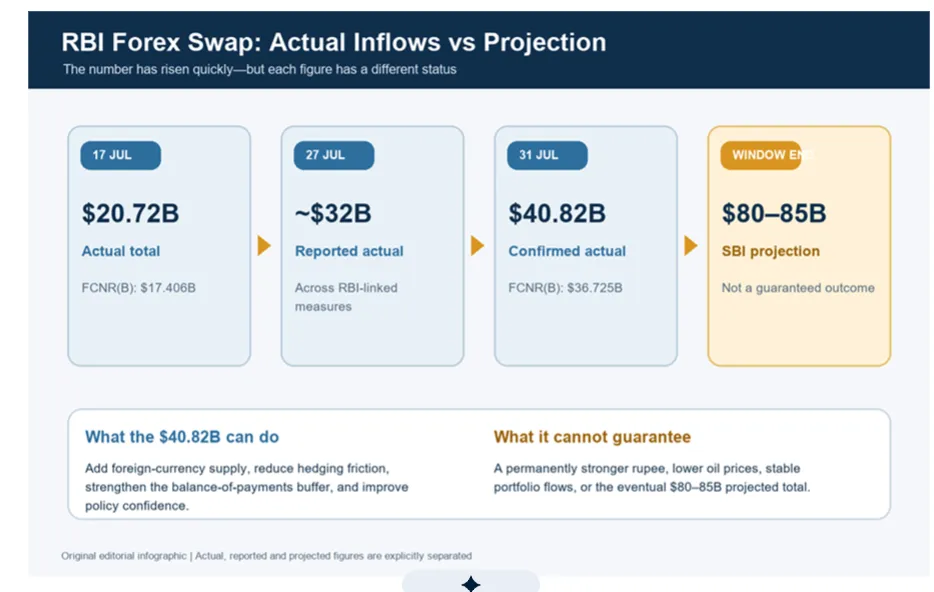
Figure 1. The 31 July figure is confirmed actual mobilisation; the $80–85 billion range remains a projection.
How the swap window works
RBI announced the measures on 5 June and operationalised them on 8 June. For eligible fresh FCNR(B) deposits, banks can swap the foreign currency with the central bank on concessional terms. This reduces or removes part of the hedging burden that would otherwise make long-dated foreign-currency deposits expensive to mobilise.
The programme also covers eligible OFCB and ECB flows. The original operational details reported by Reuters show that the policy was designed to strengthen the balance of payments and improve access to foreign currency during a period of pressure on the rupee and the external account.
The deadlines are not identical. The FCNR(B) deposit window remains available until 30 September 2026, while OFCB and ECB channels run until 31 December 2026. That difference matters when comparing forecasts, because a projected final total may assume several more months of borrowing-channel inflows after the deposit window closes.
The 2013 comparison: useful, but not identical
The obvious historical reference is 2013, when the taper tantrum triggered capital outflows and a sharp fall in the Indian rupee. RBI's own retrospective says the 2013 FCNR(B) and overseas-borrowing windows mobilised about $34 billion. The 2026 programme has already moved beyond that amount in less than two months.
The comparison is impressive, but it should not become a slogan. The global rate environment, oil shock, starting level of reserves, banking balance sheets and exchange-rate regime are different. The relevant lesson is that subsidised hedging can mobilise dollars quickly. It does not prove that the same policy will produce the same market outcome.
Other emerging economies also mobilise foreign currency through diaspora deposits, sovereign bonds or special remittance accounts. Those tools can diversify funding, but they usually create interest, rollover or currency-management obligations. A country receives liquidity today and accepts a future repayment or swap obligation. That trade-off is why the phrase 'free dollars' is misleading.
Why $40.82 billion does not guarantee a stronger rupee
More foreign-currency supply can reduce immediate pressure in the spot and forward markets. It can also improve confidence that banks and the central bank have access to dollars. However, USD/INR still responds to oil prices, the broad US dollar, portfolio flows, importer demand, government borrowing, and the RBI's own intervention choices.
India's oil bill is especially important. A rise in crude prices increases the dollars required by refiners and importers. That demand can absorb part of the supply created by the swap window. Likewise, foreign portfolio selling can outweigh deposit inflows during a risk-off episode. A large headline number is a buffer, not a force field.
The maturity profile also matters. FCNR(B) deposits and external borrowings eventually mature. If the money is rolled over smoothly, the impact can be manageable. If global funding conditions tighten near maturity, refinancing becomes more expensive. That risk is not an argument against the programme. It is a reason to examine the liabilities as carefully as the initial inflow.
Who gains—and what they still need to manage
| Participant | Possible benefit | Risk still present |
| NRI depositor | Potentially attractive foreign-currency deposit terms | Bank credit, tax, tenor and reinvestment conditions. |
| Indian bank | Cheaper or more predictable hedging for eligible inflows | Asset-liability matching and future rollover. |
| Importer | Better dollar liquidity can reduce disorderly moves | Oil prices and corporate dollar demand can still lift USD/INR. |
| Exporter | A more stable currency improves planning | An unexpectedly stronger rupee can reduce translated revenue. |
| Institutional investor | Stronger external buffer can improve confidence | Market pricing still depends on rates, growth and global risk. |
Illustrative scenario—not a real investor case: An Indian importer must pay $5 million in six weeks. The $40.82 billion programme may improve market liquidity, but it does not fix the importer's future exchange rate. A treasury team would still compare forward cover, option costs, cash-flow tolerance and the risk of leaving the exposure open.
Common misconceptions
Misconception 1: $40.82 billion has permanently entered RBI's usable reserves. The scheme involves swaps and liabilities; headline mobilisation is not identical to unrestricted, permanent reserve accumulation.
Misconception 2: The rupee must strengthen by a predictable amount. Exchange rates reflect many simultaneous flows, and RBI may prioritise orderly movement over a specific level.
Misconception 3: $80–85 billion is the next confirmed milestone. It is a research projection that depends on deposit mobilisation, bank participation and the remaining policy windows.
What to watch next
The next useful update is not merely another headline total. Watch the share of FCNR(B) deposits versus borrowings, the pace of mobilisation before 30 September, and whether banks are competing aggressively on deposit rates. Those details reveal the cost and durability of the inflows.
For the Indian rupee, monitor crude oil, the Dollar Index, foreign portfolio flows, forward premiums and RBI communication. For forex trading in India, a policy number should be treated as one input in a risk framework. The rupee outlook also depends on whether foreign exchange inflows persist after the initial policy response. It is not a substitute for checking live USD/INR prices, spreads, leverage and position size.
Final view: a stronger shield, not an all-clear
The $40.82 billion milestone proves that the RBI forex swap facility has attracted serious demand. It gives policymakers a larger buffer and shows that banks can mobilise foreign currency quickly when hedging economics improve. But the programme has not abolished India's exposure to oil, the dollar cycle, portfolio flows or future rollover costs. The strongest reading is therefore disciplined: the shield is bigger, yet the rupee still has something to prove.
Editorial note: This article is for education and information. The importer example is hypothetical. Market levels and policy figures can change after publication and do not constitute investment or trading advice.
Download the WikiFX app for the latest forex updates.

Knowledge pays at WikiFX.Every time you share a WikiFX article, you'll receive 50 Reward Points. Grow your rewards with every share and unlock exclusive gifts in the WikiFX Points Mall. Start earning today!
Here's how you can grab rewards.

Interesting Articles for You




Read more

XTrend Speed Review 2026: Reported Chart & Trade Order Discrepancies Along with Poor Withdrawals
Did you witness an opposite market movement to the candlestick chart shown on the XTrend Speed platform? Were your profits being allegedly cancelled by the South Africa-based brokerage firm? Faced losses due to incorrect trigger of limit order on the XTrend Speed login? Did the broker cancel your multiple withdrawal requests? Many traders have reportedly raised these issues on broker evaluation platforms such as WikiFX. This XTrend Speed review examines user-reported allegations and shares an outlook on the regulatory status.

Bangladesh ACC Files Case Against Eight Over Tk23.68 Crore Chattogram Land Fraud
Bangladesh's Anti-Corruption Commission (ACC) has filed a case against eight people, including a serving executive engineer of the Public Works Department (PWD), over the alleged embezzlement of about Tk23.68 crore through forgery and fraud involving government land in Chattogram. The ACC announced the case at a press conference on 4 October, as reported by The Business Standard, which published the details of the filing.

A 19.2x Nifty is cheap in rupees. In dollars, the hurdle is 13–15%
Foreign funds pulled roughly Rs 3 lakh crore out of Indian equities in 2026, with about Rs 36,000 crore of that leaving in September alone. Those are the numbers in a widely shared post on X by Vivek Khatri (@CaVivekkhatri), whose argument runs in one direction: the Nifty is cheap in rupees and expensive in dollars. The post's snapshot: Nifty PE near 19.2, the rupee near 96.3, the US 10-year Treasury at 5.28%. Individually, those look calm. Over a year, they do not. According to the post, the rupee is down about 8.5% over the year, about 7% in 2026, and almost 10% in the last financial year alone. The Nifty is down about 13% over the same stretch. Nifty IT is down about 27%. "They still bought IPOs," the post says of foreign investors. "They sold the secondary market." Put in position terms: a single-currency valuation is not a cushion if the currency itself is moving against you.
RBI MPC Meets Today: An Anticipated 25 BPS Hike Would be the First Since February 2023
The RBI's Monetary Policy Committee begins its three-day meeting today, October 5, and the rate decision lands on Wednesday, October 7 at 10:00 am. The repo rate is 5.25%. A 25 basis point increase takes it to 5.50% — the first hike since February 2023. Most of the street expects exactly that. A Reuters poll of 61 economists had 35 forecasting 25 bps. An ET Poll published Monday pointed the same way: 25 bps, to 5.50%. Governor Sanjay Malhotra holds a press conference at 12:00 pm, two hours after the statement, and the RBI livestreams both on its YouTube channel. If you hold USD/INR, or any floating-rate loan priced off an external benchmark, Wednesday morning is the only scheduled event this week that moves your numbers.
WikiFX Broker
Latest News
RBI MPC Meets Today: An Anticipated 25 BPS Hike Would be the First Since February 2023
WikiFXBOJ Interest Rate Forecast: Tokyo Inflation Builds Case for Next Hike
WikiFXA 19.2x Nifty is cheap in rupees. In dollars, the hurdle is 13–15%
WikiFXChris and Tiger Podcast – Euro Slides as France Fears, High Yields Shape Markets
WikiFXWinproFx Review 2026: Mixed User Reports on Trading and Withdrawals
WikiFXBangladesh ACC Files Case Against Eight Over Tk23.68 Crore Chattogram Land Fraud
WikiFXTrading Pro Review of the FCA Warning and Rejected Withdrawal
WikiFXWhy Gold and the Dollar Are Rising Together Today
WikiFXUS Dollar Price Forecast: Soft NFP Hits Fed Bets, Can GBP/USD and EUR/USD Recover?
WikiFXVizag Techie Loses ₹20 Lakh in Crypto Investment Scam
WikiFXRate Calc
