Indian Stocks Rally, but the Rupee Breaks a Six-Day Winning Streak—What's Behind the Sudden Reversal

Abstract:Indian stock indices today, i.e., June 22, 2026, recorded growth, with the BSE Sensex rising 297.11 points to 77,094.07, recording a 0.38% jump. On the other hand, the NSE Nifty hit approximately 24100, largely aided by broad-based purchases across sectors, except for consumer durables and fast-moving consumer goods (FMCG). The Nifty grew by 89.80 points (0.37%+) to 24,102.90.
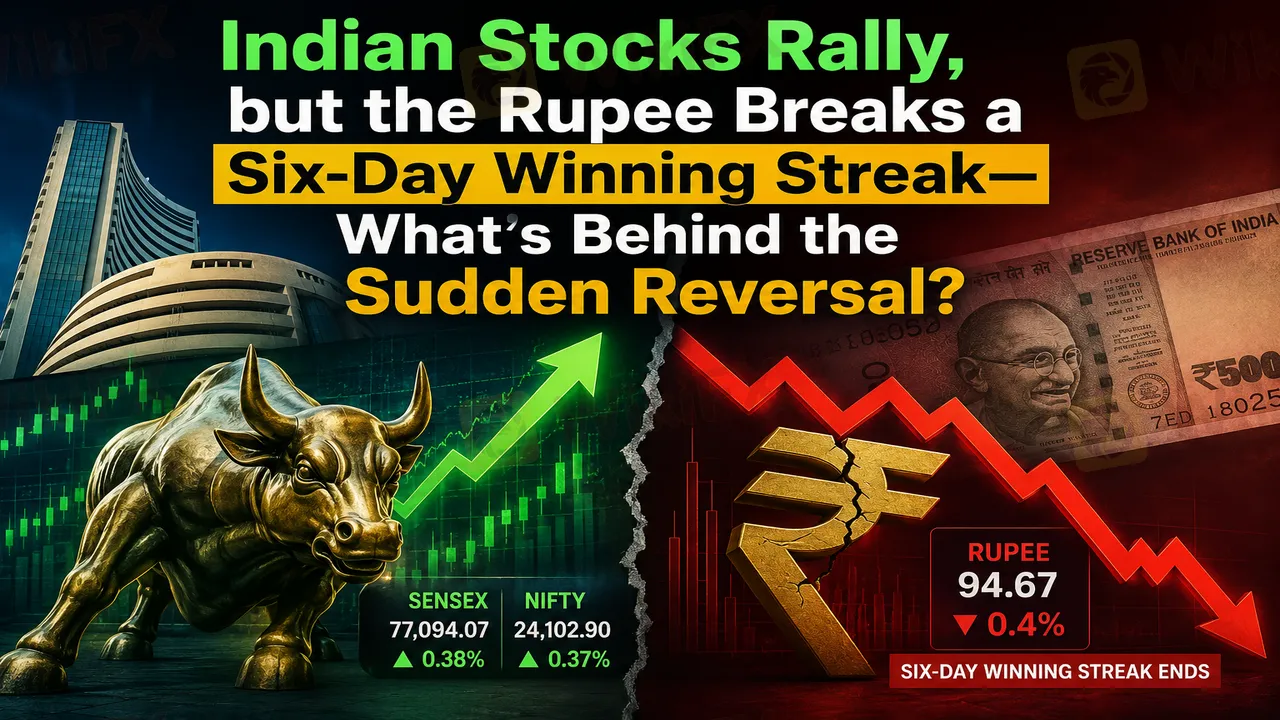
Indian stock indices today, i.e., June 22, 2026, recorded growth, with the BSE Sensex rising 297.11 points to 77,094.07, recording a 0.38% jump. On the other hand, the NSE Nifty hit approximately 24100, largely aided by broad-based purchases across sectors, except for consumer durables and fast moving consumer goods (FMCG). The Nifty grew by 89.80 points (0.37%+) to 24,102.90.
What Contributed to the Rally in Indian Indices?
The positive investor sentiment following the peace deal signed between Iran and the US at the end of last week led to a rally across indices. International crude oil prices slipped to around $80 per barrel.
The conflict, which began in February 2026, put the global economy in choppy waters with the disruption in the global oil supply due to the elongated closure of the Strait of Hormuz. However, repeated efforts through Pakistan and Middle East nations brought an agreement between the US and Iran. Lets look at the contours of the peace deal that made the market buoyant.
Key Highlights of the Signed Peace Agreement
- The signed agreement lays out an immediate ceasefire, making both sides agree to abstain from hostile actions.
- It also creates a framework to address long-pending disputes concerning Irans nuclear programs and regional security issues.
- According to the agreement, the United States of America (US) will start lifting its naval blockade surrounding Iran and working to restore regular passage of ships through the Strait of Hormuz within 30 days.
- Iran has agreed to ensure the smooth, safe passage of commercial ships and reaffirms its commitment to not pursue nuclear weapons.
- The signed memorandum contains plans for negotiations on economic reconstruction, sanctions relief and the upcoming management of Irans uranium stockpile under international oversight.
- Although both the US and Iran have reached a consensus on pursuing a final settlement within 60 days, they can extend the deadline by mutual consent.
Top Stock Gainers on Sensex
| Company Name | Current Price (INR) | Price Growth (INR) |
| Tech Mahindra | 1,435 | 25.60 |
| Sun Pharma | 1,863 | 24.60 |
| Infosys | 1,065 | 14.00 |
| HDFC Bank | 786.40 | 6.61 |
| Kotak Bank | 402.15 | 2.90 |
| RIL | 1,327 | 17.00 |
| BEL | 431.50 | 4.61 |
| Bajaj Finserv | 1,782 | 12.80 |
| Bajaj Finance | 968.30 | 6.50 |
| SBI | 1,041 | 5.66 |
| ICICI Bank | 1,352 | 5.91 |
Top Stock Gainers on Nifty
| Company Name | Current Price (INR) | Price Growth (INR) |
| Kirloskar Oil | 2,390.00 | 398.00 |
| Triveni Turbine | 737.30 | 65.00 |
| Kirloskar Bros. | 2,073 | 140.00 |
| Poly Medicure | 1,671.00 | 108.00 |
| Aegis Logistics | 1,070.00 | 61.90 |
| Inox India | 2,041.00 | 123.00 |
| IDBI Bank | 87.65 | 4.68 |
| Mankind Pharma | 2,538.00 | 124.00 |
| Lemon Tree Hotels | 118.75 | 5.71 |
| KSB | 947.80 | 45.30 |
| Clean Science & Tech | 821.10 | 39.00 |
Note - Share prices and other details mentioned in tables are sourced from The Economic Times, a leading English Daily in India.
While equity investors cheered the easing geopolitical tensions, the currency market painted a different picture today.
Rupee Loses the 6-day Winning Momentum, Slides 0.4% on June 22, 2026
The Indian rupee lost a six-day-long winning streak on Monday, largely due to the near one-year peak achieved by the dollar against a basket of currencies. The dollar strengthened despite easing concerns driven by lower oil prices. The rupee ended the trading session at 94.67 (approximately, falling 0.4% from its close on Friday. This fall was preceded by a nearly 1% gain by the rupee in six consecutive sessions.
In fact, there has been a broader fall in the Asian currencies today. They slipped between 0.3% and 0.7% today. The US Federal Reserves hawkish stance prompted traders to include wagers on a rate hike later this year, making the dollar index climb to its highest levels around the 101 handle since May 2025.
Conclusion
Indian financial markets sent mixed signals on June 22, 2026. While equities rallied on the back of improved global sentiment following the Iran-US peace agreement and easing crude oil prices, the rupee failed to extend its six-session winning streak. The strong performance of the Sensex and Nifty reflects growing investor confidence in India's economic outlook, with broad-based buying supporting gains across multiple sectors.
However, the rupee's decline highlights that currency markets remain influenced by global factors beyond domestic optimism. A stronger US dollar, expectations of further Federal Reserve tightening, and weakness across Asian currencies outweighed the positive impact of lower oil prices. Going forward, investors will closely monitor developments in the Iran-US peace process, movements in crude oil prices, and signals from the US Federal Reserve, as these factors are likely to determine whether Indian stocks can sustain their momentum and whether the rupee can regain its recent strength.
Download the WikiFX app for the latest financial updates, news, trading strategies, and more.

Interesting Articles for You
Review 2026: Are Traders Losing Sleep Over Missing Funds? Details Inside!, Account Suspensions


Read more

Is TradingPRO Safe? FCA Warning, Indonesia Blocklist Evidence, and 7 Checks Before You Deposit
This Trading Pro broker review checks the FCA warning, Indonesia blocklist evidence, licence claims, and what South Asian users should verify before depositing.
MT4 White Label Cost in 2026: What Brokers Must Budget Beyond the Platform Fee
The visible fee in an MT4 white label proposal is rarely the real cost of operating it. For an existing broker, the decision is not simply whether an MT4 white label platform is “cheap” or “expensive.” The real question is whether the commercial model remains viable after integration, support, data, client migration, compliance, and exit costs are included. That is why an MT4 white label cost review should be built as a 24- to 36-month operating case. It should compare three credible choices: 1. Keep the present MT4 setup and improve its weakest controls. 2. Replace the MT4 white label provider but retain the client proposition. 3. Migrate selected clients or products to another platform while running MT4 in parallel. This guide explains how to build that case without relying on headline prices or generic vendor claims.

The Rise of Deepfake Investment Scams: ASIC Shares Key Warning Signs
Artificial Intelligence (AI) has grown remarkably recently. However, it has also amplified the scope for financial fraud. One such is the rapid use of deepfake technology involving AI-generated videos, images and audio clips imitating real people. Fraudsters are leveraging these technologies to impersonate financial advisers, celebrities, business leaders and government officials to lure victims into fake investment schemes. Understanding the emerging implications, the Australian Securities and Investments Commission (ASIC) has cautioned investors of investment avenues promoted through convincing AI-generated content. Seemingly authentic, deepfakes are designed to manipulate trust and make people transfer funds before authenticating the investment’s legitimacy.

Best White Label Trading Platform 2026
The decision to switch white label providers or migrate to a modern white label trading platform is no longer a luxury for growth-minded brokers—it's a strategic necessity for survival in 2026. The convergence of technological stagnation, regulatory evolution, and shifting client expectations has created a perfect storm.
WikiFX Broker
Latest News
FBS Review: Is Your Deposit Safe?
WikiFXPocket Broker Review: Can You Actually Withdraw Your Money?
WikiFXTHINK MARKETS Broker Might Not Want You To See This
WikiFXYAIBroker Review: Website Is Down and Users Report Withdrawal Problems
WikiFXBONUS Review: Is Your Deposit Safe?
WikiFXAlpari Review 2026: Official Warnings and High Complaint Patterns
WikiFXHow to Spot Your First Trial Short on H1 After a Break
WikiFXIG Review: Broker Complaints Collide With Mixed Regulation Signals
WikiFXHow to Lock In Profits and Create a Zero-Risk Trade
WikiFXSTARTRADER Adds SK Hynix CFD Days After $26.5B US Listing
WikiFXRate Calc

