MT4 White Label Cost in 2026: What Brokers Must Budget Beyond the Platform Fee

Abstract:The visible fee in an MT4 white label proposal is rarely the real cost of operating it. For an existing broker, the decision is not simply whether an MT4 white label platform is “cheap” or “expensive.” The real question is whether the commercial model remains viable after integration, support, data, client migration, compliance, and exit costs are included. That is why an MT4 white label cost review should be built as a 24- to 36-month operating case. It should compare three credible choices: 1. Keep the present MT4 setup and improve its weakest controls. 2. Replace the MT4 white label provider but retain the client proposition. 3. Migrate selected clients or products to another platform while running MT4 in parallel. This guide explains how to build that case without relying on headline prices or generic vendor claims.
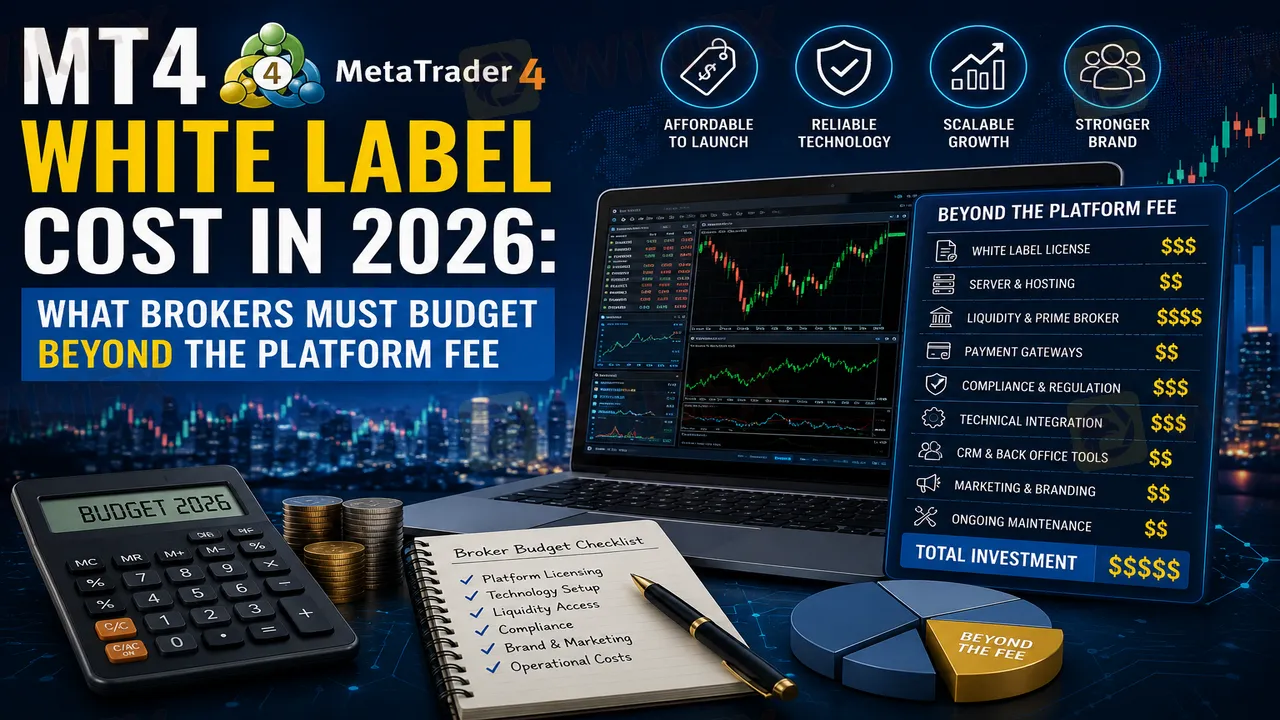
A procurement-focused guide for broker operators and decision-makers
Educational disclaimer: This article is for general business education. It is not legal, regulatory, financial, or procurement advice. White label pricing, permissions, data obligations, and product rules vary by provider and jurisdiction. Obtain independent legal, compliance, security, and commercial advice before signing or changing a platform agreement.
The visible fee in an MT4 white label proposal is rarely the real cost of operating it.
For an existing broker, the decision is not simply whether an MT4 white label platform is “cheap” or “expensive.” The real question is whether the commercial model remains viable after integration, support, data, client migration, compliance, and exit costs are included.
That is why an MT4 white label cost review should be built as a 24- to 36-month operating case. It should compare three credible choices:
- Keep the present MT4 setup and improve its weakest controls.
- Replace the MT4 white label provider but retain the client proposition.
- Migrate selected clients or products to another platform while running MT4 in parallel.
This guide explains how to build that case without relying on headline prices or generic vendor claims.
The short answer: what does an MT4 white label really cost?The total cost normally has six layers:
| Cost layer | Typical scope | Common mistake |
| Platform commercial terms | Setup, recurring licence, account or usage charges | Comparing only the first invoice |
| Trading infrastructure | Hosting, bridge, monitoring, backup, market data, connectivity | Assuming it is included in “white label” |
| Operating integrations | CRM, KYC, payments, reporting, support, affiliate tools | Treating every connector as a one-time job |
| Client transition | Data mapping, testing, communications, training, parallel run | Assuming clients will move without support cost |
| Controls and resilience | Access management, audit logs, security testing, incident response | Leaving it for after go-live |
| Exit exposure | Data export, termination fees, replacement work, transition support | Discovering lock-in only when leaving |
The lowest entry price can therefore produce the highest 36-month bill. A broker that accepts a low setup fee but has weak data rights, costly integrations, or an unclear support boundary may pay more through operational disruption and later migration.
Why an MT4 white label cost model needs a different lens in 2026MT4 remains familiar to many traders and can still be part of a working broker operation. However, familiarity is not a cost model.
An MT4 broker solution may depend on a chain of providers: platform access, hosting, bridge, liquidity connectivity, CRM, payment rails, identity verification, reporting, and support. Each dependency can have its own fee schedule, service level, data boundary, and outage process.
For firms in regulated markets, outsourced technology does not remove management responsibility. The FCAs current outsourcing guidance states that firms remain responsible for managing risks from outsourced and third-party arrangements throughout their lifecycle. That is a useful procurement principle even when the FCA is not your direct regulator: map the service, assign ownership, and test the dependency before signing. FCA guidance on outsourcing and operational resilience.
Do not use that principle to claim a particular provider is compliant. The applicable obligations depend on your entity, clients, products, and jurisdictions. Use it to ask better questions.
Start with the commercial schedule, not the sales deck
Ask for every cost in a single commercial schedule. The document should identify what is fixed, variable, pass-through, discretionary, and subject to future change.
At a minimum, separate the following:
- implementation or onboarding fee;
- recurring platform access or licence fee;
- active-account, user, transaction, or volume fees;
- server, hosting, monitoring, and backup charges;
- bridge, liquidity, market-data, and connectivity costs;
- support tier, after-hours coverage, and incident charges;
- integration, custom development, and change-request fees;
- training, migration, and transition services;
- termination, export, and handover charges.
Questions to ask an MT4 white label provider
- Which services are included in the monthly price, and which are optional?
- Which fees increase with active accounts, volume, symbols, managers, or servers?
- Can the provider change pricing during the term? If so, how much notice is required?
- Which third-party charges are passed through without markup disclosure?
- What will a new integration, new liquidity connection, or regional configuration cost?
- What support is included during a P1 incident, weekend event, or market disruption?
- What does data export cost when the contract ends?
If the supplier cannot produce a line-item schedule, treat the total cost as unknown. Do not fill the gaps with optimistic assumptions.
Build a 36-month MT4 total-cost model
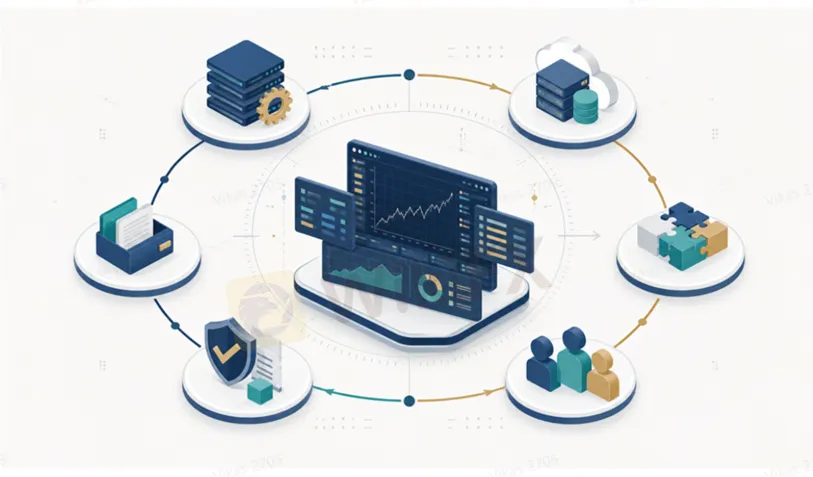
Illustration: the full 36-month cost structure behind an MT4 white label operating model.
Use a simple model before negotiating price. The exact amounts come from quotes, but the categories should remain stable.
A Practical Model
36-month total cost of ownership
= platform and infrastructure cost
- integration and change cost
- operations and staffing cost
- control and assurance cost
- client transition cost
- exit reserve
Run three volume scenarios:
| Scenario | Purpose | What to test |
| Low case | Slow client growth or delayed launch | Minimum fees, cash burn, minimum revenue commitments |
| Base case | Approved operating plan | Normal support load, expected integration work, target accounts |
| High case | Successful growth or volatility event | Capacity, per-account fees, support scaling, bridge and data charges |
Do not hide one-time cost in the base case. A migration project can consume senior operations, compliance, support, finance, and technology time even when the vendor quotes a fixed implementation fee.
Add an “uncertainty reserve”
The most useful cost line is often a contingency reserve. Use it for items that are real but hard to price before discovery:
- data clean-up and mapping defects;
- client statement or report corrections;
- custom middleware between the MT4 white label platform and the CRM;
- unplanned staff training and first-line support;
- replacement of a connector that fails acceptance testing;
- additional legal, security, or audit work;
- extended parallel-run costs.
The reserve should not be a vague percentage copied from another project. Tie it to the number of unknown integrations, the quality of historical data, and the number of client journeys that will change.
The integration bill is usually bigger than expected
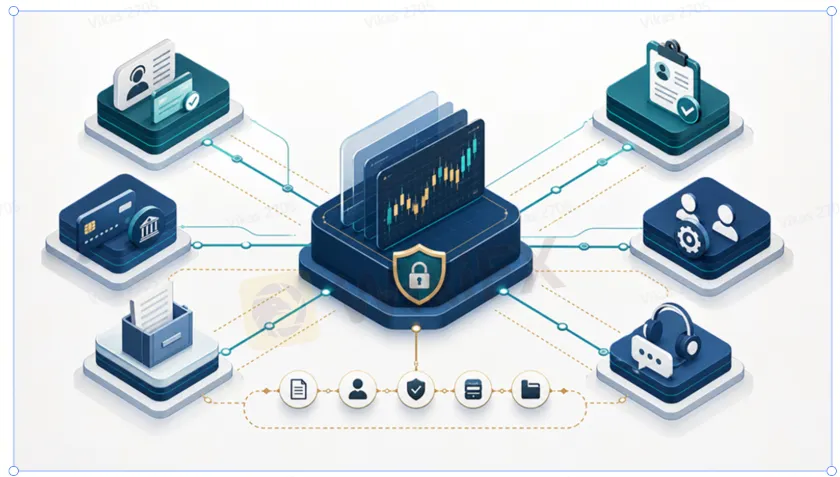
Illustration: the systems and audit trail that surround the trading platform.
An MT4 white label platform is not a complete broker operating model. It must work with the systems that manage clients, money, service, and reporting.
Create an integration map before approving a provider:
| Business process | System of record | Evidence to request from the supplier |
| Client onboarding | CRM/KYC | API fields, error handling, status mapping, audit trail |
| Deposits and withdrawals | Payment and finance systems | Reconciliation process, exception workflow, permissions |
| Accounts and trading | MT4/bridge/risk tools | Account lifecycle, limits, order exceptions, data export |
| Client statements | Platform and reporting tools | Data fields, statement logic, archive and correction process |
| Partners or IBs | Partner system/CRM | Attribution rules, commission calculations, change history |
| Complaints and support | Service desk/CRM | Ticket linkage, escalation path, client communications |
Ask the provider to show a failed case, not only the happy path. For example, request a demonstration of a rejected deposit, a client identity status change, a stale market-data alert, an order exception, and an export of account history.
If the response is “our API can do that,” ask for the specific endpoint, payload, status values, rate limits, audit data, and expected owner when it fails.
Data migration is a cost and a client-risk issue
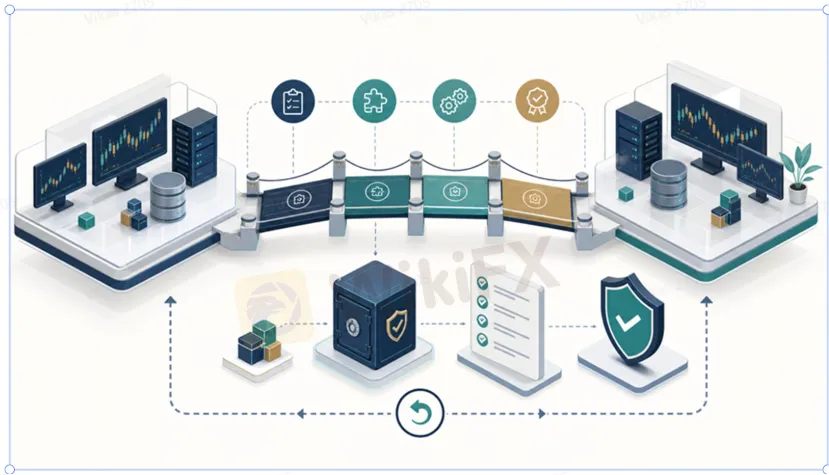
Illustration: a controlled migration, reconciliation, and rollback-ready exit plan.
The largest hidden cost in an MT4 transition is often not the data extraction itself. It is proving that the migrated information is complete and usable.
Your migration inventory should include:
- client account identifiers and account status;
- trading history, balances, adjustments, fees, and swaps;
- open orders and position-handling rules for cut-over;
- client statements and reporting archives;
- KYC status, consent records, and risk acknowledgements where applicable;
- support history, complaint records, and communication preferences;
- partner attribution and commission history;
- configuration history, admin access, and important audit events.
The goal is not to move every historical field. The goal is to preserve what clients, finance, compliance, support, and management need to operate and answer questions after the move.
The migration test that matters
Use a controlled sample. Export data from the old environment, import it into the target environment, and reconcile it against agreed totals and client-level records.
Test at least:
- a standard active client;
- a client with historic adjustments or disputes;
- a client with a partner or IB relationship;
- a dormant client;
- an account with multiple deposits or withdrawals;
- a client using automated tools or custom indicators.
Do not promise a seamless MT4 migration before these checks pass. If an old client tool cannot operate in the new environment, that is a client communication and retention cost, not a minor technical footnote.
Price the parallel run honestly
Running old and new environments in parallel is often safer than a single cut-over. It is also not free.
Parallel operation can require duplicate hosting, support coverage, reconciliations, client communications, data snapshots, and incident escalation. It may also create decision friction when systems disagree.
Budget for the following questions:
- How long is the planned parallel period?
- Which client cohort moves first, and why?
- Which reports are reconciled daily, weekly, and monthly?
- Who can pause the migration after a defect is found?
- Which client communications require approval before they are sent?
- What is the rollback point, and what data must be restored?
The cheaper plan is not always the plan with the shortest parallel run. A controlled overlap can avoid the much larger cost of a public service failure or mass support backlog.
Turn vendor quotes into an RFP comparison sheet
Do not compare proposals in separate PDFs or sales emails. Put them into one controlled comparison sheet and require every supplier to answer the same questions.
For every quoted item, record the scope, price basis, billing currency, billing frequency, assumption, contract reference, owner, and whether the item is included in the 36-month model. Mark any missing answer as not confirmed, not as zero.
Your RFP comparison should also separate these four labels:
- Included: contractually included at the quoted price.
- Optional: available, but separately priced and not required for initial launch.
- Pass-through: charged by another provider or based on external usage.
- Unconfirmed: mentioned in a demo or proposal but not yet supported by a written scope.
This simple discipline prevents a common procurement failure: treating a feature shown in a demo as an included operating service. It also gives finance and management a clean way to compare providers whose proposals use different wording.
Before selecting a provider, hold a joint review with operations, technology, finance, client support, and compliance. Each function should identify one cost that is missing, uncertain, or hard to recover after signing. Resolve those points in the commercial schedule or acceptance criteria, not in an informal email.
Contract terms can change the cost more than the platform fee
Review the agreement with technology, compliance, finance, and legal stakeholders. Focus on operational clauses as much as pricing.
Clauses to examine
| Clause | Why it affects your cost |
| Minimum term | Can turn a trial into a multi-year commitment |
| Minimum monthly commitment | Becomes expensive when client growth is slower than planned |
| Change-control pricing | Makes new symbols, integrations, or configurations hard to budget |
| Data ownership and export | Determines whether a future migration is feasible |
| Service level and exclusions | Defines the support you will actually receive during disruption |
| Incident notification | Affects your ability to communicate with clients and regulators |
| Subcontractors | Can expand the supply chain without clear oversight |
| Termination assistance | Determines the quality and cost of your exit |
The European Securities and Markets Authority has published cloud-outsourcing guidelines that highlight the governance importance of technology-provider arrangements for firms within their scope. This does not substitute for your own legal assessment, but it reinforces the need to treat cloud, data, and subcontracting clauses as procurement issues rather than technical footnotes. ESMA cloud-outsourcing guidelines.
Avoid three misleading MT4 cost comparisons
“Provider A has the lowest monthly price”
This comparison is incomplete unless both proposals include the same hosting, bridge, integration, support, change, and exit scope.
“We can migrate later”
Later is often more expensive. As client records, partner arrangements, custom tools, and manual workarounds accumulate, data and process complexity grow.
“The platform includes everything”
Ask exactly what “everything” means. It may exclude the systems that determine client experience and control: payments, KYC, reporting, liquidity connectivity, client support, and compliance processes.
A decision framework for an existing MT4 broker
Use a weighted scorecard after the cost model is complete.
| Area | Suggested weight | Decision question |
| 36-month total cost | 25% | Is the cost sustainable in low, base, and high scenarios? |
| Data and exit rights | 20% | Can we extract, reconcile, and move the data we need? |
| Integration fit | 20% | Can critical client and finance journeys work without fragile custom work? |
| Resilience and support | 15% | Are incident response, monitoring, and recovery ownership clear? |
| Client transition | 10% | Can affected clients be moved without unmanaged retention risk? |
| Commercial flexibility | 10% | Can we adapt products, volume, and providers without punitive fees? |
The scores should be based on evidence: a contract clause, a sandbox test, a data export, a reference call, or a documented workflow. Do not score sales statements as proof.
FAQs
How much does an MT4 white label cost?
There is no reliable universal price. Your model should include licence and infrastructure charges, integrations, operations, controls, migration, and exit. Ask each MT4 white label provider for a complete commercial schedule and model at least 24 to 36 months.
Is an MT4 white label platform cheaper than moving to a newer platform?
It may be cheaper in the short term, especially when client habits and existing integrations are stable. It may be more expensive over time if recurring custom work, data constraints, weak support, or limited flexibility create operational drag. Compare whole operating cases, not platform labels.
What is the biggest hidden cost in an MT4 broker solution?
For many brokers, it is integration and migration work. The cost is not just development. It also includes testing, reconciliation, training, client communications, support, and the time needed to resolve exceptions.
Can a broker switch MT4 white label provider without moving clients?
That depends on the commercial arrangement, data rights, client account design, integrations, and operational model. Treat it as a migration until you have tested the data, workflows, communications, and exit conditions.
What should an MT4 white label contract say about data?
It should specify who owns or controls the data, what can be exported, the format and frequency of exports, relevant audit information, access during transition, deletion or retention expectations, and termination-assistance costs.
Final takeaway
The right MT4 white label cost decision is not the proposal with the smallest monthly number. It is the operating model that you can afford, control, audit, support, and eventually leave.
Before signing, obtain a complete cost schedule, test the critical integrations, run a sample data export, build a migration reserve, and negotiate your exit while the vendor still wants your business.
Sources and further reading
- Financial Conduct Authority, Outsourcing and operational resilience.
- European Securities and Markets Authority, Guidelines on outsourcing to cloud service providers.
You can contact us on WhatsApp -
+852 6317 7384
Read more
SIMPLEFX Review 2026: Trading Chart Complaints Continue - What Traders Should Know
SIMPLEFX, a Saint Vincent and the Grenadines-based brokerage entity, receives complaints mostly about trading chart manipulations. Generally, while researching broker reviews, complaints usually centre on hassles concerning fund withdrawals. User complaints for this broker have come from many regions, including South Asia. This SIMPLEFX review examines these user allegations and shares its regulatory framework.
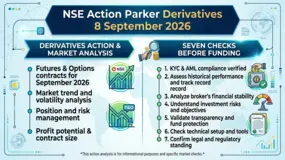
NSE Action Parker Derivatives 8 September 2026 and Seven Checks Before Funding
The NSE action Parker Derivatives 8 September 2026 is a current exchange disciplinary direction, not an expulsion notice. The National Stock Exchange page records a ₹1.5 lakh penalty and tells the member to strengthen supervision of existing Authorised Persons, stop onboarding new Authorised Persons until that work is completed, re-inspect the relevant branch or AP in the next quarter, and comply with prevailing anti-money-laundering rules. Indian clients should distinguish an Authorised Person from the broker itself. The published direction does not say that existing clients must close accounts or that trading membership has been cancelled. Before opening, funding or changing an account, verify the exact firm, website, member status, payment beneficiary and the scope of the latest direction.
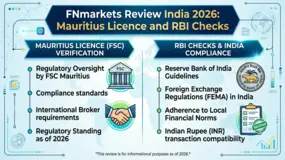
FNmarkets Review India 2026: Mauritius Licence and RBI Checks
This FNmarkets review for Indian readers starts with four verifiable facts. The Mauritius FSC public register lists FNmarkets (Mauritius) Ltd as an Investment Dealer, licensed on 12 August 2025. The broker website identifies the same entity and states licence GB25204149. However, the RBI list of authorised electronic trading platforms checked on 9 September 2026 did not show FNmarkets. The broker's help centre also sets a $50 minimum withdrawal and requires full account verification. These facts do not prove fraud, but they make FNmarkets regulation and payment checks essential before an Indian resident deposits money.
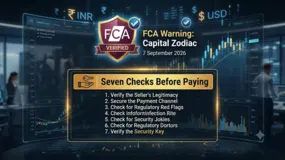
FCA Warning Capital Zodiac 7 September 2026 and Seven Checks Before Paying
The FCA named Capital Zodiac as an unauthorised clone on 7 September 2026. Check capitalzodiac.com, capitalzodiac.net and FRN 806702 before paying.
WikiFX Broker
Latest News
FNmarkets Review India 2026: Mauritius Licence and RBI Checks
WikiFXSwiss Franc steadies as Fed hike expectations offset safe-haven flows
WikiFXNSE Action Parker Derivatives 8 September 2026 and Seven Checks Before Funding
WikiFXSilver Price Forecast: XAG/USD rises to near $66.40 as US Dollar declines, US CPI in focus
WikiFXEuro rebounds against British Pound on diverging ECB-BoE interest rate paths
WikiFXIndian Rupee: Stable range with shallow gains against US Dollar – DBS
WikiFXMT4 Phase-Out Accelerates as More Forex Brokers Move to MT5
WikiFXSilver Price Forecast: Head-and-Shoulders risk builds below $67
WikiFXCrude Oil rallies into 14-week highs as US and Iran spend the week attacking tankers
WikiFXSilver Price Forecast: Rally puts head-and-shoulders pattern on ice
WikiFXRate Calc

