Money Plant FX Review: High-Risk Forex Broker Warning
Abstract:Money Plant FX is offshore, unregulated, and flagged high risk, with traders alleging zeroed balances. Check the facts before you open an account.
What Is Money Plant FX?
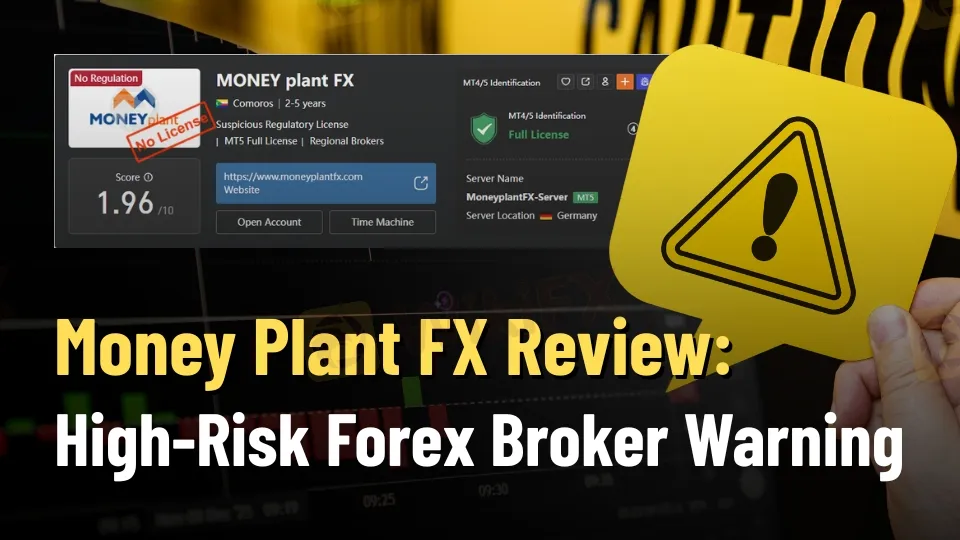
Money Plant FX is an offshore forex and CFD broker operating under the name MONEYPLANT and registered in the Comoros since 2023. The broker offers trading on MetaTrader 5 (MT5), copy trading, and a mobile trading app, promoting access to over 30 forex pairs, commodities, metals, indices, and stocks with leverage up to 1:500 and a minimum deposit of 100 USD. On its WikiFX profile, Money Plant FX is clearly marked as not regulated and classified as a high‑risk regional broker with no valid forex trading license.
Although the broker claims to hold an MT5 “Full License,” this only refers to its trading platform technology, not to any financial regulatory authorization. WikiFX explicitly states that no forex trading license has been found for Money Plant FX and warns that its operations are unlicensed, leaving clients without formal regulatory protection in the event of disputes.
Regulatory Status: Unregulated, No License, Not Authorized
Despite marketing itself as a global forex broker, Money Plant FX has no recognized forex regulation and no official license from a credible financial authority. WikiFX notes that “no forex trading license” exists for this broker and labels it as “Not regulated,” indicating that Money Plant FX operates outside the oversight of bodies that enforce client‑fund protection, capital requirements, and conduct rules.
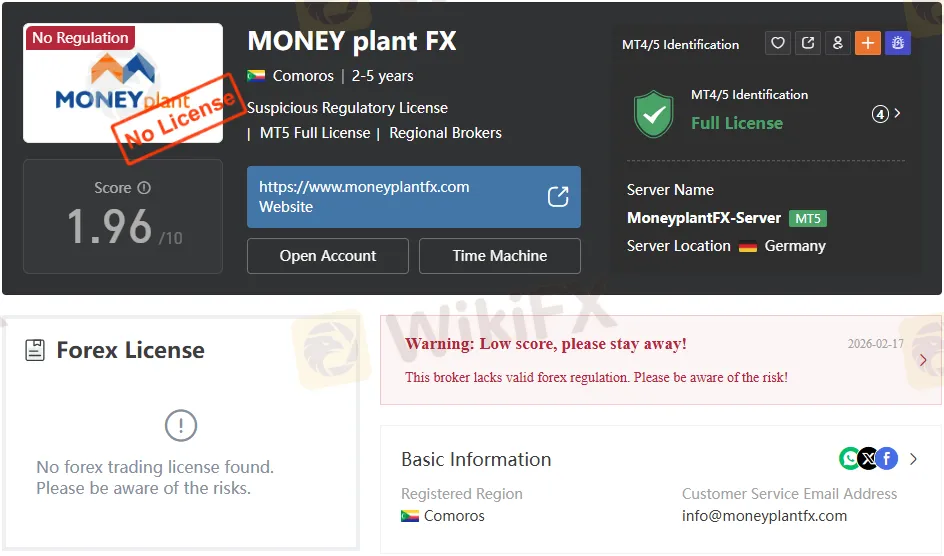
This lack of authorization is a critical red flag for anyone concerned about forex scams or a potential forex trading scam. In the event of frozen accounts, unfair pricing, or non‑payment of withdrawals, clients of an unregulated broker like Money Plant FX generally cannot rely on compensation schemes or formal ombudsman channels, which greatly increases the risk of a forex investment scam or online trading scam.
Key Trading Conditions and Why They Matter
Money Plant FX advertises a Standard account with a minimum deposit of 100 USD, spreads from 1.2 pips, and leverage up to 1:500 on MT5, alongside a free demo account for practice. It claims low or even zero commissions and markets itself as a cost‑effective forex broker, but important cost details, such as swap (overnight) fees, are not clearly disclosed, and there is no Islamic (swap‑free) account option.
High leverage up to 1:500 can quickly magnify both profits and losses, and when offered by an unregulated broker, it often becomes a tool to entice inexperienced traders into over‑exposed positions typical of forex broker scams. The combination of aggressive leverage, incomplete fee transparency, and the lack of a license heightens the risk that clients may be drawn into forex fraud or a broader online investment scam rather than a fair trading environment.
Funding, Withdrawals, and Hidden Risks
According to its WikiFX profile, Money Plant FX supports deposits and withdrawals via bank transfer, credit/debit cards, Skrill, Neteller, and other alternative payment methods, with a stated minimum deposit of 100 USD and advertised withdrawal processing within 24 hours. Deposits are often promoted as fee‑free, but withdrawal charges can be steep—up to 40 USD or 2.5% — depending on the chosen method, which can significantly erode profits, especially for smaller accounts.
These terms might appear acceptable at first glance, yet the absence of regulation and the serious user complaints described below show that the real issue is not just fees but whether withdrawals are actually honored. When a broker is unlicensed, a pattern of delayed or blocked payouts can indicate an online or investment scam rather than isolated operational problems, putting Money Plant FX squarely in the spotlight for forex and online trading scams.
Real User Complaints: Serious Scam Red Flags
One reported case describes how, after depositing funds with Money Plant FX, the client was given a demo account instead of a real trading account. The brokers own team allegedly traded on this demo account, lost the entire balance, and left the client with 0, while two withdrawal requests of 3,800 each remain pending and unpaid, which is a typical pattern seen in forex scams and exposure‑worthy forex trading scam schemes.
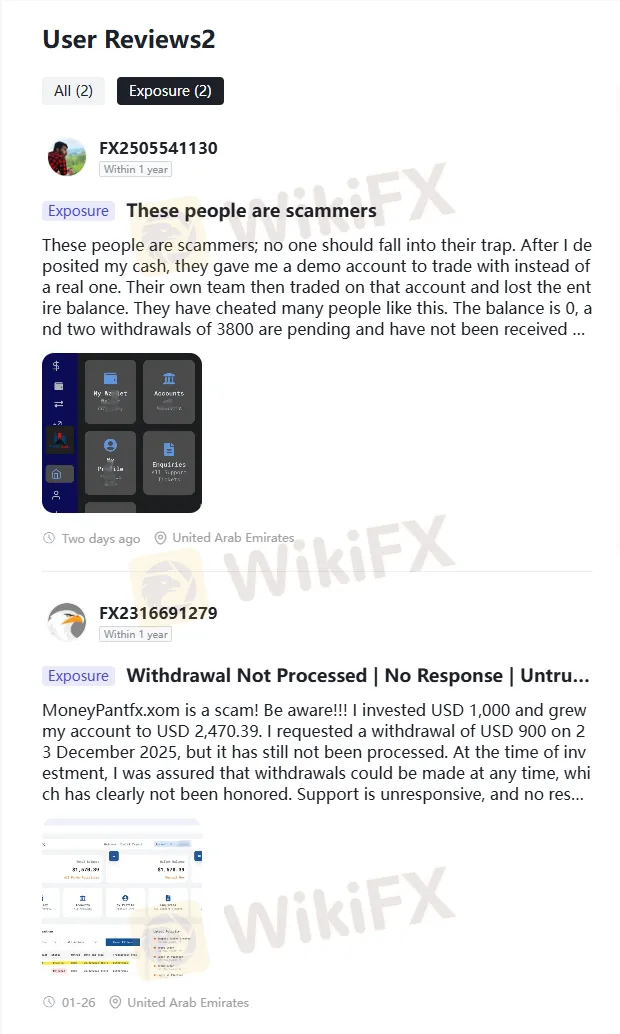
Another complaint from the United Arab Emirates states that the victim invested 1,000 USD, grew the account to 2,470.39 USD, and then requested a 900 USD withdrawal on 23 December 2025, which still has not been processed. Despite earlier assurances that withdrawals could be made at any time, the client reports that support is unresponsive, no responsible officer can be reached, and the platform shows “serious transparency and credibility issues,” all of which strongly suggest an ongoing forex investment scam or online scam rather than a trustworthy broker.
Why Money Plant FX Looks Like a High-Risk Scam
Given the unregulated status, offshore registration in Comoros, opaque fee structure, and credible user testimonies of non‑payment, Money Plant FX meets multiple warning criteria for forex fraud and online investment scam exposure. The practice of directing clients to a demo account after taking real deposits, allowing internal staff to trade until the balance reaches zero, and then failing to process withdrawals mirrors tactics used in forex and online trading scams targeting retail traders.
Furthermore, WikiFX rates Money Plant FX as a high‑risk broker, clearly noting the lack of valid supervision and warning users about the dangers of dealing with an unlicensed platform. When a broker carries such risk flags and is simultaneously collecting deposits from the public, potential clients should treat it as a scam alert and consider Money Plant FX a strong candidate for forex scams and broader investment scams rather than a safe forex trading partner.
How the WikiFX App Helps Expose Brokers Like Money Plant FX
The WikiFX App compiles regulatory data, broker profiles, and user reviews in one place, making it easier to check whether a forex broker like Money Plant FX is licensed or operating without authorization. In this case, WikiFX clearly marks Money Plant FX as “Not regulated” and “High potential risk,” providing both a structured company summary and real user comments that help traders identify a likely forex scam before sending any money.
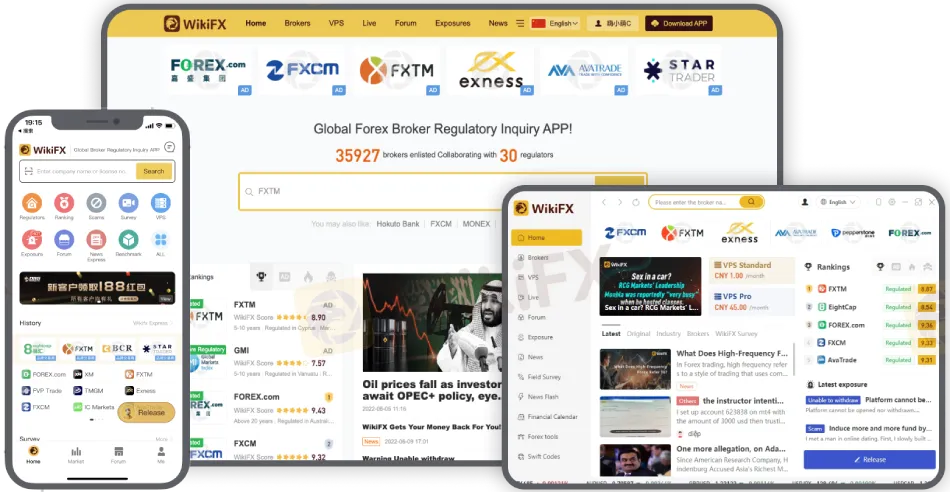
By using the WikiFX App, users can verify license numbers, review complaint histories, and compare safer, properly authorized alternatives rather than relying on a brokers marketing claims. Mentioning and using the WikiFX App as part of your due diligence process greatly reduces the chance of falling for forex broker scams, online trading scams, or any similar scams dressed up as legitimate forex investment opportunities.
What Traders Should Do Next
If you are considering opening an account with Money Plant FX, the combination of no license, offshore registration, high leverage, inconsistent fee information, and serious withdrawal complaints should be a clear warning to walk away. Prospective clients should treat this as a genuine scam alert, avoid depositing funds, and instead look for well‑regulated brokers with transparent terms and a clean record, rather than risk involvement in potential forex fraud or an online investment scam tied to Money Plant FX.
Traders who have already deposited with Money Plant FX and are experiencing blocked withdrawals should immediately document all communication, take screenshots of account history, and consider reporting the issue to local financial authorities or consumer protection bodies in their jurisdiction. Using the WikiFX App to submit reviews and read other victims‘ experiences can also help expose the broker’s practices and warn others before they become the next target="_blank" kwlink="6384064000816950219725">target of this suspected forex trading scam.


Read more

RBI's Record $136-Billion NRI Deposit Campaign: Closed Early, Windfall and Risks for Traders
The Reserve Bank of India's special FCNR (B) deposit window pulled in a record $136 billion in just 10 weeks, forcing the central bank to shut it down on August 31 – a full month early. The flood of dollars lifted India's forex reserves to a fresh peak of $740.8 billion and left the banking system awash in ₹9.7 trillion of surplus liquidity, the highest in four years. For Indian retail traders, the ripple effects on the rupee, stocks and interest rates are already visible and will persist for years.

Proxtrend LTD Review for India After Japan’s 20 June 2025 Warning
Japan’s Kanto Local Finance Bureau issued an unregistered-business warning concerning Proxtrend Ltd on 20 June 2025. The notice concerns online solicitation of over-the-counter derivatives. This Proxtrend LTD review, checked on 11 September 2026, examines that dated warning alongside the broker’s corporate disclosures and the separate rules relevant to residents of India. The warning is not a new September announcement or an Indian regulatory finding.

EASY TRADING ONLINE Review 2026: Withdrawal & Account Block Complaints
Did your funds fail to reach your account despite being approved by EASY TRADING ONLINE, an Australia-based brokerage entity? Have you been subject to months of withdrawal delays despite being compliant with norms? Did your trading account suddenly become invalid upon a withdrawal request? All of these complaints have come up on broker review platforms such as WikiFX. This EASY TRADING ONLINE review studies multiple user complaints while also updating its existing regulatory status.

SEBI Commodity Position Limits 9 September 2026: 2% Caps and New Penalties Explained
SEBI changed India’s commodity derivatives position-limit framework on 9 September 2026, and the circular took effect immediately. The new SEBI commodity position limits double the client-level caps for agricultural commodities to 2% of deliverable supply for Broad commodities, 1% for Narrow commodities and 0.5% for sensitive commodities. SEBI also capped the daily monetary penalty for a client-level breach: ₹200,000 where the violation exceeds 2% of the prescribed limit, and ₹10,000 where it is up to 2%. Traders should not read the change as permission to ignore exchange risk controls; excess positions can still be squared off.
WikiFX Broker
Latest News
Forex Brokers Explained: The Battle of 'A Book' and 'B Book'
 WikiFX
Canadian Dollar firms as US Dollar loses momentum, Oil prices extend rally
WikiFXGold holds steady above $4,400 as traders await US inflation data
WikiFXSilver Forecast: XAG/USD rebound capped as bearish bias holds
WikiFXUSDJPY: 86% of Retail Traders Are Long
WikiFXNew Zealand Dollar edges higher to near 0.5850 ahead of US PPI inflation data
WikiFX11.09.26 Daily Forecast
WikiFXWTI Oil nears $100 as Middle East tensions keep supply concerns elevated
WikiFXCMC Markets Extends US Share Trading Into Overnight Session
WikiFXSEBI Commodity Position Limits 9 September 2026: 2% Caps and New Penalties Explained
WikiFXRate Calc
