JP Markets Regulation Review: Legit or Fraud?
Abstract:JP Markets SA (Pty) Ltd holds FSCA License No.46855. Learn about its regulation, derivatives trading license, and MT4/MT5 platform compliance.
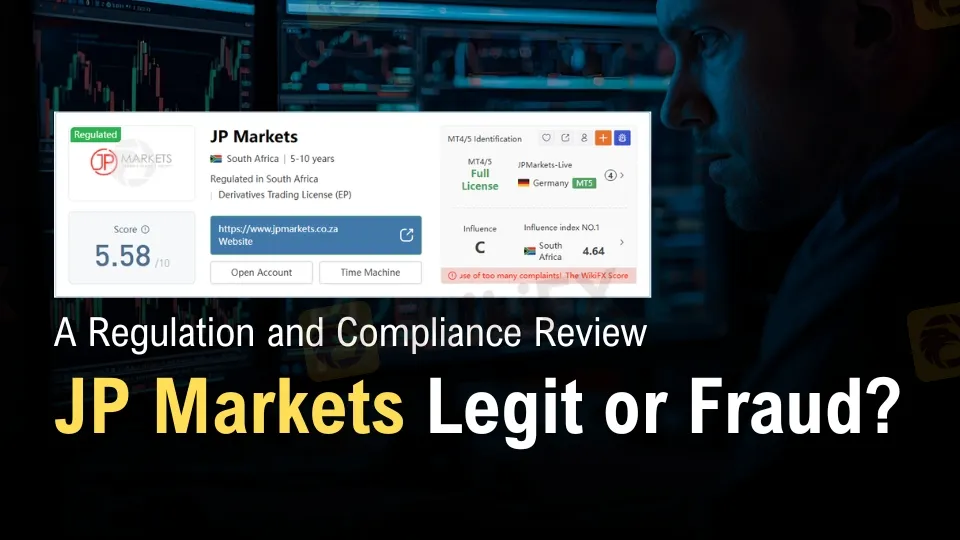
JP Markets Review: Regulatory Standing
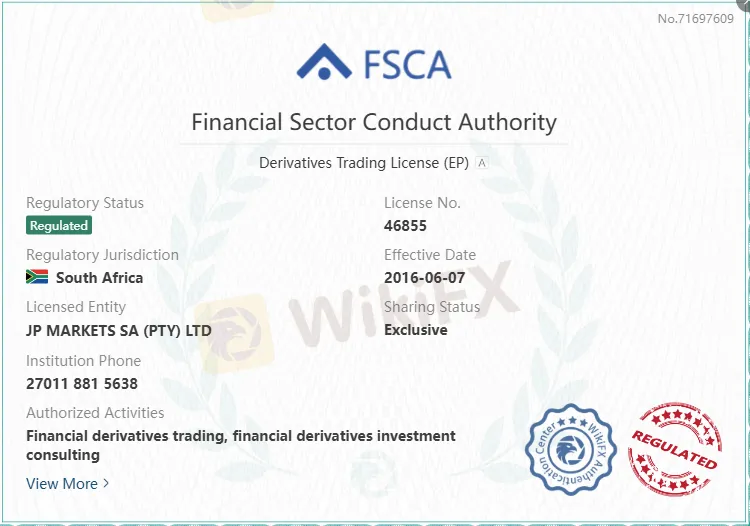
JP Markets SA (Pty) Ltd is a South African broker founded in 2016. It operates under the Financial Sector Conduct Authority (FSCA) with license number 46855, authorizing it to provide financial derivatives trading and investment consulting. The firm holds a Derivatives Trading License (EP) and is registered exclusively in South Africa.

The brokers regulatory status is marked as “Exceeded” in some references, which suggests that while the license remains valid, certain compliance thresholds may have been surpassed. This nuance is important for traders evaluating whether JP Markets is fully aligned with FSCA oversight.
Domain and Licensing Transparency
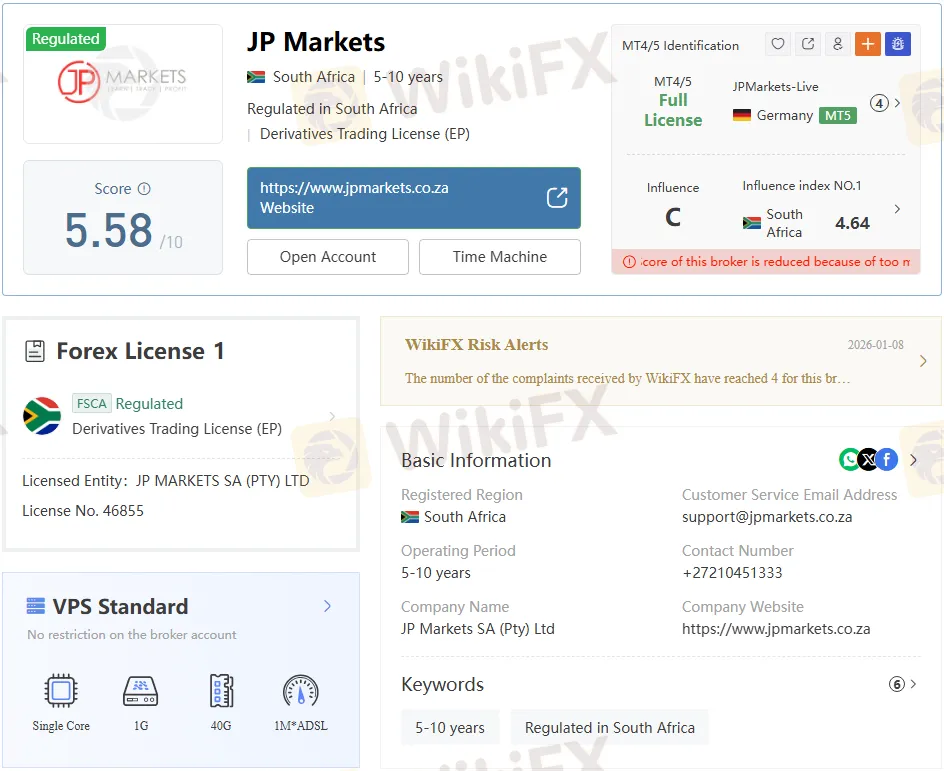
- Company Website: jpmarkets.co.za
- Registered Entity: JP Markets SA (Pty) Ltd
- Effective Date of License: 7 June 2016
- Regulatory Jurisdiction: South Africa
- Contact Numbers: +27 21 045 1333 / +27 11 881 5638
- Customer Service Email: support@jpmarkets.co.za
- Office Address: No.4 Century Falls Road, Century City, Cape Town, 7441
This transparency in licensing and contact details is a positive indicator compared to offshore brokers that often obscure their registration data.
Trading Platforms and Technology
JP Markets provides access to MetaTrader 4 (MT4) and MetaTrader 5 (MT5).
- MT5: Full license, available on PC, web, and mobile. Suitable for experienced traders.
- MT4: Supported, with one server, positioned as beginner-friendly.
- Execution Speed: Average of 256.75 ms.
- Server Location: South Africa, with a ping of around 163 ms.
The broker emphasizes MT5 as its flagship platform, offering advanced technical and fundamental analysis tools.
JP Markets Instruments
JP Markets offers a broad range of tradable instruments:
- Forex
- Stocks
- Indices
- Commodities
- Cryptocurrencies
- Bonds
- Options
- ETFs
This multi-asset coverage is wider than many regional competitors, positioning JP Markets as a full-service broker within South Africas retail trading landscape.
Account Types and Features
JP Markets provides several account structures tailored to different trading styles:
| Account Type | Minimum Deposit | Leverage | Spread | Commission | Notes |
| VIP | R5,000 | Up to 1:500 | From 0.5 pips | $3 | Tight spreads, professional conditions |
| JPM Micro 300 | R100 | Up to 1:500 | From 3 pips | None | 300% bonus, higher spreads |
| Premium | R100 | Up to 1:2000 | From 1 pip | None | High leverage, no commission |
| Islamic | R100 | Up to 1:500 | From 1.5 pips | None | Swap-free, Shariah compliant |
| Zero Stop-Out | R100 | Up to 1:500 | From 3 pips | None | Stop-out at 0%, riskier conditions |
| JPM Bonus 300 | R100 | Up to 1:500 | From 2 pips | None | 300% deposit bonus |
| 25% Drawdown Bonus | R100 | Up to 1:500 | From 2 pips | None | Cushion against drawdowns |
The Premium account stands out with leverage up to 1:2000, far higher than most regulated brokers. While attractive to aggressive traders, such leverage significantly increases risk.
Fees and Spreads
- VIP Account: Spreads from 0.5 pips, $3 commission.
- Premium Account: Spreads from 1 pip, no commission.
- Islamic Account: Spreads from 1.5 pips, swap-free.
- Zero Stop-Out: Spreads from 3 pips.
- JPM Bonus 300: Spreads from 2 pips.
Compared to competitors, JP Markets offers competitive spreads on VIP accounts but less favorable conditions on bonus-linked accounts.
Deposit and Withdrawal Options
JP Markets supports payments through:
- Capitec Pay
- OZOW
- Paystack
- Skrill
- Alphapo
However, the broker does not disclose processing times or fees, which may concern traders seeking clarity on transaction costs. Competitors often provide detailed timelines and fee structures, giving them an edge in transparency.
Customer Support and Accessibility
- Support Channels: Live chat, contact form, email, phone.
- Availability: 24/5.
- Social Media Presence: Facebook, X (Twitter), Instagram, LinkedIn, WhatsApp, YouTube, TikTok.
- Regional Restrictions: Services limited to South Africa, Namibia, Swaziland, and Lesotho.
This regional focus narrows JP Markets global reach but strengthens its positioning as a domestic broker.
Pros and Cons
Pros
- FSCA-regulated with license number 46855
- MT5 platform with full license
- Wide range of instruments including forex, stocks, and commodities
- Multiple account types including Islamic account
- Minimum deposit as low as R100
- Strong local presence and transparency in contact details
Cons
- Regulatory status marked as “Exceeded”
- Limited regional availability
- Lack of detailed payment processing information
- Higher spreads on bonus accounts
- Limited global competitiveness compared to international brokers
Competitor Context
Compared with larger global brokers, JP Markets offers higher leverage (up to 1:2000) but less international coverage. Competitors such as IG or Saxo Bank provide broader regulatory footprints across multiple jurisdictions, while JP Markets remains confined to South Africa and neighboring regions.
For traders seeking ultra-high leverage and localized support, JP Markets may be appealing. For those prioritizing global access and multi-jurisdictional regulation, competitors may offer stronger safeguards.
Bottom Line
JP Markets SA (Pty) Ltd is a licensed FSCA broker with a derivatives trading license and a clear regulatory footprint in South Africa. Its offering includes MT4/MT5 platforms, multiple account types, and leverage options up to 1:2000.
While the broker demonstrates legitimacy through its FSCA license and transparent contact details, traders should weigh the risks of high leverage and the limitations of regional restrictions. The “Exceeded” regulatory status also warrants careful consideration.
Verdict: JP Markets is legitimately regulated but best suited for traders comfortable with high leverage and operating within Southern Africa. Those seeking broader international protections may find stronger alternatives elsewhere.


Read more

Pepperstone Review 2026: Massive Deposit & Withdrawal Complaints Against This Regulated Broker
Have you experienced issues with Pepperstone deposit & withdrawal processing? From your experience, do you feel that the Australia-based forex broker causes losses to its clients? Did the brokerage entity freeze your account and give you a margin call? All these trading allegations have been rampant on broker review platforms such as WikiFX. This Pepperstone review article takes a close look at the user complaints, especially in 2026. Additionally, we have given an overview of the regulatory framework under which the brokerage entity operates.

Wundersys vs tradgrip: Two Offshore Newcomers Go Head to Head — and Neither Brings Home a Trophy
Some broker comparisons end with a confident "go with this one." This is not one of them — and that honesty is exactly what makes it worth reading. Wundersys and tradgrip are two young, offshore-registered brokers that keep popping up in front of beginner traders, often through aggressive online marketing. Both promise the usual buffet: tight spreads, generous leverage, multiple account tiers. And both, according to WikiFX, sit near the very bottom of the safety scale. So instead of crowning a champion, this comparison is really about something more useful: learning to read the warning signs, understanding the small differences that still matter, and knowing why "the better of two risky options" is still a conversation about risk.
The 6 Lowest-Commission Forex Brokers South Asian Traders Are Flocking To in 2026
If you trade forex from India, Pakistan, Bangladesh, Sri Lanka, or Nepal, you already know the quiet truth that eats into every trader's results: it is not just the market that decides whether you profit — it is the cost of getting in and out of each trade. Shave a couple of dollars off your commission on every lot, multiply it across hundreds of trades a year, and you are looking at the difference between a strategy that works and one that bleeds out slowly. South Asian traders are some of the most cost-conscious in the world, and rightly so. So we pulled the data on the brokers most often recommended for the region, cross-checked every name on WikiFX, and ranked them by the one number that matters most here: what they actually charge you to trade. Before the list, one quick lesson that will make this whole ranking click.

XPO Fund Wants $10,000 Before You Trade a Single Real Dollar — Read This Stunning Revelation
If you have spent even a week inside trading communities lately, you already know the pitch by heart. Pass a quick "challenge," get handed a funded account worth tens of thousands of dollars, and keep up to 80% of everything you make. No risking your own savings, no slow grind of building capital from scratch — just skill, a small fee, and a fast track to the big leagues. It is the exact dream every new trader is secretly chasing, and an entire industry has sprung up to sell it. XPO Fund is one of the louder voices selling that story right now. Its website is slick, its plans sound generous, and its marketing leans hard on words like "industry's lowest fee" and "fast payouts." But before you reach for your card, there is one number sitting quietly on this firm's profile — a number it would rather you scroll past — that every experienced trader would beg you to look at first. And no, it is not the profit split. Let's pull XPO Fund apart piece by piece: what it actually is, who is real
WikiFX Broker
Latest News
XPO Fund Wants $10,000 Before You Trade a Single Real Dollar — Read This Stunning Revelation
 WikiFX
Why Sunk Costs Trap Traders in Losing Positions
WikiFXHidden Traps Built Into Your First Forex Trading Plan
WikiFXIFA Review: KYC Withdrawal Blockade Meets an Unauthorized Broker Warning
WikiFXEasyEquities Review 2026: Should You Trade with This Broker?
WikiFXSageFX Review 2026: Should You Trade with This Broker?
WikiFXQuotex Review 2026: Blocked Withdrawals and Regulatory Warnings
WikiFXBalancing Chart Volatility With Account Limits in Stop Loss Placement
WikiFXHTFX Review 2026: Withdrawal Complaints, Offshore Regulation, and Account Access Risks
WikiFXCFI Review 2026: Should You Trade with This Broker?
WikiFXRate Calc

