TotalFX Regulation Review: Compliance and Trading Safety
Abstract:TotalFX review reveals FSCA oversight with license No. 51105, proving compliance and secure trading safety across forex, crypto, and CFDs.
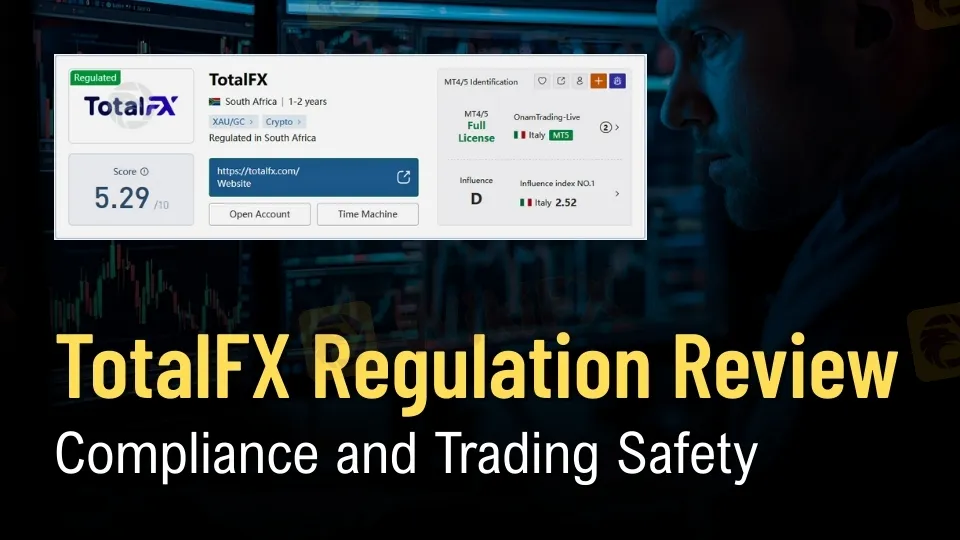
FSCA Oversight and Licensing Transparency
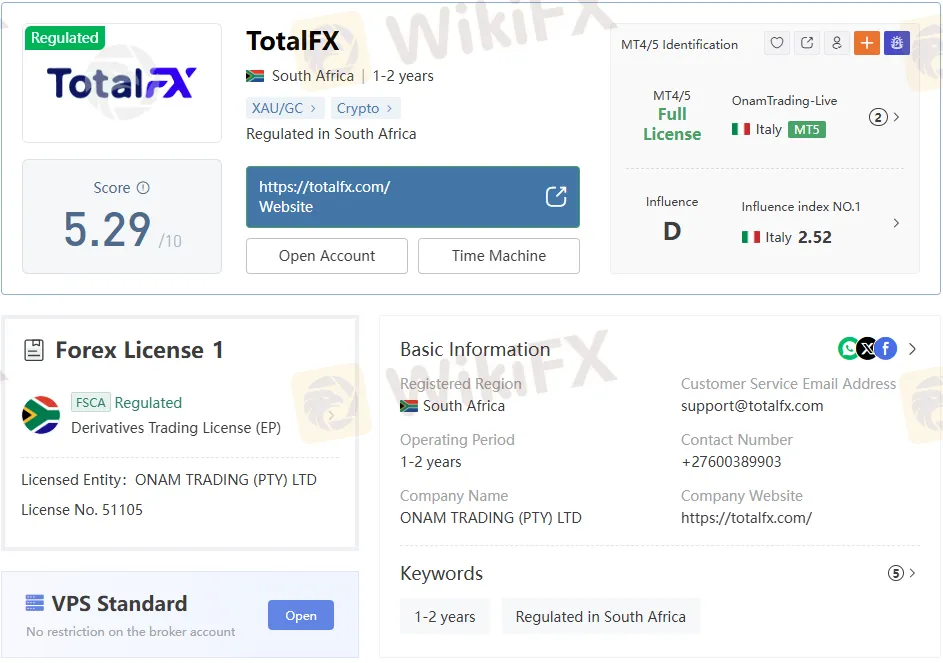
TotalFX operates under the regulatory supervision of the Financial Sector Conduct Authority (FSCA) in South Africa. The brokers license, No. 51105, is held by ONAM Trading (Pty) Ltd, with authorization granted on 10 February 2021. This license covers a wide range of financial activities, including derivatives trading, securities investment consulting, bond trading, and pension-related financial products.
The FSCA‘s involvement provides a layer of compliance assurance. Unlike offshore brokers with vague oversight, TotalFX’s South African registration offers traders a clear jurisdictional framework. This regulatory standing is a critical factor in evaluating trading safety, especially in a market where unregulated entities often pose risks.

Domain Registration and Corporate Background
The brokers official domain, totalfx.com, was registered on 30 March 2000 and is valid until 30 March 2032. The domain is hosted via Cloudflare name servers, with its status marked as “client transfer prohibited,” signaling protection against unauthorized transfers.
The company behind the broker, ONAM Trading (Pty) Ltd, has been operating for 1–2 years under the TotalFX brand. While the corporate entity is relatively new, the domains long-standing registration suggests continuity and brand stability.
Trading Instruments and Market Coverage
TotalFX provides access to a broad spectrum of instruments:
- Forex (over 60 currency pair CFDs)
- Shares
- Indices
- Cryptocurrencies
- Metals
- Energies
- ETFs
- Soft commodities
- Bonds
- Options
This multi-asset offering positions TotalFX competitively against brokers that limit clients to forex or equities. The inclusion of cryptocurrencies and ETFs reflects an effort to align with modern trading demands, while traditional instruments such as bonds and commodities cater to conservative investors.
Account Types and Fee Structures
TotalFX offers two account types:
| Account Type | Minimum Deposit | Spread | Commission | Platforms |
| Zero | $0 | From 0.6 pips | $0 | MT5 & cTrader |
| Raw | $0 | From 0.0 pips | $2.75 per side | MT5 & cTrader |
Both accounts feature no minimum deposit requirement and leverage up to 1:1000. The Zero account appeals to traders seeking commission-free trading, while the Raw account provides institutional-style spreads with a transparent commission structure.
Compared to competitors, the leverage offered is significantly higher. While this can amplify profits, it also increases risk exposure, making risk management essential.
Platforms: MT5, MT4, and cTrader
TotalFX supports three major platforms:
- MetaTrader 5 (MT5): Advanced charting, automated trading, and copy trading.
- MetaTrader 4 (MT4): Simplified interface, suitable for beginners.
- cTrader: Professional-grade execution with desktop, web, and mobile compatibility.
The availability of all three platforms is a notable advantage. Many brokers restrict clients to MT4 or MT5, but TotalFXs inclusion of cTrader broadens its appeal to experienced traders seeking alternative execution environments.
Pros and Cons of TotalFX
Pros:
- Regulated by FSCA (License No. 51105).
- Wide range of trading instruments, including crypto and ETFs.
- MT5, MT4, and cTrader platforms supported.
- No minimum deposit requirement.
- Copy trading functionality is available.
Cons:
- Payment methods remain unclear.
- Regulatory scope noted as “exceeded regulation,” raising questions about cross-border permissions.
- Limited operating history under ONAM Trading (Pty) Ltd despite long-standing domain registration.
Competitor Context
When compared to regional competitors, TotalFX‘s leverage of 1:1000 stands out. Many FSCA-regulated brokers cap leverage at lower levels to mitigate risk. Additionally, TotalFX’s dual account structure mirrors offerings from global brokers but with more aggressive spreads and commissions.
However, the brokers WikiFX score of 5.29/10 indicates mixed market perception. Competitors with longer operating histories and clearer payment transparency often score higher, suggesting TotalFX still has ground to cover in building trader confidence.
Bottom Line: Is TotalFX Safe?
This TotalFX Review highlights a broker that combines regulatory compliance under FSCA with a diverse product offering and competitive trading conditions. The presence of license No. 51105 provides legitimacy, while the inclusion of MT5, MT4, and cTrader ensures platform flexibility.
Yet, traders should weigh the brokers relatively short operational history and lack of clarity on funding methods against its regulatory standing. For those seeking high leverage and multi-asset exposure under FSCA oversight, TotalFX presents a viable option.
Verdict: TotalFX delivers compliance-backed trading safety with expansive market access, but transparency in payment systems and longer operational history will be key to strengthening its reputation.


Read more

Pay a 17% Tax First, Then You Can Withdraw" — How Nixse Allegedly Held One Trader's €25,000 Hostage
Imagine logging into your trading account and seeing a balance of €25,860. You started with €12,450, you traded carefully, and now you want to pull out a modest €5,000 — money that, on paper, is sitting right there waiting for you. Then the message arrives: before you can withdraw a single euro, you must first pay a "stock market flat tax" of 17% on all your earnings. That is more than €4,400, demanded upfront, with no invoice, no official document, no legal basis whatsoever. You refuse. Your account is promptly frozen. That is not a hypothetical. According to a complaint filed on WikiFX, it is exactly what one French trader says happened to them with Nixse — and it is a textbook example of one of the oldest, ugliest tricks in the online trading world. Let's unpack what Nixse is, what users are reporting, and why the warning signs around this broker are flashing bright red.
TotalFX Dangles 1:1000 Leverage and a $0 Minimum Deposit - But Is Its Regulation Strong?
On the surface, TotalFX reads like a brand-new trader's wish list come to life. No minimum deposit, so you can start with almost nothing. Leverage cranked all the way up to a jaw-dropping 1:1000. Spreads advertised from 0.0 pips. Both MetaTrader 5 and cTrader available. Copy trading baked right in. Tick, tick, tick, tick. If you were building a checklist of "things that make a broker look beginner-friendly," TotalFX would seem to hit nearly every box. But how strong is its regulatory background? Let's find out!
Octa vs XTB — The Battle Of Two Very Different Broker Philosophies
Octa vs XTB Showdown: One Is Banned By The RBI, The Other Has 24 Years Of Stock-Market Pedigree — Which Should Indian Traders Actually Trust In 2026? If you are an Indian trader who has done even a casual Google search for forex brokers, two names will have crossed your screen — Octa (formerly OctaFX) and XTB. Both are widely advertised, both have massive global followings, and both claim to offer competitive trading conditions for retail traders. But these two brokers could not be more different in their philosophy, regulation, and legal standing in India. Octa is a mobile-first, high-leverage, beginner-friendly offshore broker that has rapidly grown across emerging markets — including, controversially, India. XTB is a 24-year-old publicly-listed European broker with deep Tier-1 regulation that has specifically chosen NOT to accept Indian clients in 2026. Yes, you read that right. XTB does not accept Indian residents. And Octa, the one that does serve Indian residents, has been adde
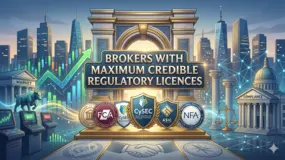
Brokers With Maximum Credible Regulatory Licences
Walk into any forex marketing pitch in India in 2026 and the first claim you will hear is some variation of "we are regulated by multiple international authorities". The implication is obvious — multiple regulators equals safer brokers. But after WikiFX has documented thousands of complaint cases from Indian and other South Asian traders, one inconvenient truth has become impossible to ignore: Not all regulatory licences are equal. Not even close. A broker can claim "regulated by 5 authorities" — and if those 5 authorities are all offshore-tier (MISA, Vanuatu, Seychelles, Saint Lucia, Comoros), it offers approximately the same protection as no regulation at all. Meanwhile, a single FCA or ASIC licence carries more practical investor protection than a dozen offshore registrations stacked together. This is the WikiFX 2026 ranking of forex brokers by genuine regulatory credibility — measured not by quantity of licences, but by the strength and enforcement weight of the regulators behind
WikiFX Broker
Latest News
Trading.com Secures MiCA Licence in Cyprus as Crypto Access Becomes Part of Its EU Strategy
 WikiFX
BONUS Review 2025: Is This Forex Broker Safe?
WikiFXThe Hidden Risks of Margin Calls and How to Trade Trends Safely
WikiFXLONG ASIA Review 2026: Withdrawal Complaints and Unverified Regulation
WikiFXT4Trade Review 2026: Official Warnings and Withdrawal Risks
WikiFXPay a 17% Tax First, Then You Can Withdraw" — How Nixse Allegedly Held One Trader's €25,000 Hostage
WikiFXTotalFX Dangles 1:1000 Leverage and a $0 Minimum Deposit - But Is Its Regulation Strong?
WikiFXBrokers With Maximum Credible Regulatory Licences
WikiFXDeriv Review 2025: Is This Forex Broker Safe?
WikiFXManual vs. Mechanical Trading: Turning Market Feel Into Automated Rules on MT5
WikiFXRate Calc

