KRX
Abstract:KRX, founded in 2005 and headquartered in Korea, operates as an unregulated broker, listing various financial products and services such as stocks, bonds, REPO bonds, ETPs, derivatives, and commodities. While KRX offers a wide range of trading options, its lack of regulation raises concerns about the safety and security of funds. Customer support is provided through email, and educational resources include market news updates and an Information Center. However, traders should be aware of the risks involved in online trading and verify information directly with KRX before making decisions.
| KRX | Basic Information |
| Company Name | KRX |
| Founded | 2005 |
| Headquarters | KRX |
| Regulations | Not regulated |
| Products and Services | Stocks, bonds (including treasury bonds, REPO bonds, general bonds), ETPs (ETFs, ETNs, ELWs), derivatives (underlying assets: stock price indices, individual stocks, ETFs, treasury bonds), other products (e.g., petroleum, gold, emissions) |
| Fees | Listing fees vary based on individual contracts; low listing fees and annual dues compared to other exchanges |
| Customer Support | Email support: kospilisting.global@krx.co.kr (KOSPI listings), kosdaq.tech.global@krx.co.kr (KOSDAQ technical support) |
| Education Resources | Market news updates, Information Center (publications, Korea Investment Guide) |
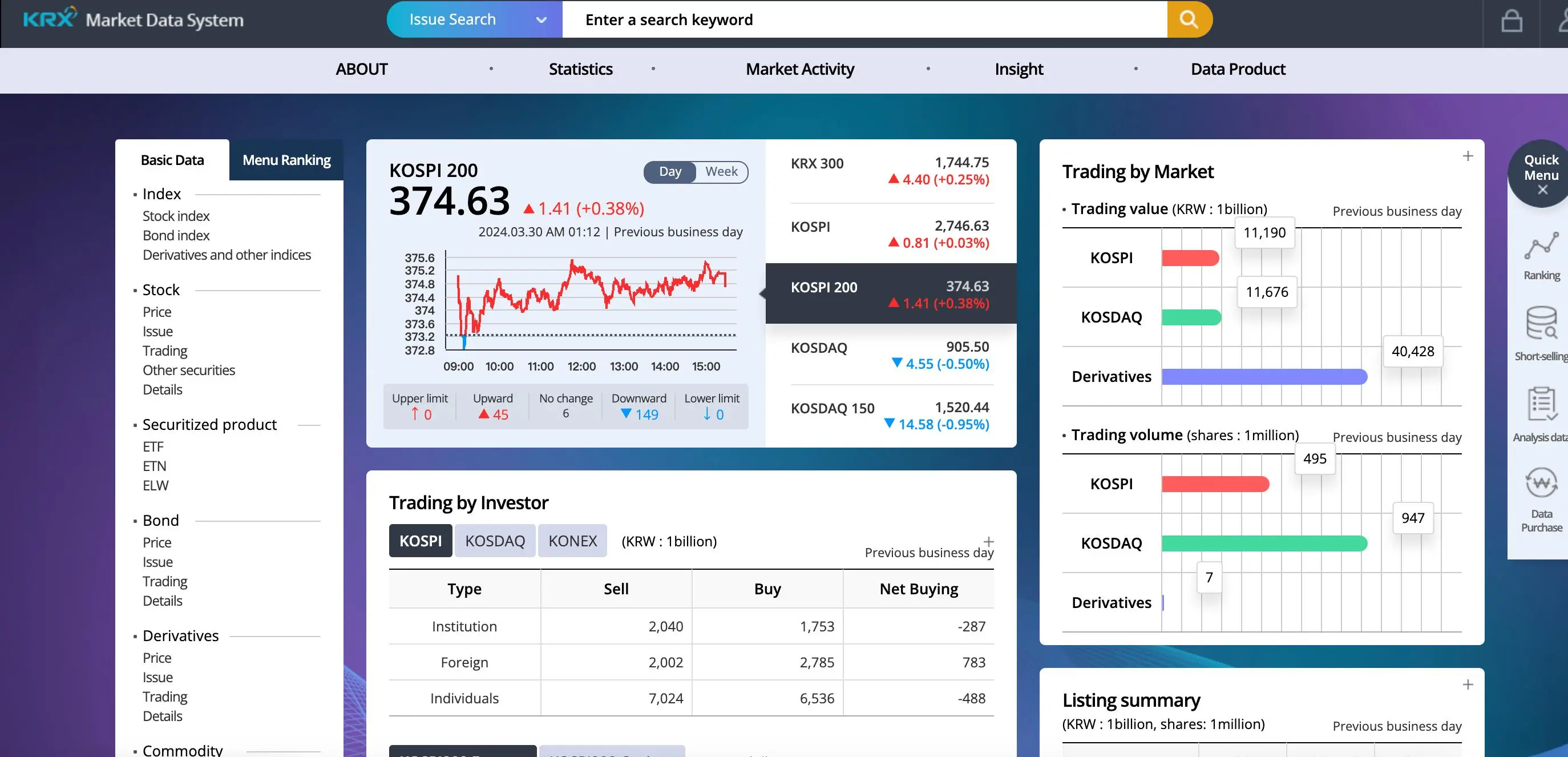
| Trading Tools | KRX Market Data System provides statistics, market activity, insights, and data products for trading |
Overview of KRX
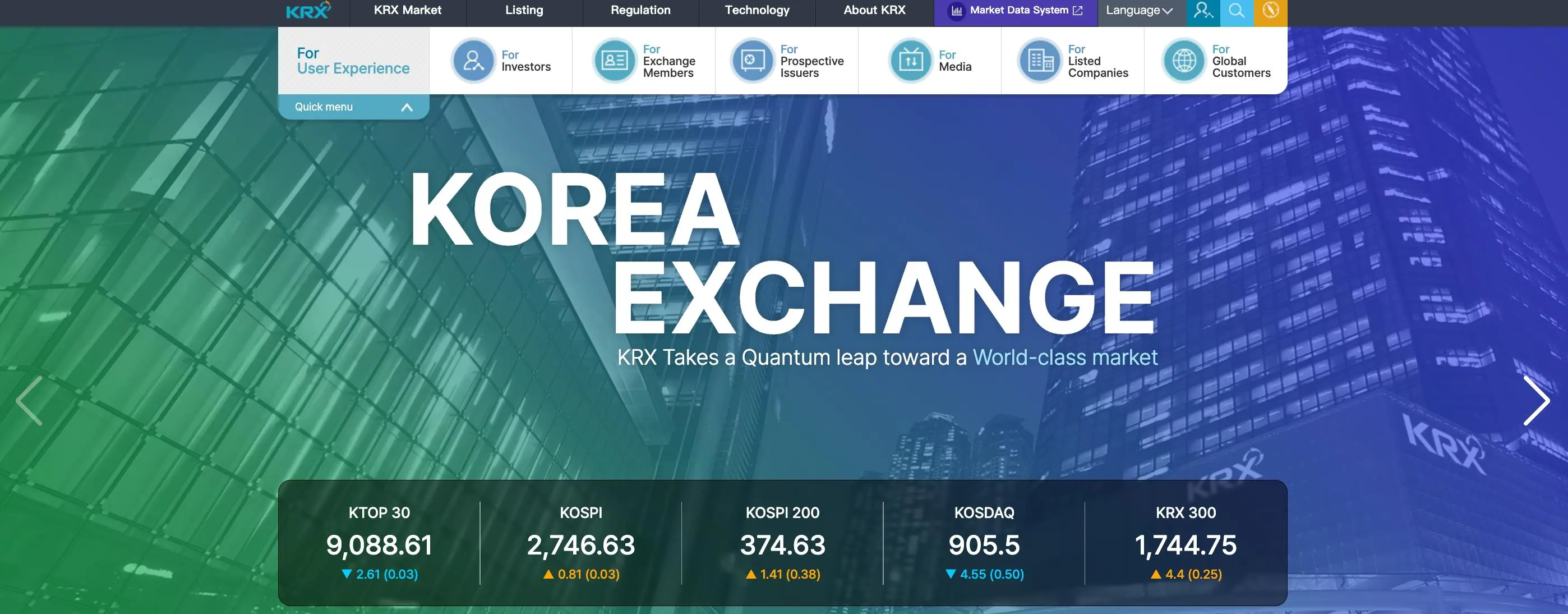
Korea Exchange (KRX), founded in 2005 and headquartered in Seoul, South Korea, is a major financial market operator. It serves as the primary exchange for trading various financial instruments, including stocks, bonds, ETPs (Exchange-Traded Products), and derivatives. KRX operates several markets, including the KOSPI, KOSDAQ, and KONEX. With a diverse range of products and services, KRX provides investors with access to a well-balanced and liquid market, attracting a wide range of investors. However, it's important to note that KRX is not regulated, which may raise concerns about the safety and security of trading on its platform.
Is KRX Legit?
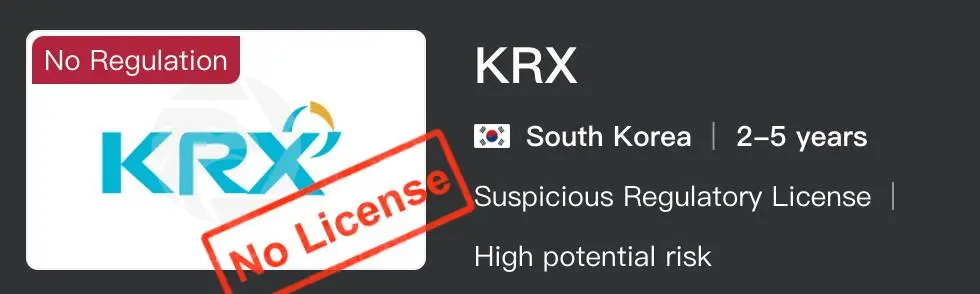
KRX is not regulated by any recognized financial regulatory authority. As an unregulated broker, it operates without oversight from regulatory bodies that are responsible for ensuring compliance with industry standards and protecting the interests of traders. This lack of regulation raises concerns about the safety and security of funds, as well as the transparency of the broker's business practices.
Pros and Cons
KRX offers a wide range of financial products and services, including stocks, bonds, ETPs, and derivatives, providing investors with diverse investment opportunities. The exchange is known for its well-balanced investor base and product diversity, making it a popular choice among traders. However, one major drawback is that KRX is not regulated by any recognized financial regulatory authority. This lack of regulation raises concerns about the safety and security of trading on the exchange, as there is no oversight of its activities. Additionally, while KRX imposes low listing fees and annual dues on listed companies, the costs for underwriting can vary significantly depending on individual contracts, potentially leading to higher expenses for companies seeking to list on the exchange.
| Pros | Cons |
|
|
|
|
|
|
Products and Services
On the KRX markets, stocks, bonds, including treasury bonds, REPO bonds, general bonds, etc. and REPO bonds, ETPs, such as ETFs, ETNs, and ELWs, are listed. Derivatives products of which underlying assets are stock price indices, such as KOSPI200 and KOSDAQ150, V-KOSPI200, individual stocks, ETFs, treasury bonds, etc., and other products, such as petroleum, gold, emissions, etc. are traded as well.

Here is a comparison table of trading instruments offered by different brokers:
| Broker | Forex | Commodities | Crypto | CFD | Indices | Stock | ETF | Options |
| KRX | No | Yes | No | No | Yes | Yes | Yes | No |
| RoboForex | Yes | Yes | Yes | Yes | Yes | Yes | Yes | No |
| IC Markets | Yes | Yes | Yes | Yes | Yes | Yes | No | No |
| Exness | Yes | Yes | Yes | Yes | Yes | Yes | No | No |
How to Open an Account
To open an account on KRX, follow these steps:
1. Register with the Financial Supervisory Service: Foreign investors need to register with the Financial Supervisory Service to trade in the Korean markets.
2. Sign a contract with a securities firm: After registration, sign a contract with a securities firm to start trading.
3. Trade Korea-related ETFs: Alternatively, investors can trade Korea-related ETFs listed on overseas markets such as Hong Kong, US, France, Ireland markets, etc.
4. Find detailed procedures: For detailed procedures and tradable ETFs, visit the Investment Process menu on KRX's website.

Fees
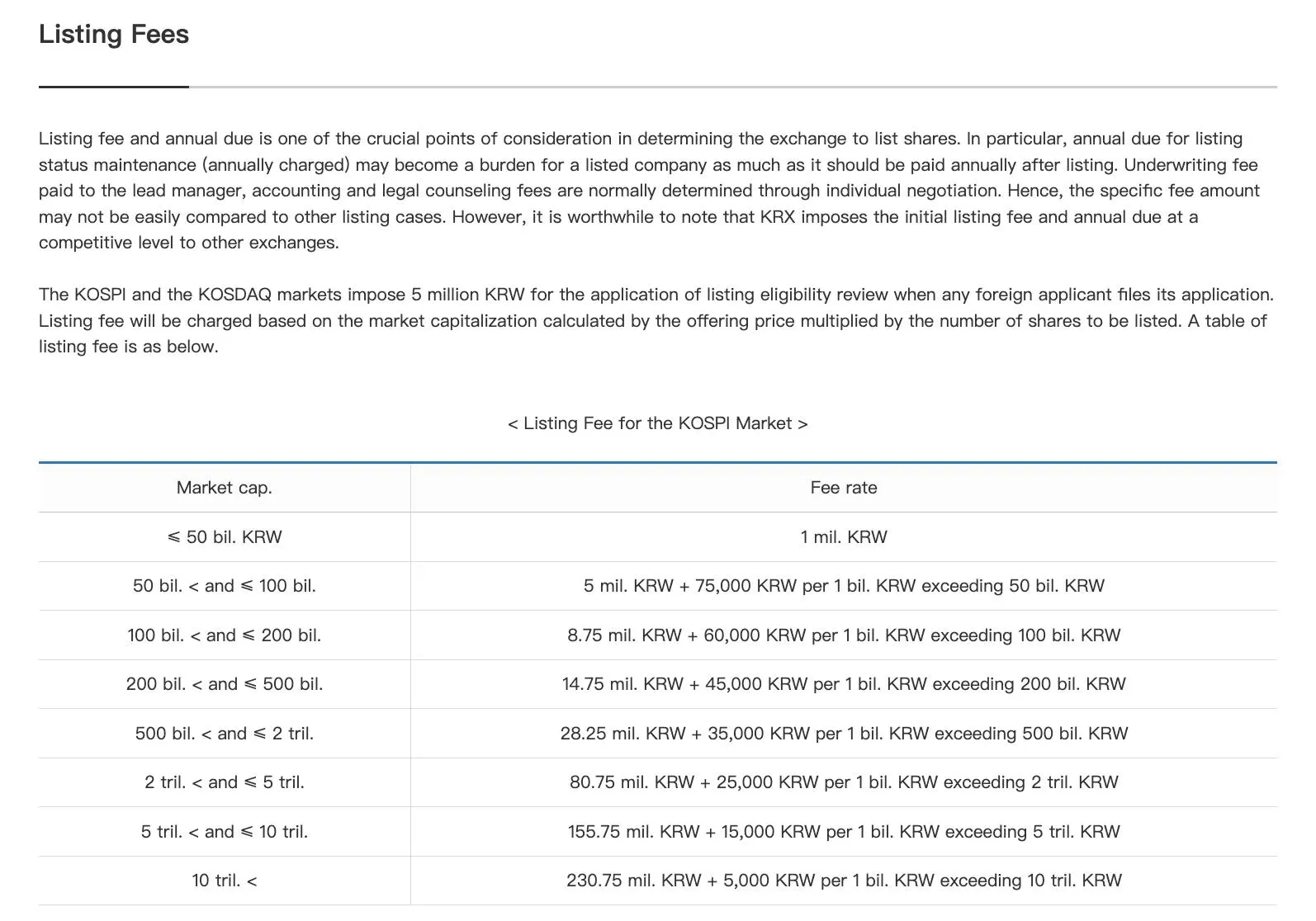
Since costs for underwriting, such as costs for lead managing, accounting, legal consulting, etc. are determined by individual contracts, listing fees can vary case by case. Additionally, KRX imposes on listed companies very low listing fees and annual due at a much lower level than any other exchanges. You can find such costs on the KRX website (global.krx.co.kr -> Listing -> Cost & Disclosure).
Customer Support
KRX provides customer support through email. For KOSPI listings, the contact email is kospilisting.global@krx.co.kr, and for KOSDAQ technical support, the email is kosdaq.tech.global@krx.co.kr.
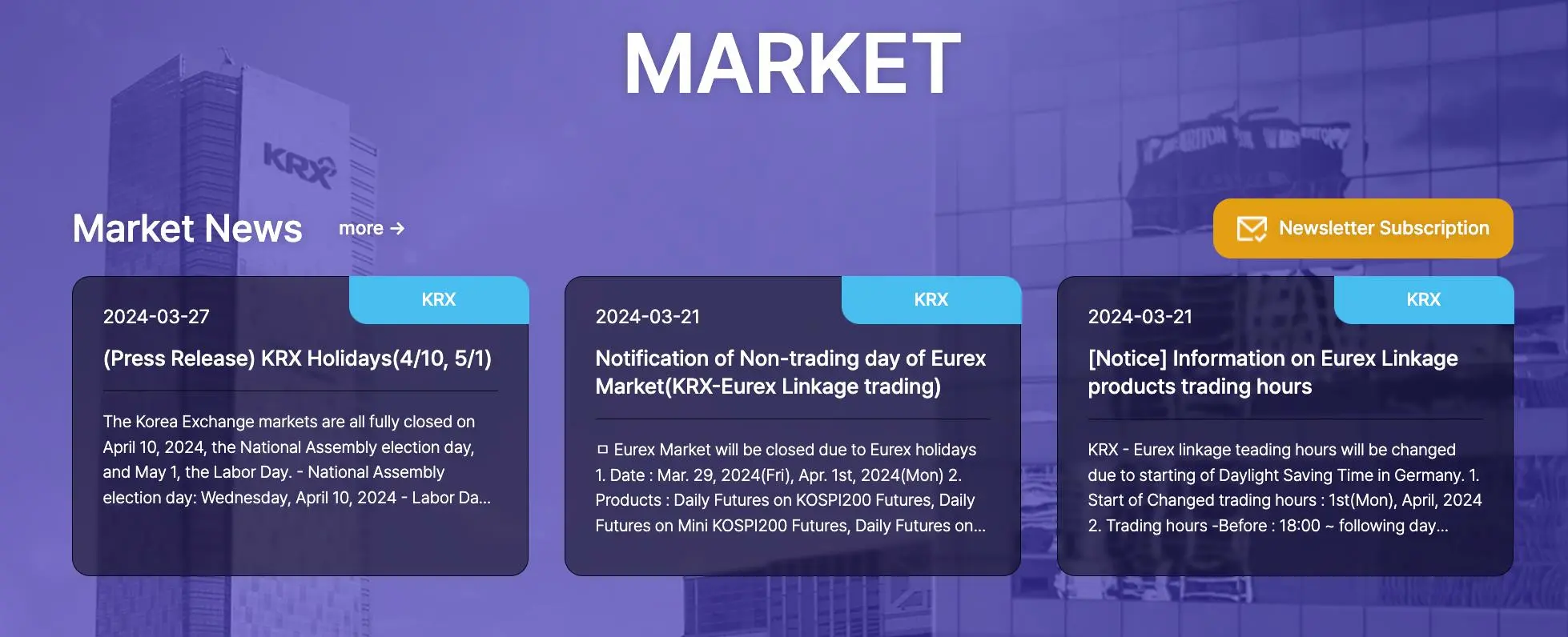
Educational Resources
KRX provides educational resources through market news updates and an Information Center offering publications and the Korea Investment Guide.
Trading Tools
KRX offers a Market Data System that provides statistics, market activity, insights, and data products for trading.
Conclusion
KRX offers a wide range of financial products and services, making it a comprehensive trading venue. It boasts a well-balanced investor base and diverse product offerings. However, being unregulated raises concerns about transparency and investor protection. Despite this, KRX imposes low listing fees and annual dues for listed companies, making it an attractive option for those looking to list their securities.
FAQs
Q: Is KRX regulated by any financial regulatory authority?
A: No, KRX is not regulated by any recognized financial regulatory authority.
Q: What are the costs involved in listing on KRX?
A: Costs for underwriting, such as lead managing, accounting, and legal consulting fees, can vary significantly. KRX imposes low listing fees and annual dues for listed companies compared to other exchanges.
Q: How can I contact KRX for customer support?
A: You can contact KRX for customer support through email. For KOSPI listings, the email is kospilisting.global@krx.co.kr, and for KOSDAQ technical support, the email is kosdaq.tech.global@krx.co.kr.
Q: Does KRX offer educational resources?
A: Yes, KRX provides educational resources through market news updates and an Information Center offering publications and the Korea Investment Guide.
Q: What trading tools does KRX offer?
A: KRX offers a Market Data System that provides statistics, market activity, insights, and data products for trading.
Risk Warning
Online trading involves significant risk, and you may lose all of your invested capital. It is not suitable for all traders or investors. Please ensure that you understand the risks involved and note that the information provided in this review may be subject to change due to the constant updating of the company's services and policies. In addition, the date on which this review was generated may also be an important factor to consider, as information may have changed since then. Therefore, readers are advised to always verify updated information directly with the company before making any decision or taking any action. Responsibility for the use of the information provided in this review rests solely with the reader.

Read more
capital.com Review 2026: Traders Report Alleged Trade Manipulation & Withdrawal Concerns
Did you have to pay extra fees to recover your deposited funds on capital.com, a Bahamas-based brokerage entity? Were you denied withdrawals in the name of an invalid account? Did the broker fail to respond to your withdrawal requests for weeks? Faced losses due to alleged slippage and stop-loss errors? This capital.com review investigates user allegations and shares how the broker's regulatory structure appears.
One X Post, 12 Likes: A Trump Tariff Warning Aimed at Indian Markets
A vital post contains three separate assertions, and only the first is about trade policy. One, that Trump will impose large tariffs on India over Russian crude purchases. Two, that the H-1B visa action taken on the day of the post is the first in a sequence. Three, that Indian equities and the rupee are exposed to both. There is no figure attached to "large," no indication of which Indian exports would be covered, and no timeline other than the 3 November election date the post itself cites. The H-1B reference is equally bare.
FBS Regulation Checks Before Choosing the Company Behind an Account
FBS regulation should be checked against the company named in an account agreement, not a brand-level statement alone. The FBS About page archived on 24 September 2026 describes operations under several local licences. That statement does not identify the provider for every applicant in South Asia. Before using an FBS login link to apply or submit documents, establish which company would contract with you and what the relevant authorisation covers.
Monsoon 13% Short, US Yields Above 5%; India Faces Food, Fuel & Fertilizer Shortage Risks
India is being hit by four shocks at once, according to a post on X published on Tuesday night: food, fuel, fertiliser and finance. The four numbers behind it are the ones worth checking. Monsoon rainfall running about 13% below normal and the weakest since 2015. Crude oil near $100 a barrel. None of them has been confirmed. The post attributes the framing to External Affairs Minister S. Jaishankar. Nothing published about Jaishankar in the past 72 hours mentions a four-F warning. Treat the attribution as unverified. What is verifiable is the timing. The post went out hours before an RBI policy decision, with Brent already slipping below $100 and US equity futures sitting at records. That split matters more to a USD/INR position than the label does. The four numbers, one at a time Everything in this section comes from the post. Food. El Niño left this year's monsoon about 13% short, the weakest since 2015, which points to lower crop harvests. Fuel. The US-Iran war has kept crude
WikiFX Broker
Latest News
Oil, Yields and French Debt Keep Global Markets Under Pressure
 WikiFX
Tag Markets Broker Review: Regulated but Is It Safe for Traders?
WikiFXLuxury Brand Owner Shot Dead After Losing US$100 Million in Trading Last Month
WikiFXOil Turned on Its Vertex Day: What It Means for Gold
WikiFXShareflo Finds 33,675 UK Companies Behind on Filings as Director ID Checks Take Effect
WikiFXKuantan Investment Scam Raids Expose RM215,000 Operation
WikiFXRBI Vows to Steady 'Undervalued' Rupee After It Hits Five-Month Low
WikiFXDoctor Loses RM300,000 in an Investment That Promised 10% Monthly Returns
WikiFXInflation fears on the rise as one-year outlook in Fed survey hits highest level since May 2023
WikiFXFBS Regulation Checks Before Choosing the Company Behind an Account
WikiFXRate Calc
