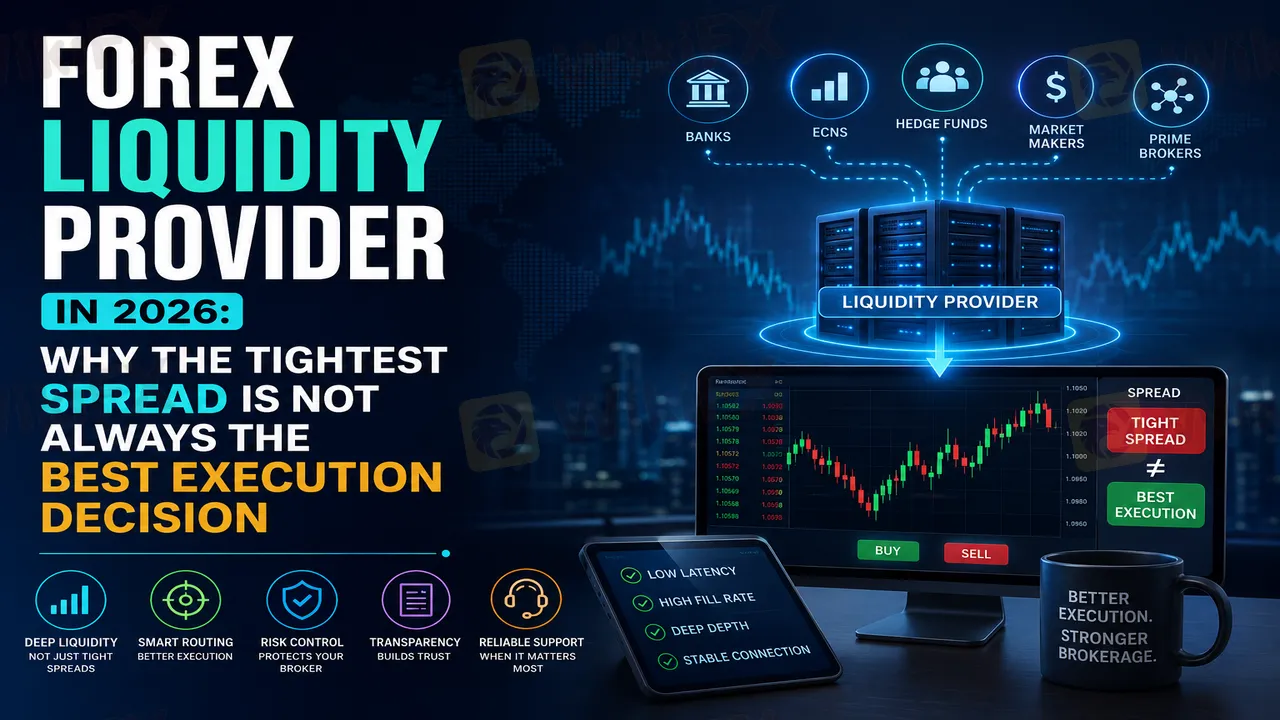
Forex Liquidity Provider in 2026: Why the Tightest Spread is Not Always the Best Execution Decision

Abstract:Choosing a forex liquidity provider is not a search for the lowest displayed spread or the longest provider list. It is a broker decision about pricing integrity, depth, routing, credit, reporting, incident response, and client communication. This 2026 guide explains how a forex LP, FX liquidity provider, or liquidity provider forex arrangement fits into a broker’s execution chain; what to test before onboarding; why a “best forex liquidity provider” claim cannot replace due diligence; and how to compare cost beyond commission. Use the execution-quality scorecard, provider questions, routing scenarios, and 90-day onboarding plan to assess whether a liquidity relationship can support your actual client mix, instruments, risk model, and jurisdiction. The goal is not to make a universal ranking. It is to build evidence that your broker can explain, supervise, reconcile, and recover its execution service when market conditions are difficult.
**Editorial and risk notice:** This B2B guide is for brokerage executives, dealing desks, operations, technology, risk, and compliance teams. It is not investment advice, a recommendation of any liquidity provider, or a promise of spreads, fills, execution quality, client growth, or trading outcomes. Confirm legal status, product scope, market access, contractual responsibilities, and local obligations with qualified advisers and counterparties.
At 09:30 on a volatile trading day, a broker‘s top-of-book price still looks competitive. Ten minutes later, the dealing desk sees a different problem: executable depth is thinner than expected, one venue’s response has slowed, and the client-support team has no plain-language explanation for why fills now differ from the quiet-market experience. The broker did not merely buy liquidity. It bought an execution dependency.
That is the proper starting point for evaluating a forex liquidity provider. A liquidity relationship is a chain: counterparties, prime or credit arrangements where relevant, aggregation, order routing, pricing rules, broker risk controls, client-facing platform behaviour, reporting, and incident recovery. A quote is evidence only when it can be traced through that chain.
Executive Takeaways
· A forex LP should be assessed through executable quality and control evidence, not marketing claims about spreads or number of venues.
· Test normal, fast-market, stale-price, rejection, partial-fill, and outage conditions before client volume depends on the relationship.
· Define what the broker, aggregator, bridge, platform, and liquidity provider each own for pricing, execution, status, records, and client notices.
· Model total cost across commissions, markups, technology, credit, data, reconciliation, exception handling, and contingency.
· Do not publish “best forex liquidity provider” claims unless comparison criteria, scope, and evidence are current and defensible.
1. What a Liquidity Provider Does - and What It Does Not Do for Your Broker
In a practical FX brokerage setup, a liquidity provider may supply prices, executable quotes, market depth, or access to a trading relationship. The broker may consume this directly or through an aggregator, bridge, prime-of-prime arrangement, or other connectivity layer. The precise model varies. The common error is to use “liquidity” as one word for several different functions.
Separate these questions during procurement:
1. Price formation: Which sources create the displayed price and how are stale, crossed, or abnormal quotes filtered?
2. Execution: Which venue or counterparty can accept an order; what happens to a reject, partial fill, or delayed acknowledgement?
3. Risk and credit: Who carries what exposure, who can change limits, and who observes a stressed position or concentration?
4. Client service: Which status is shown to the client, how is a dispute investigated, and which record is authoritative?
5. Resilience: How does the broker detect degradation, divert routing, reconcile records, and communicate during disruption?
Composite Scenario: Good Displayed Prices, Weak Executable Depth
This scenario is illustrative. A broker tests a new FX liquidity provider during calm hours and sees attractive top-of-book pricing. During a controlled high-volume simulation, however, fill ratios decline beyond the first visible tier and the order-routing dashboard lacks a clear reason code. The team does not conclude the provider is unsuitable; it discovers that its proposed client segments, quote display, routing settings, and support wording need to be tested together. The broker adds measurable depth, reject, and latency thresholds before any wider rollout.
**Common mistake:** comparing a screenshot of spreads from one time window. A client experiences the executable service, including depth, rejects, slippage, controls, and recovery - not a single displayed number.
Key Takeaways: Define the Service
· Ask what is executable, by whom, and under which conditions.
· Do not confuse an aggregation layer with the underlying counterparty relationship.
· Make the client-facing execution promise match the evidence you can retain.
2. What to Measure Before Calling an FX Liquidity Provider “Better”
There is no universal best provider because client mix, instruments, jurisdictions, risk appetite, technology, and commercial model differ. A broker serving small retail tickets has different evidence needs from a broker handling larger or more specialised flow. Use a scorecard that makes these differences visible.
| Evaluation area | Questions to test | Evidence to retain |
| Price quality | Are quotes live, consistent, and appropriate for the intended instruments? | time-stamped quote samples; filter and mark-up rules |
| Executable depth | How much can be executed at each level in normal and stressed conditions? | depth snapshots; fill and partial-fill analysis |
| Routing | How are venues selected, prioritised, capped, or bypassed? | routing policy; test logs; change approval |
| Latency and rejects | Where are acknowledgements delayed or orders rejected? | percentile metrics; reason codes; incident records |
| Credit and limits | Who sets limits and what occurs when they are reached? | responsibility matrix; escalation playbook |
| Operations | Can trades, prices, fees, and adjustments be reconciled? | daily breaks; ownership; close-of-day evidence |
| Resilience | Is there a measurable failover and client communication process? | outage drill; recovery result; approved templates |
The scorecard should distinguish a provider‘s data from the broker’s own observation. Provider reports can be valuable, but due diligence requires your test protocol, timestamp convention, sample definition, and interpretation. A better-looking average spread can conceal weak performance at the times and sizes that matter to your clients.
Key Takeaways: Meaningful Comparison
· Compare identical instruments, sizes, time windows, and conditions.
· Review distributions and exception paths, not only averages.
· Agree what counts as a material execution, reporting, or service-quality issue before contract signature.
3. Build One Execution-Control Model Across Liquidity, Platform, and Support

Conceptual visual: multiple market-access streams flow through one broker-owned routing, risk, monitoring, and client-service control hub.
The picture below represents the desired outcome: several market-access streams may reach one broker control hub, but routing, permissions, monitoring, records, and client communication remain accountable. The broker should be able to answer the same basic question from every team: what happened, where did it happen, who owns the next step, and what does the client see?
Shared Control Versus Fragmented Control
| Control point | Shared broker model | Fragmented model to avoid |
| Instrument definitions | One approved symbol, contract, and trading-condition record | Different descriptions across platform, LP, and support materials |
| Order status | One event vocabulary and reference trail | Client and dealing desk see unrelated status labels |
| Routing changes | Approved change, test, monitoring, and rollback | A technical change occurs without risk or support readiness |
| Price/fee records | Common reconciliation source and retention approach | Separate reports with no agreed tie-out process |
| Incidents | Named owner, severity rule, client message, and post-incident review | Each vendor says another party owns the answer |
The FCA‘s current outsourcing and operational-resilience guidance is a useful general discipline: firms should understand the people, processes, technology, information, and third-party dependencies needed to deliver important services, while retaining accountability for risk. The exact rules that apply depend on the broker’s jurisdiction and permissions, but the design principle travels well.
Governance Workflow for a Liquidity Change
Business need -> counterparty and control review -> technical configuration -> normal and stressed testing -> dealing/support readiness -> monitored release -> retain, amend, or roll back. The review should identify changes to client terms, instruments, risk limits, routing rules, market data, reporting, commissions, records, and communications.
Key Takeaways: Execution Ownership
· Multiple liquidity sources do not remove the need for one broker-owned operating model.
· A routing setting is a client-service change when it affects outcomes or explanations.
· Every high-impact change needs a named owner and rollback condition.
4. Due Diligence Questions for a Liquidity Provider Forex Relationship
Use a written request list before commercial negotiation. It reduces the risk that a compelling demo bypasses operational questions.
Market Access and Commercial Scope
· Which legal entity contracts with the broker and what instruments, venues, and jurisdictions are in scope?
· Is the proposed service direct, aggregated, bridged, prime-of-prime, or another structure? What are the material dependencies?
· What commercial metrics drive fees: tickets, notional, spread, mark-up, monthly minimum, data, connection, credit, or professional services?
Execution and Data
· What order types, fill policies, last-look or reject behaviours where applicable, and reason codes are supported?
· What timestamps, clock synchronisation assumptions, identifiers, and records are available for investigation and reconciliation?
· How are bad prices, stale feeds, crossed markets, and venue degradation detected and handled?
Risk, Service, and Exit
· Who can alter limits, routing, instrument availability, or emergency controls? What is the approval path?
· What support windows, maintenance notices, incident commitments, and escalation contacts are contractually documented?
· How are data export, outstanding trades, fees, disputes, transition assistance, and termination handled?
**Common mistake:** treating a provider‘s onboarding questionnaire as the broker’s due diligence. The broker needs its own record of decisions, testing, exceptions, and accepted residual risks.
5. Forex Liquidity-Provider Cost: Model the Exception, Not Just the Commission
The visible commission or spread may be only one component. A brokers cost model should include connection and aggregation technology, market data, credit or collateral arrangements where applicable, platform/bridge settings, monitoring, staff time, reconciliation, client-support training, exception investigation, change requests, contingency capacity, and exit work.
Build three scenarios. In the base case, use the contracted scope and expected volumes. In the growth case, test a larger client base, additional instruments, regions, or trading hours. In the stress case, test venue degradation, unusual volatility, a reconciliation break, or a need to shift routing rapidly. The stress case often exposes the true cost of manual handling and weak records.
6. Indonesia: Local Legality, Client Funds, Language, and Payment Boundaries
For an Indonesian Pialang Berjangka, a liquidity decision cannot be separated from the service and legal model. Bappebtis public rules state that activity as a Pialang Berjangka requires an applicable business licence and include requirements concerning customer information and segregated customer funds. Verify the current requirements, permissions, and operating implications with the relevant legal/compliance team; a technology or liquidity arrangement does not itself establish authorisation.
Localisation also means operational Bahasa Indonesia. Status labels, risk notices, payment communications, support scripts, and incident templates must stay consistent with the underlying records. If a connected flow includes local payment methods, clearly define the status owner, reconciliation timing, client message, and escalation boundary. Do not use a payment method or a liquidity connection as a claim that client funds are protected, that execution is guaranteed, or that trading results are likely.
7. A 90-Day Liquidity Onboarding Plan
| Period | Objective | Evidence before the next gate |
| Days 0-20 | Define target flow and execution policy | client segments; instrument scope; risk model; regulatory review; scorecard |
| Days 21-45 | Complete provider and connectivity diligence | written scope; dependency map; commercial model; data and incident requirements |
| Days 46-70 | Configure and test | normal/stressed test logs; routing controls; reconciliation; support playbooks; client wording |
| Days 71-90 | Limited cohort and decision | monitored outcomes; exception register; reconciliation evidence; go/no-go/rollback decision |
FAQs
What Is a Forex Liquidity Provider?
A forex liquidity provider is a counterparty or service participant that may supply pricing, executable liquidity, market depth, or market-access connectivity to a broker. The exact role depends on the contractual and technical structure. Brokers should confirm the legal entity, scope, execution model, and responsibilities rather than assuming that one label describes the entire chain.
How Do I Find the Best Forex Liquidity Provider?
Use “best” as a search term, not a conclusion. Create a written scorecard based on your instruments, client flow, risk model, jurisdiction, technical stack, support capacity, and resilience needs. Compare like for like and retain evidence from normal and stressed testing.
What Should a Broker Measure After Launch?
Monitor quoted and executed price behaviour, depth, fill and reject patterns, latency, routing changes, limit events, reconciliation breaks, client complaints, incidents, and recovery performance. Review them against pre-agreed thresholds and owners.
Conclusion
The right forex liquidity provider relationship is not the one with the strongest headline. It is the one a broker can supervise through difficult conditions: with traceable data, understood routing, accountable owners, clear client communication, and a workable contingency. Build that evidence before volume arrives, and the liquidity decision becomes a managed service rather than an opaque dependency.
Sources and Further Reading
· FCA: Outsourcing and operational resilience
· FCA: 2026 operational-resilience observations
· ESMA: CFD product-intervention information
· Bappebti: Pialang Berjangka requirements
· Bappebti: customer information and segregated-fund requirements
For more details, contact us on WhatsApp: +852 6317 7384,
Name: Wikifx-link
Download the WikiFX app for in-depth forex updates.

Knowledge pays at WikiFX.
Every time you share a WikiFX article, you'll receive 50 Reward Points. Grow your rewards with every share and unlock exclusive gifts in the WikiFX Points Mall. Start earning today!

Interesting Articles for You
Review 2026: Users Report Disturbing Withdrawal Issues - Is the Broker Still Reliable?


Read more
IG Review for India 2026: RBI Alert List, Regulation, Login, and Forex Risk
IG review for India in 2026: see the RBI Alert List entry, overseas regulation, login checks, forex limits, and a clear broker safety checklist.

Orbex Review 2026: Are Traders Worried Over Profit Confiscations & High Commissions?
Orbex, a Cyprus-based brokerage entity, has recorded 30 exposure complaints on WikiFX, a leading forex broker regulation inquiry tool, so far. Other review websites have also recorded a healthy number of complaints against the brokerage firm. These complaints largely talk about the alleged profit confiscations by the broker in the name of trading violations, difficulty in accessing fund withdrawals, capital losses due to artificial slippage, etc. In this Orbex review, we have investigated user complaints and provided a regulatory overview of the broker.
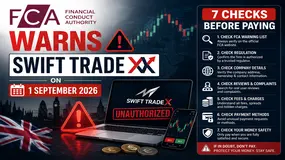
FCA Warns Swift TradeX on 1 September 2026: 7 Checks Before Paying
FCA warns Swift TradeX in a notice first published and updated on 1 September 2026. The UK Financial Conduct Authority says the firm may be providing or promoting financial services without permission, is not authorised, and may be targeting people in the UK. The notice names the website swifttradexai.com, a Worcester address and a UK telephone number, but also cautions that unauthorised businesses may use incorrect or borrowed contact details. The confirmed issue is authorisation status—not a court finding about every transaction. Anyone considering a payment should stop, verify the firm independently, and avoid using contact information supplied by the platform itself.
ThinkMarkets Review for India 2026: RBI Alert, Regulation, Login, and Forex Risk
ThinkMarkets review for India: check the RBI Alert List, overseas entities, regulation, login security, forex rules, costs, withdrawals, and leverage risk.
WikiFX Broker
Latest News
EUR/JPY Price Forecast: Trades near 181.50 after rebounding from descending channel bottom
WikiFXChinese Yuan: Services PMI rebound keeps PBoC cautious – Commerzbank
WikiFXXin Synergy Escalates Probe Into Former Directors Over Moneylending Operations
WikiFXAUD/JPY Price Forecast: Rebounds above 112.50, while staying constrained below 100-day SMA
WikiFXRising gilt yields are not saving the British Pound
WikiFXNZD/USD Price Forecast: New Zealand Dollar moves little following RBNZ Bremans remarks
WikiFXiFOREX Europe Review 2026: CySEC Regulation and Recent Withdrawal Complaints
WikiFXFormer Minister Remanded Over Tabung Haji Saudi Lease
WikiFXCIMB Tests RM1.38 Billion Tokenised Sukuk Settlement
WikiFXFCA Receives 333 Whistleblowing Reports in Q2, 170 Cases Lead to Action
WikiFXRate Calc

