FOMC hikes rates but signals pause
Abstract:The official non-manufacturing purchasing managers' index (PMI) stood at 56.4 versus 58.2 in March, according to data from the National Bureau of Statistics, above the 50-point mark that separates expansion and contraction in activity on a monthly basis.

The official non-manufacturing purchasing managers' index (PMI) stood at 56.4 versus 58.2 in March, according to data from the National Bureau of Statistics, above the 50-point mark that separates expansion and contraction in activity on a monthly basis.
In the most recent meeting, the US Federal Reserve hiked rates by 25 basis points, as anticipated, to take interest rates in the US to 5.25%, slightly beyond the terminal rate of 5.1%. However, the US Dollar Index (DXY) fell to the key support level of 100.80 which was last reached in April and February 2023, following the release of the rate hike decision.
The DXY trading lower was driven primarily due to comments from Chair Powell where he indicated that the Federal Reserve was “closer to the end than the beginning” and that it “felt like they are close, or even there”. This signaled to the market that the Federal Reserve could pause on future rate hikes, leading to the weakness seen on the DXY.
In the lead-up to the Federal Reserve rate decision, the upside on the DXY was limited by the round number resistance area of 102 and the 200-period moving average (200 MA). With the DXY approaching the key support level of 100.80 and the relative strength index (RSI) heading down toward the oversold region, watch out for the development of price action along the support level. If the DXY continues to trade lower the next key support level is at 100 which was last tested in April 2022.


Read more
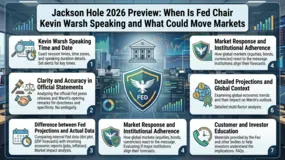
Jackson Hole 2026 Preview: When Is Fed Chair Kevin Warsh Speaking and What Could Move Markets
Fed Chair Kevin Warsh is listed to deliver Jackson Hole keynote remarks on 28 August 2026. See the schedule, market scenarios and USD-gold watchlist.

Wealth-db.co.uk FCA Warning: How to Spot the DB UK Bank Clone
The FCA says wealth-db.co.uk is a clone of DB UK Bank Limited. Compare the fake contact details, genuine FRN, website, and seven checks before paying.
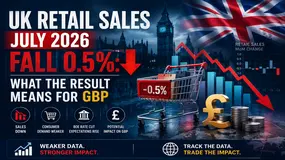
UK Retail Sales July 2026 Fall 0.5%: What the Result Means for GBP
UK retail sales fell 0.5% in July 2026, while the three-month measure rose 1.1%. See the ONS details and what the mixed result may mean for GBP.

Pakistan Forex Reserves Reach $22.5 Billion: Why a Stable USD/PKR Snapshot is Not Yet a Trend
Pakistan forex reserves stood at $22.506 billion on 13 August 2026, while the SBP dashboard showed a USD/PKR mark to market rate of 277.5713 on 20 August. This article separates the SBP forex reserves facts from predictions about the Pakistan rupee and the forex market Pakistan.
WikiFX Broker
Latest News
USDCHF: Rising Channel Continuation Toward the Target Zone
 WikiFX
Poland: Growth supported by investment rebound – ING
WikiFXOEXN Broker Review: Regulated but is it Safe for Traders?
WikiFXBreaking: Nonfarm Payrolls benchmark revision to lower US employment by 79,000 through March 2026
WikiFXDow Jones Industrial Average round-trips a Fed that promised nothing
WikiFXSouth Korean Won: BoK tightening supports KRW against US Dollar – Commerzbank
WikiFXMexican Peso tumbles as Warsh embarks on inflation fight
WikiFXSilver Price Forecast: False breakout and hawkish Fed sink XAG
WikiFXJapanese Yen dips further despite hotter inflation, upbeat employment data
WikiFXMalaysian Ringgit: BNM seen on steady policy path – DBS
WikiFXRate Calc

