EUR/USD ADVANCES, RECLAIMING 1.0950 ON US DOLLAR WEAKNESS, DESPITE HAWKISH FED COMMENTS
Abstract:EUR/USD found support around 1.0940 and rose toward the 1.0970 area during a quiet American session. The US Dollar is falling after a two-day rally, amid a decline in the 10-year Treasury Yields and a mixed performance in US stock markets. Hence, the EUR/USD is trading at 1.0961 after hitting a low of 1.0920.

• Federal Reserve‘s policymakers’ hawkish comments did not underpin the US Dollar
• US housing data missed estimates, though EUR/USD traders ignored it.
• EUR/USD Price Analysis: Upside risks lie at 1.1000, potentially exposing the YTD high; downside risks are below 1.0900.
EUR/USD found support around 1.0940 and rose toward the 1.0970 area during a quiet American session. The US Dollar is falling after a two-day rally, amid a decline in the 10-year Treasury Yields and a mixed performance in US stock markets. Hence, the EUR/USD is trading at 1.0961 after hitting a low of 1.0920.
THE EURO GAINED ON A SOFT US DOLLAR AS US TREASURY BOND YIELDS DROPPED
The Euro gained on a soft US Dollar as US Treasury bond yields dropped. Sentiment deteriorated as Wall Street registers losses. Sentiment deteriorated as Wall Street registers losses. Federal Reserve officials led by the St. Louis Fed President James Bullard reinforced the need for further tightening. Nevertheless, Bullard commented that he does not see a recession and expects rates to go between 5.50% and 5.75%. Of late, Atlanta‘s Fed President Raphael Bostic noted that he estimates another hike and then a pause. He added that inflation would take some time to ease to the Fed’s target, and he also does not foresee a recession.
In the meantime, Federal Reserves expectations for the May meeting lie at an 86.7% chance for a 25 bps hike, according to the CME FedWatch Tool.
In terms of data, the economic agenda in the US showcased a decline of 0.80% month-over-month in Housing Starts for March, following a 7.3% surge in February (revised down from 9.8%). Meanwhile, Building Permits fell by 8.8%, which was lower than the expected gain of 1.45%, although the figures for February were revised upward to 15.8% from 13.8%.
On the Eurozone (EU) front, the European Central Bank (ECB) Chief Economist Philip Lane said the ECBs baseline is to raise rates at the May 4 meeting. He added that data showed that supply chain shocks have eased and lower energy prices would help tackle inflation. Lastly, he said that the ECB is in “wait-and-see mode.”
The EU‘s calendar featured Germany’s Zew Index for April. Although they remained optimistic, expectations for future conditions missed estimates at 4.1 vs. 15.6 forecasts. Regarding current conditions, the index was -32.5 less than the -40 expected, an improvement considering that the priors month reading was -46.5. A senior ZEW official noted that “Experts expect banks to be more cautious in granting loans” and added that “high inflation rates and the internationally restrictive monetary policy are also weighing on the economy.”
EUR/USD TECHNICAL ANALYSIS
From a daily chart perspective, the EUR/USD is still upward biased, with the 20-day Exponential Moving Average (EMA) tracking the price action as a dynamic support. The 1.50% drop from April 14 to 17 was capped around 1.0909 before bouncing off from the latter toward current exchange rates. Although mixed, oscillators suggest that the EUR/USD could be poised for another leg-up.
If EUR/USD cracks 1.1000, that could put into play a challenge of the YTD high at 1.1075 before testing 1.1100. On the other hand, a fall below 1.0900, and the EUR/USD could dip to the 20-day EMA At 1.0890 before plunging to the 50-day EMA At 1.0795.


Read more
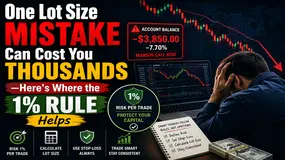
One Lot Size Mistake Can Cost You Thousands—Here's Where the 1% Rule Helps
Switched from one trading strategy to another but could not avert heavy losses? Wondering what went wrong despite your market analysis being spot on? It may not be a strategic issue then. It may just be that you chose the wrong lot size. Yes, a single oversized position can get your account exposed to far greater risks than you may imagine. You may be moved by the impressive profits with increasing lot sizes. But by doing so, you also invite a proportionate rise in losses. This is where you need to apply the essential 1% risk management principle. This rule helps you assess how much you can afford to lose if a trade does not go as planned.

Your Backtesting Results Mean Nothing If You Ignore This One Live Trading Reality
Backtesting remains one of the primary skills forex traders learn. By implementing a trading strategy based on historical currency pair price information, traders can view their past performance. The strategy leading to consistent profits during backtesting can raise confidence and lay a structured approach to the forex market. However, the path is not as simple as it may sound. Several traders tend to meet a harsh reality when transitioning to live trading. The strategy that seemed almost flawless on historical charts suddenly fails to deliver the results it did before. The sudden difference may not necessarily be because of a poor strategy. Rather, it indicates limitations concerning backtesting and several factors that play their part in a live market where conditions change frequently. It is thus important to understand these differences so that you can set realistic expectations and work on to achieve consistent success.

Can AI Really Improve Forex Trading? The Benefits, Risks and Hidden Limitations
We are living in the age of artificial intelligence, where everything including financial matters such as forex are rapidly influenced by this phenomenon. AI-powered tools are here to identify numerous trading opportunities and analyze thousands of data, all in seconds, becoming the preferred option for both retail and institutional traders. Regardless of its immense benefits, traders often question - Whether the AI can truly transform their forex trading experience or is it just like another technology offering scope for unrealistic expectations? While the AI can ensure faster trading and more informed decisions, it is never a sure shot way to profits. As a trader, you need to understand both the strengths and limitations of AI when it comes to generating real wealth.

Copy Trading Gone Wrong? The Mistakes That Could Wipe Out Your Entire Trading Account
We all love trading geniuses and their strategies that earn them profits season after season. And we also love following them to make our investment journey seamless. Copy trading is one such tactic that beginners employ to enter the forex market. What do most of them usually do? They pick an experienced investor from the list and let the platform replicate every trade automatically. The fact that experienced traders continually earn profits, the feeling of copying their trades remains intense. However, the uncertain forex landscape can bite you hard by simply copying trades and not focusing on technical analysis and the charts during the day. Beginners can have a set of preconceived notions that can potentially open the gate for losses. In this article, we have highlighted such mistakes traders should avoid.
WikiFX Broker
Latest News
21 Arrested in Melaka Raid on Fake Stock Investment Call Centre
 WikiFX
Octa Review: Profit Withdrawals, Account Blocks, and Broker Risk Signals
WikiFXSpotting Forex Ponzi Schemes and Confidence Scams Before You Deposit
WikiFXWhat Indian Beginners Should Check Before Choosing a Forex Broker
WikiFXINVESTIZO Review: Unregulated Broker Under Fire Over Withdrawals and Profit Cancellation
WikiFXBuild Trading Discipline Using a Bar-by-Bar Blind Test
WikiFXBreak the Habit of Adding to Your Losing Trades
WikiFXBehind the Regulated Facade: Is ACCUMARKETS Freezing Out Successful Traders?
WikiFXFBS Review: CySEC & ASIC Licensed, Yet Scored 2.51 , What's Really Going On?
WikiFXIpoh Businessman Loses RM1.25 Million in Crypto Group that Promised High Returns
WikiFXRate Calc

