Behind the good news of a strong rand is some bad news in South Africa
Abstract:A strong rand typically makes all South Africans happy since it represents a vote of confidence in the country. The rand, on the other hand, is being propped up by expectations that the South African Reserve Bank would undertake a more aggressive rate-hiking cycle to head off any stagflationary price shocks in food and petrol, while maintaining in lockstep with the US Federal Reserve's more hawkish posture.

A strong rand typically makes all South Africans happy since it represents a vote of confidence in the country. The rand, on the other hand, is being propped up by expectations that the South African Reserve Bank would undertake a more aggressive rate-hiking cycle to head off any stagflationary price shocks in food and petrol while maintaining in lockstep with the US Federal Reserve's more hawkish posture.
A strengthening of the rand is usually a reason for jubilation because it is viewed as a statement of confidence in the economy and financial markets. However, hopes that the SA Reserve Bank (Sarb) would move decisively in the face of approaching inflation threats and remain in lockstep with the Fed during its rate-hiking cycle support its present strength and resilience.
Both Sarb and the US Federal Reserve are expected to frontload interest rates in their fight against inflation at some point, boosting them by 50 basis points all at once and then gradually increasing them from there, according to economists. For the current rate-hiking cycle, the Fed's starting point is historically low-interest rates, whereas Sarb's is higher.
The rand is now giving a 7.1 percent carry trade return - the number of profit investors can make by investing in one currency versus another dependent on the level of domestic interest rates.
The carry trade yield in South Africa is only surpassed by the Brazilian real, Chilean peso, and Colombian peso – the other emerging market commodity-producing countries that have gained ground on rising commodity prices – with government bond yields trading at a significant premium to developed market interest rates.
Investors are taking advantage of this premium at a time when they are plainly satisfied with the degree of risk that South Africa provides to their portfolio, particularly in comparison to the bigger macroeconomic and geopolitical concerns that exist in the Northern Hemisphere. Because it is geographically far from the Ukraine war zone and less likely to be affected by any potential greater European consequences, it appears that South Africa is suddenly being regarded as a safe haven.

According to Bloomberg numbers given by Investec analyst Annabel Bishop, the rand has gained 6% year to year, compared to a 7.8% loss over the same period last year, making it the fourth best-performing emerging market currency this year.
The rand's strengthening to R14.8 per dollar was fueled by R2.9 billion in portfolio inflows into SA bonds in only two days this week, with foreigners taking advantage of the 50 basis point spike in SA bond rates since Russia's war began over a month ago, according to Bishop.
Considering our financial markets' depth and liquidity, the rand's capacity to weather rising economic and geopolitical turmoil in recent weeks is noteworthy, given that it is generally the first emerging market currency to be sold off when investors flee for shelter.
But, with no end in sight for the conflict and the outlook for domestic and global inflation becoming increasingly bleak, will it be able to prolong or hang on to these gains?
Rising energy and food costs, trade disruptions, and fresh supply-side limitations emanating from the Russia-Ukraine war, according to BNP Paribas, could push inflation in developing economies up four percentage points to 10% this year. That's double-digit inflation, which no one wants to hear because it implies that hard times are on the way.
On the local front, Jeff Schultz, a senior economist at BNP Paribas South Africa, believes Russia's conflict will have serious, long-term consequences for global supply chains, commodities prices, and global inflation. He reminds out that, up to this point,
However, he warns that inflation expectations could become a problem, with consumers expecting more entrenched higher inflation in response to “the substantial price shocks the economy is about to face in fuel and food price increases (the latter two components accounting for the majority of lower income-expenditure deciles).”
As a result, he has raised his bank's inflation prediction for South Africa by 50 basis points to 6.5 percent in 2022, up from 6 percent earlier.
Given the worsening inflation picture, Schultz believes that front-loading may become a tactic for Sarb in subsequent meetings as it “tries to nip inflation expectations in the bud and build up buffers against a more uncertain global environment.”
Because higher interest rates would not solve high global wheat prices or unblock supply chain disruptions, Absa economist Peter Worthington, who expects CPI to rise sharply in the coming quarters, does not believe aggressive rate hikes “in the face of a stagflationary shock” would be an appropriate policy response.
“Although extreme tightening would not be prudent at this time, especially given the stability of the rand,” he says, “We feel some tightening is required to cope with the reality that inflation expectations may have shifted further away from the 4.5 percent target.”
Sarb should be applauded for keeping a careful check on inflation and is likely to do so in the future.
Upside inflation risks are emerging, and the Fed may have no choice but to respond with the firepower required to moderate greater inflation expectations before they take hold.
In an otherwise bleak macroeconomic climate, this means a rand explosion is improbable - excellent news in an otherwise bleak macroeconomic situation.

Related broker


Read more

Succedo Markets Review 2026: The First Withdrawal Worked—What Happened Next?
Most traders who have opened accounts with Succedo Markets, a Saint Lucia-based brokerage entity, have reported withdrawal request denials after a pleasant first experience. Traders globally, including those from India, have made these complaints. Meanwhile, some traders have reportedly taken legal recourse to recover their stuck funds. The critical nature of these complaints made us share this in-depth Succedo Markets review. This review does not only examine user allegations but also shed light on its regulatory framework.

Tattvam Review 2026: Investigating Complaints Concerning Trade Executions
Did you encounter trade-related concerns with Tattvam, a Mauritius-based brokerage entity? Several users have reportedly accused the broker of cancelling profitable trades, allegedly citing scalping as the reason. At the same time, traders have reportedly expressed concerns over the lack of understanding among the broker officials about critical trading aspects such as copy trading. In this Tattvam review, we have carefully examined user-reported allegations. Additionally, we have given a regulatory overview of the broker.

suxxessfx Review 2026: Funds Worth $5K-$42K Reportedly Lost. Check Our Investigation!
suxxessfx, a Seychelles-based brokerage entity, grabbed massive ire from traders on broker review platforms such as WikiFX, a globally recognized forex broker regulation inquiry app. Exposure reports have revealed fund losses worth over $5K-$42K on the broker’s trading platform. This suxxessfx review examines serious user allegations and its regulatory status. Read on!
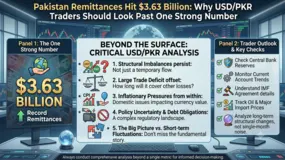
Pakistan Remittances Hit $3.63 Billion: Why USD/PKR Traders Should Look Past One Strong Number
Pakistan remittances reached $3.631 billion in July 2026, up 13% year on year and 4.5% from June, according to the latest State Bank of Pakistan data release. The SBP remittances update is a useful external-sector input, but it is not a currency forecast. This guide explains what the inflow can mean for the Pakistan forex market and USD PKR, and what it cannot prove about the next Pakistan rupee move.
WikiFX Broker
Latest News
Canadian Dollar strengthens despite hawkish Fed rhetoric
 WikiFX
USDCHF: Rising Channel Continuation Toward the Target Zone
WikiFXUSD/JPY Forecast: Retreats from one-month high but dip-buying eyed
WikiFXEuro strengthens against Canadian Dollar ahead of Germanys HICP data
WikiFXCould we see a reversal from here?
WikiFXGold price in India: Rates on August 31
WikiFXGold pares losses on softer USD; Fed hike bets cap recovery
WikiFXGold extends losses as hawkish Fed bets rise amid US‑Iran tensions
WikiFXGODO Obtains CySEC Licence as Broker Adds Cyprus-Regulated Entity
WikiFXAustralian Dollar holds above 1.2100 vs NZD; eyes Aussie GDP and RBNZ
WikiFXRate Calc

