Pakistan's Real Deficit Is Trust, Not Fiscal ?! Argues Analyst — IMF Sees 9.9% Inflation

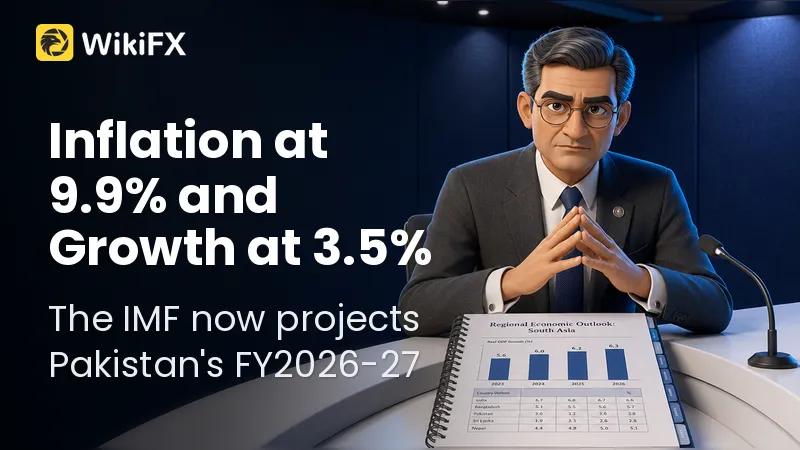
Abstract:The claim landed in the same news cycle as a harder number. The IMF now projects Pakistan's FY2026-27 inflation at 9.9% and growth at 3.5%, according to Dawn, Geo News, Daily Times, Bol News and ARY News. The government's own target for the year is 4%.
Four pillars, no numbers
Pakistan's biggest economic deficit is not fiscal. It is a “deficit of public trust”, argues X user Asad Ashah (@Asad_Ashah), in a post that has pulled 101 likes and 43 reposts in about 21 hours.
The post is a diagnosis, not a forecast. Ashah credits the 2026 Nobel laureates in economics, Robert E. Hall and Michael Woodford, with showing how household and business expectations shape stabilisation outcomes. He credits the 2025 laureates — Joel Mokyr, Philippe Aghion and Peter Howitt — with explaining growth through creative destruction, building on Schumpeter.
From that he draws four pillars: macroeconomic stability, creative destruction, good governance, and public trust. The pillar he calls most neglected is the one nobody publishes a number for.
He writes that trust “reduces uncertainty, transaction costs and risk premiums” and encourages investment, tax compliance and long-term commitments.
That is the most testable sentence in the whole post, and it comes with no evidence attached. He also argues that trust cannot be bought with public expenditure or borrowed from international lenders.
Fair enough. But the post offers no timeline and no policy sequence. The thread collected 4 comments against 101 likes. Whatever agreement it found, it did not find much argument either.
The IMF's numbers, and the ministry's counter
Geo News reports the Fund's FY27 projections as 3.5% GDP growth, 9.9% inflation and a 6.5% unemployment rate. ARY News notes the growth figure sits below the government's 4% target. The FY2026-27 budget itself totals 18.771 trillion PKR, built on a 4% growth assumption and an exchange rate of 278.5 PKR to the dollar, per the Vivekananda International Foundation.
Finance Minister Muhammad Aurangzeb has been telling investors the opposite story. At the Citi Macro Forum he pointed to three consecutive years of primary budget surpluses, a fiscal deficit at a 22-year low, and stronger foreign exchange buffers (Mettis Global).
He also set out plans to widen financing sources: more Panda bond issuance, Sukuk, and a rupee-denominated bond settled in dollars. The stated aim is lower borrowing costs and longer debt maturities.
In Bangkok, at the MENAP meeting on the sidelines of the 2026 World Bank Group–IMF Annual Meetings, he repeated the 22-year-low deficit and the three-year surplus streak.
He put growth at 3.7% and said reserves stand at a historic high, sufficient to cover three months of imports (ProPakistani, SAMAA TV). He told the IMF that subsidies would be budget-neutral, targeted and time-bound.
Three growth numbers, one fiscal year
3.7%. 3.5%. 4%.
The minister's figure, the Fund's forecast, the budget's assumption. All three describe the same fiscal year, and only one of them is written into the spending document.
The inflation side is less contested, and it is moving the wrong way. Multiple outlets report the IMF raised its FY27 inflation forecast to 9.9%. The 8.4% figure for the earlier forecast comes from a separate X post by @iabdullah278 (4,316 followers, verified, about 17.5 hours old), not from any of the news reports reviewed here. Treat that comparison as unconfirmed.
What is confirmed: 9.9% inflation against 3.5% growth means prices rise faster than output. For anyone holding rupee exposure, that is the number that sets the real return.
Where a trust deficit turns into a cost
For a currency position, trust is not a slogan. It is the risk premium, and it hides in specific places.
Reserves covering three months of imports set how much dollar demand the market can absorb before the spot rate has to move. That is the buffer. It is the same figure the minister is quoting to rating agencies, which tells you how much weight the government puts on it.
The October 7 IMF staff-level agreement anchors the programme, per ProPakistani. Programme continuity is what keeps external financing lines open and what S&P Global Ratings told Aurangzeb it wants to see.
SAMAA TV reports he is pushing to lift Pakistan's sovereign rating into the BB category; S&P stressed policy continuity and effective implementation of reforms. A rating move changes the cost of borrowing abroad. It does not move the spot rate on its own.
Subsidy design matters for the same reason. Budget-neutral, targeted, time-bound is the language that keeps untargeted spending from breaking the deficit arithmetic.
For a USD/PKR position, the cost that usually moves first is the forward premium and the swap points, which track the interest-rate differential and how tightly the spot rate is steered.
Inflation near 9.9% and reserves at three months of import cover pull that calculation in opposite directions. Which one wins depends on what the next inflation print and the next reserve reading actually show.
What the two posts agree and disagree on
Only two posts on this subject surfaced in the material reviewed, and they are not having the same conversation.
Ashah's post argues that Pakistan's recurring crises are institutional, and offers a four-pillar framework with no figures. @iabdullah278's post offers one figure — 9.9% inflation for 2026-27 against a prior forecast of 8.4% — with no framework and no cited source.
Where they overlap: both point at prices as the visible symptom. Where they diverge: the first says the missing asset is trust, the second treats the forecast itself as the story. Neither names an institution for its central claim.
Engagement is thin on both. The main post's 101 likes and 43 reposts, and the second post's 5 likes and zero reposts, are not evidence for anything. They only tell you that this argument is not yet being fought out in public.
What to watch, and where to check it
The material reviewed here names no scheduled date for the next IMF programme review, no date for an S&P rating decision, and no date for the Panda bond, Sukuk or rupee-denominated dollar-settled issuance.
The World Bank Group–IMF Annual Meetings are currently under way, which makes statements out of that venue the nearest thing to a fixed calendar item.
Three figures are worth tracking against what has already been published:
- Actual inflation prints versus the IMF's 9.9% projection. If the forecast is revised again, that tells you which way real returns on PKR are heading.
- Foreign exchange reserves against the three-month import cover Aurangzeb cited. That cover is the buffer that decides how much dollar demand the market can absorb.
- Any S&P Global Ratings action on the BB ambition. A move changes Pakistan's external borrowing cost, and through it the pull on reserves.
Primary numbers can be checked at the source rather than through reposts: the IMF's published projections, the Finance Division's own statements from the Annual Meetings, and S&P's rating announcement when it comes.


Read more

RBI Slashes No-Underlying Forex Derivative Limit to USD 5 Million, Bans Rebooking of Cancelled Rupee
India's central bank cut the no-underlying forex derivative limit from USD 100 million to USD 5 million, barred rebooking of cancelled rupee contracts and imposed a 20% cash reserve on large hedges, effective 10 October 2026.

XAU/USD Hits $4,500: Washington Bought Bonds—and Gold Exploded
Gold surged above $4,500 after the US Treasury expanded its purchases of longer-dated government bonds, pushing yields and the dollar lower. But this was not debt forgiveness or Federal Reserve money printing—it was a liquidity operation that exposed a much bigger fear: America may be finding it increasingly difficult to live with market-driven interest rates.
UK Inflation Jumps to 2.9%: What the July Data Means for GBP and Bank Rate Expectations
UK CPI rose to 2.9% in July 2026 from 2.6% in June. See what the data may mean for GBP, gilt yields and Bank Rate expectations without overreading one release.

Prime of Prime Forex in 2026: The Credit and Control Questions Brokers Must Answer Before Connecting
A Prime of Prime forex arrangement can help a broker access trading relationships, credit intermediation, technology connectivity, and liquidity aggregation that may otherwise be difficult to obtain directly. But the label does not prove direct bank access, executable depth, or a particular execution outcome. This 2026 guide explains what a forex Prime of Prime, PoP liquidity provider, prime brokerage forex service, and forex prime broker proposal can mean in practice; where the credit and order-routing chain must be documented; how to test pricing, limits, rejects, records, and resilience; and which commercial terms create hidden operating cost. Use the comparison framework, red-flag list, and 90-day launch plan to assess fit for your client mix and risk model. The objective is a controllable execution dependency with traceable evidence, not a marketing claim about institutional access.
WikiFX Broker
Latest News
NPBFX Broker Review: Regulated but Is It Safe for Traders?
WikiFXIndian Police Arrest Two in Alleged ₹10 Crore Crypto Investment Fraud
WikiFXU.S. Dollar Pulls Back From Yearly Highs: Analysis For EUR/USD, GBP/USD, USD/CAD, USD/JPY
WikiFXFirst Light News: Chip Rout Rattles Equities as Q3 Earnings Season Kicks Off
WikiFXClient Saved via WikiFX Exposure ! Is slay4x Considered a Safe Broker or a Scam in Q4 2026?
WikiFXUS Dollar Price Forecast: DXY Eyes 102.49, Can EUR/USD Hold 1.1180 Ahead of CPI?
WikiFXScore Capital Markets Ltd 2026 Review: Gateway or Trap?
WikiFXFirst Light News: US CPI, Aussie Jobs and Bank Earnings in Focus
WikiFXRetiree Loses RM118,000 Through Fake Stock Investment Website
WikiFXED Files Charge Sheet in Nexa Evergreen Investment Case Involving Rs 2,676 Crore
WikiFXRate Calc
