UK Inflation Jumps to 2.9%: What the July Data Means for GBP and Bank Rate Expectations

Abstract:UK CPI rose to 2.9% in July 2026 from 2.6% in June. See what the data may mean for GBP, gilt yields and Bank Rate expectations without overreading one release.
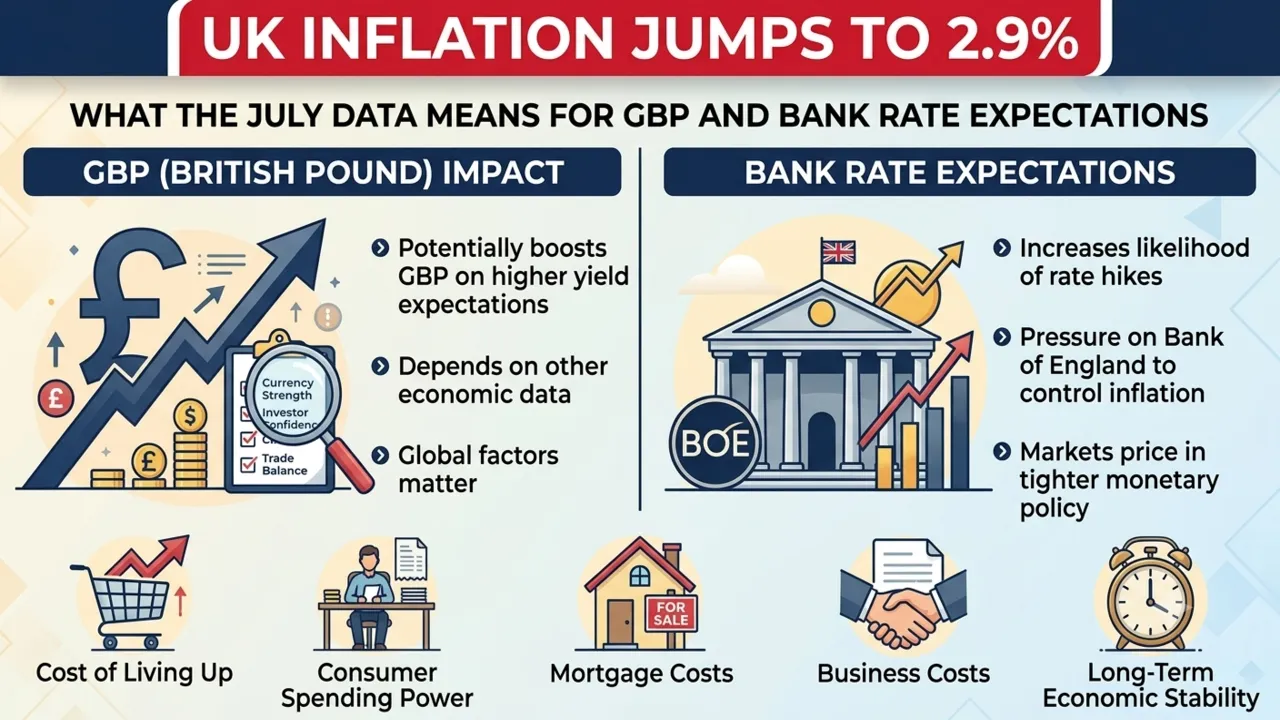
| Quick AnswerUK consumer price inflation rose to 2.9% year on year in July 2026, up from 2.6% in June. CPIH increased to 3.1% from 2.8%, while RPI rose to 3.2% from 3.0%. The upside move may make rapid Bank Rate cuts harder to justify, but one release does not determine the next decision or guarantee a stronger pound. |
Quick Answer
What the July Inflation Data Showed
The Office for National Statistics published the July release on 19 August. The acceleration in the headline rate was linked mainly to energy-related costs, which matters because policymakers and markets will ask whether the increase is broad and persistent or concentrated in volatile components.
CPI is the main inflation target measure. CPIH includes owner-occupiers' housing costs, while RPI is a legacy measure that is still referenced in some contracts. These measures answer different questions and should not be mixed in a single headline comparison.
- CPI: 2.9% year on year, up from 2.6% in June.
- CPIH: 3.1%, up from 2.8%.
- RPI: 3.2%, up from 3.0%.
Three Implications for GBP and Gilt Yields
First, a higher inflation print can push short-dated gilt yields up if traders price fewer or later rate cuts. Second, GBP may receive support if UK yields rise relative to overseas yields. Third, the reaction can reverse if investors judge the inflation increase to be temporary or if stronger price pressures weaken the growth outlook.
The correct comparison is not simply 2.9% versus 2.6%. Markets react to the difference between the official result and expectations, the details within the release, and how much of the information was already reflected in prices.
- Check two-year gilt yields and market-implied rate expectations.
- Compare GBP with the dollar and euro, not in isolation.
- Separate the initial reaction from the close and next session.
What the Bank of England May Focus on
The Bank of England is likely to look beyond headline CPI to services inflation, wage growth, labour-market conditions, inflation expectations and the persistence of domestic price pressure. Energy can lift the headline rate quickly, but its policy importance depends on whether it feeds into broader prices and wages.
The July Monetary Policy Report provides the Bank's framework and projections; the ONS release supplies the new data point. A responsible article should not turn the combination into a certain forecast for the next meeting.
Three GBP Scenarios After the Release
Hawkish repricing: gilt yields rise and expected easing is pushed back, potentially supporting GBP. Temporary-shock reading: yields and sterling give back early gains as the market focuses on energy and base effects. Growth-concern reading: higher inflation alongside weak activity creates an unfavourable mix and a less predictable sterling response.
Use timestamped observations rather than permanent claims. GBP/USD can move because of US data or Federal Reserve expectations, while EUR/GBP can reflect euro-area developments as much as the UK release.
- Confirm figures in the ONS bulletin and time-series tables.
- Check services, core and monthly changes before writing a policy conclusion.
- Label every market move with instrument, source and timestamp.
Action Checklist
- Verify CPI, CPIH and RPI in the live ONS release.
- Compare the result with market expectations and June baselines.
- Check short-dated gilt yields before claiming rate repricing.
- Separate GBP/USD drivers from EUR/GBP drivers.
- Avoid presenting one inflation release as a certain Bank Rate signal.
FAQs
What was UK CPI in July 2026?
CPI rose 2.9% year on year, compared with 2.6% in June, according to the ONS release.
Does 2.9% inflation mean the Bank of England will raise rates?
Not necessarily. The Bank considers services inflation, wages, labour conditions, expectations and growth, not one headline number alone.
Why might GBP fall after higher inflation?
If the rise is seen as temporary, already priced, or harmful to growth, sterling may fail to hold an initial yield-driven gain.
Sources
ONS — Consumer price inflation, UK: July 2026
ONS — Consumer price inflation July 2026 time series
Bank of England — Monetary Policy Report, July 2026
| Risk noticeThis article is for education and macro-market analysis, not investment advice, a price target or a trading signal. Inflation data, rates and FX markets can move quickly. Verify live official data and consider your circumstances before taking financial decisions. |
Download the WikiFX app for the latest forex updates.

Knowledge pays at WikiFX.Every time you share a WikiFX article, you'll receive 50 Reward Points. Grow your rewards with every share and unlock exclusive gifts in the WikiFX Points Mall. Start earning today!

Read more

WinproFx Review 2026: Mixed User Reports on Trading and Withdrawals
WinproFx, a Saint Lucia-based brokerage entity, has reportedly received mixed reports from traders worldwide. WikiFX, a globally recognized forex broker inquiry tool, recorded nearly 60 user feedback containing both positive and negative WinproFX reviews. While some traders reported smooth withdrawal and deposit experiences, some complained about profit cancellations on the trading platform. This article examines user reviews and shares its regulatory framework.

RoboForex Review: Examining a Pakistan User’s $1,627.39 Allegation
RoboForex review examines a Pakistan user’s $1,627.39 allegation, a balance photograph, official entity disclosures and the records still needed.

GRAND MARKETS Review 2026: Traders Report Fast Trade Execution & Low Spreads. Should You Invest?
GRAND MARKETS, an Australia-based brokerage firm, continues to receive appreciation from users regarding trading activities. These users have praised the broker for the trade execution speed, spreads, and even withdrawal processing. WikiFX, a globally-recognized forex broker inquiry tool, recorded largely positive GRAND MARKETS reviews. This article talks about user reviews, the broker's trading product portfolio, accounts offered, its regulatory structure, etc. A detailed evaluation will help you make an informed investment decision.

US and China Publish $60bn Tariff-Cut Lists-Soybeans Stay Out, and Nothing Is in Force Yet
The United States and China have published reciprocal tariff-cut lists covering about $30 billion of goods on each side, $60 billion in total. Neither list is in force. China's covers 1,619 categories of American products. America's covers 77 categories of Chinese goods. Soybeans are on neither. That omission is the first thing to register. Soybeans are the largest single US agricultural export to China, and they stay subject to China's 10% additional tariff even as corn, wheat, sorghum, beef and dairy come off the list.
WikiFX Broker
Latest News
US Dollar Price Forecast: DXY Holds Firm Ahead of NFP, Can GBP/USD and EUR/USD Recover?
WikiFXEURUSD HTF Outlook: Policy Compression Near Premium
WikiFXChatGPT Trading Boom Exposes Forex Investors to New Risks
WikiFXdbinvesting Broker Review: Regulated but Is It Safe for Traders?
WikiFXWinproFx Review 2026: Mixed User Reports on Trading and Withdrawals
WikiFXTreasury Yields Eye Declines as Payrolls Miss and Wage Growth Slows
WikiFXThe Copytrading Risks that Nobody Warns You About
WikiFXSEC Says AI Investment Scams Took $15 Million
WikiFXU.S. Dollar Rebounds From Session Lows Despite Weak Non Farm Payrolls Data: Analysis For EUR/USD, GBP/USD, USD/CAD, USD/JPY
WikiFXRate Calc
