Deriv Review 2026: Reported Manipulative Trading Charts, Withdrawal Denial & Deposit Failure
Abstract:Deriv, a Malta-based brokerage firm, receives multiple allegations on trading charts that are allegedly not in traders' interest. The constant price spikes on the Deriv platform usually lead to losses for traders, according to the user reviews shared on broker evaluation platforms such as WikiFX. Additionally, users have reported withdrawal issues and deposit credit failures on the trading platform. In this Deriv review 2026, we have examined multiple user allegations and shared its regulatory framework.
Deriv, a Malta-based brokerage firm, receives multiple allegations on trading charts that are allegedly not in traders' interest. The constant price spikes on the Deriv platform usually lead to losses for traders, according to the user reviews shared on broker evaluation platforms such as WikiFX. Additionally, users have reported withdrawal issues and deposit credit failures on the trading platform. In this Deriv review 2026, we have examined multiple user allegations and shared its regulatory framework.
Deriv Market Access Explained
Deriv is a multi-asset brokerage firm that allows traders to invest in a wide range of markets-Forex, Derived Indices, Stocks, Stock Indices, Commodities, Cryptocurrencies and ETFs.
Deriv trading platform lets you trade over 50 global currencies, including major, minor and exotic pairs. It promises competitive spreads, fast execution, sharp prices, and zero percent commission. The leverage offered to forex traders is up to 1:1000.
Deriv also offers proprietary indices (Derived Indices) with different types of exposure. These include simulated markets with indices that monitor groups of assets and are built based on defined market strategies.
Top global stocks can be traded on the Deriv platform. These include American Airlines Group, Apple Inc., Airbnb, Abbott Laboratories, and Accenture Plc.
Top American and Asian indices available for trading include Wall Street 30, US Tech 100, US 500, Hong Kong 50, and Australia 200.
Commodity traders can invest in metals such as gold, silver, copper and lead. They can also trade oil, natural gas, coffee, sugar, cocoa, and cotton.
The cryptocurrency portfolio includes Bitcoin, Bitcoin Cash, Ethereum, etc.
Top User Allegations Against Deriv
An IB Alleges Late Payment
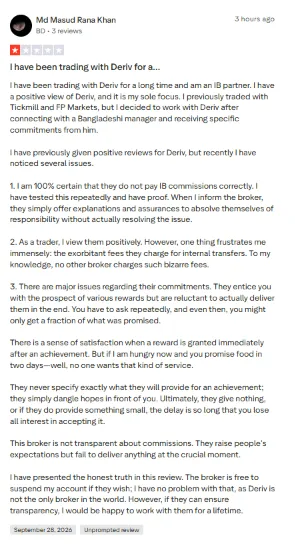
A user from Bangladesh reported that Deriv does not pay Introducing Brokers (IBs), who help connect brokerage firms with traders, their commissions on time. The IB appeared to have experienced this often and announced having proof supporting this claim. While the broker gives assurances, it allegedly fails to resolve any issue. The IB even pointed out the exorbitant internal transfer fees while sharing this Deriv review.
Investigating a Deriv Withdrawal Delay
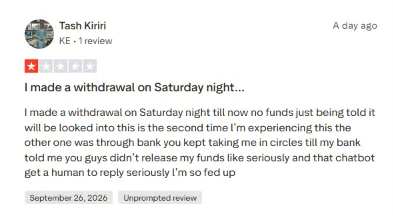
A Kenyan user reportedly faced a fund withdrawal issue, not once, but twice, on the Deriv platform. According to the trader, the first one was through the user's bank, which informed him that the broker did not process the release. And just a day ago, the very user accused the broker of causing a withdrawal delay. To learn more, read this Deriv review.
Examining a 150 Million Rupiah Frozen Case
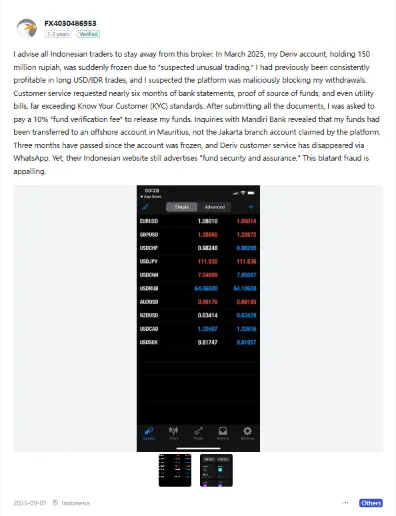
An Indonesian user reported a 150 million rupiah frozen incident on WikiFX, a renowned forex broker regulation inquiry tool. According to the trader, the broker froze the account due to suspected unusual trading. The user while claiming to have been profitable in long USD/INR trades accused Deriv of deliberately blocking his withdrawals. What's more, customer service requested the trader to share six months of bank statements, evidence of fund source, and even utility bills, way more than KYC standards, the trader added. Have a look at this complaint.
Deposit Credit Failure Allegations Against Deriv
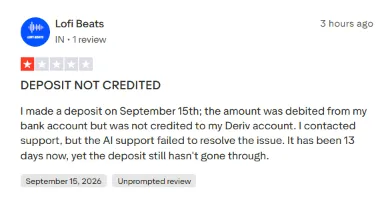
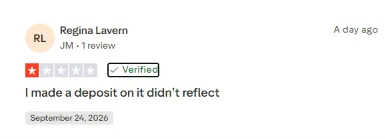
Users from India and Jamaica accused the broker of failing to credit their deposits made to the Deriv trading account. The Indian trader revealed that the fund was debited from his bank account. However, the same allegedly did not appear on the Deriv login dashboard. Have a look at these reviews.
A Pakistani Trader Raises Red Flags on the Broker's Index Trading Platform
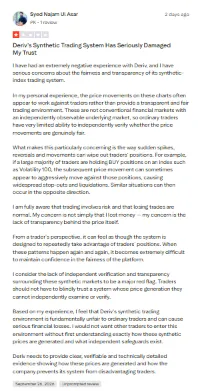
A user from Pakistan reportedly described a negative experience with Deriv, claiming that the price charts of its Synthetic Index Trading platform often used to work against traders. With no transparency, the trader claimed that users had very little ability to independently verify the authenticity of the price spike. The spikes, according to the trader, can eliminate traders' positions. While the trader acknowledged that risk was inherent in trading, his negative Deriv review had more to do with the lack of transparency regarding prices. Read this extensive complaint that seemingly expressed the user's frustration.
Investigating Multiple Trade Manipulation Complaints
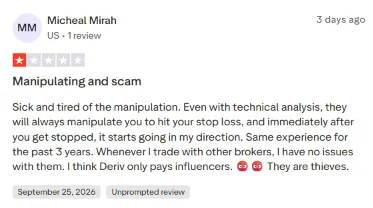
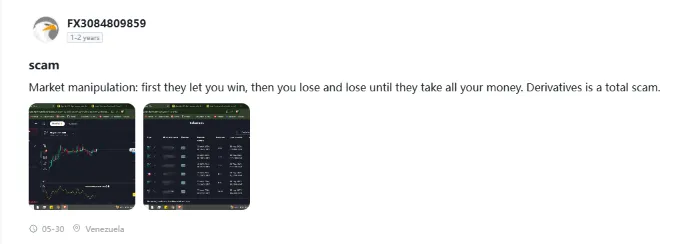
A user from the US reportedly hit out at the alleged manipulation in technical analysis that would trigger a stop-loss. Subsequently, the trade would go in the user's favor, preventing the client from maximizing. On the other hand, a Venezuala-based user complained that the platform would first let clients win before piling up losses for them. Read these multiple user allegations.
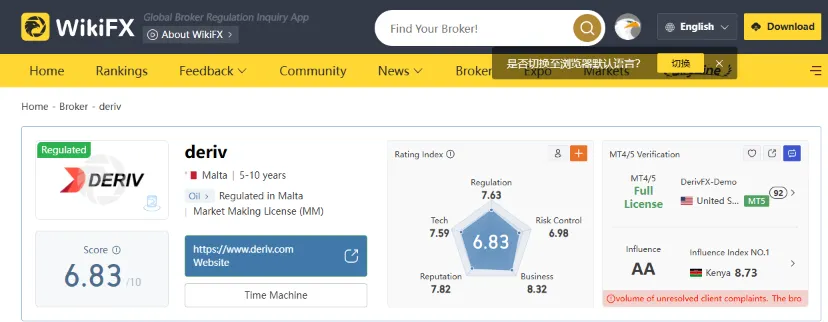
Deriv Regulation & User Trust Score
The answer to your question: Is Deriv regulated? is YES. It has multiple licenses from regulators worldwide. These regulators are the Malta Financial Services Authority (MFSA), the Capital Market Authority (CMA), the British Virgin Islands Financial Services Commission, Cayman Islands Monetary Authority, Vanuatu Financial Services Commission, and Labuan Financial Services Authority. Of these, four are offshore licenses, greatly hindering the safety net for traders in adverse circumstances such as the broker's bankruptcy. The user trust score stands at a reasonable 6.83 out of 10. If complaints continue to rise, the score may decrease.
Download the WikiFX app for the latest forex updates.

Knowledge pays at WikiFX.Every time you share a WikiFX article, you'll receive 50 Reward Points. Grow your rewards with every share and unlock exclusive gifts in the WikiFX Points Mall. Start earning today!


Read more

Gold Slid Despite the US-Iran Escalation, Rupee Opened 7 Paise Weaker at 95.88
Gold and silver fell after the weekend's US-Iran escalation, and Indian markets opened lower on 28 September. The rupee opened 7 paise weaker at 95.88 against the dollar. Brent crude traded around $107 a barrel. US 10-year yields sat near 5.20%. Those figures come from trader posts on X, not from any media report in this material. None of them has been independently confirmed. Treat them as what traders saw on their screens at the open, not as settled fact. The counterintuitive part is the metals. War usually pushes gold up. This time it didn't. "Both precious metals had other plans after this weekend's US-Iran war escalation," wrote @YuvrajShah02, an account with 15,103 followers, roughly two hours after the open. The same post says Indian markets "have also taken a hit today." That post is the event this article is about. Everything below comes either from it or from other trader posts published the same morning.
InstaForex Review of a USD 600 Deposit Complaint with Entity Limits
This InstaForex review revisits a Malaysian user's complaint dated 8 October 2021 about a USD 600 deposit, a matching bonus, and a rejected withdrawal. It is a historical case study for India and South Asia readers, not a new local incident. The website was checked on 28 September 2026. The central issue is how to distinguish account credit, withdrawable funds, and the company responsible for the account.
Savexa Review 2026: Examining Trade Allegations of Indian Users
Savexa, a Comoros-based brokerage firm, reportedly received mixed reviews from users across India. While some hailed its competitive spread and trade order execution capability, others report fake profit and constant deposit pressure. The negative Savexa reviews reportedly had more insights and depth, which called for an investigation. In this article, we have examined these reviews thoroughly and disclosed whether Savexa is regulated.

SEBI's New PMS Rules Let Fund Managers Run 'Sub-PMSes' — But the Fine Print is Still Open
SEBI's board on September 24 approved a sweeping overhaul of portfolio management rules, opening PMS to foreign securities, IPOs and a new mutual-fund-only route called PRIM. But one X user with 101,000 followers flagged a structural change that could reshape how PMS products are sold: a 'platform PMS' can now host independent fund managers (IFMs), each running their own strategy on the PMS's licence. Under the new SEBI (Portfolio Managers) Regulations, 2026, replacing the 2020 framework, existing PMS can invest in foreign securities under both discretionary and non-discretionary mandates, according to multiple media reports. The allowed list includes listed equity, debt, REITs, overseas mutual funds, ETFs, index funds and foreign government debt. All of it stays bound by FEMA and RBI's Liberalized Remittance Scheme — so you still can't buy foreign ETFs in rupees. The PMS just becomes a wrapper.
WikiFX Broker
Latest News
Romance and Investment Scams Drain Billions From Asia
 WikiFX
Fed Interest Rate Forecast: PCE Report Nears as 10-Year Yield Remains Above 5%
WikiFXTopstep Review: Is This Prop Trading Firm Safe & Trustworthy?
WikiFXInstaForex Review of a USD 600 Deposit Complaint with Entity Limits
WikiFXPRICE IS KING — BUT WHY IGNORE THE TOOLS THAT HELP YOU READ IT
WikiFXDeriv Review 2026: Reported Manipulative Trading Charts, Withdrawal Denial & Deposit Failure
WikiFXGold Slid Despite the US-Iran Escalation, Rupee Opened 7 Paise Weaker at 95.88
WikiFXTriumphFX Broker Exposed: Withdrawal Complaints and Regulatory Warnings
WikiFXRate Calc
