FII Exodus: Rupee Depreciation, 5% US yields — Why Foreign Capital Keeps Leaving India

Abstract:FIIs have been selling Indian equities for six years, and a viral post says the reason is simple: the rupee keeps falling, US yields pay 5%, so why would foreign money stay? Read on more updates.

FIIs have been selling Indian equities for six years, and a viral post says the reason is simple: the rupee keeps falling, US yields pay 5%, so why would foreign money stay? The post, from X user @VishnuFNO, has drawn 30 likes and 13 reposts in 11 hours. It also takes a swipe at the PMO, calling policymakers “brainless morons” who don't understand economics.
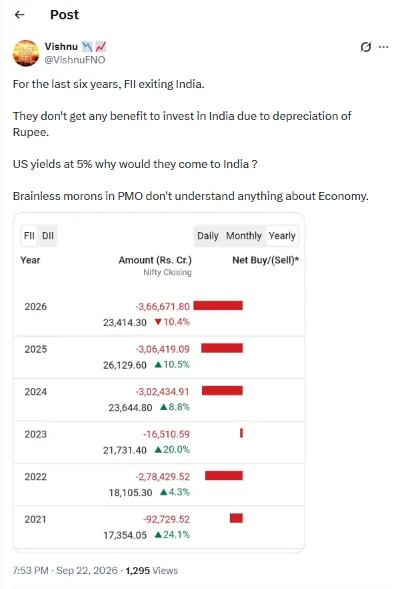
Is the post right? The data largely backs the first half. Foreign portfolio investors have pulled out Rs 20,974 crore from Indian equities through September 18, reversing two months of buying, according to Outlook Money. The Economic Times puts the September figure even higher at Rs 23,000 crore through September 19. Either way, it's a rout.
But the “six years” claim needs context. FIIs have been net sellers in most years since 2020, with occasional buying streaks. The Times of India reports that FPI outflows in September so far are nearly Rs 21,000 crore. The cumulative 2026 outflow has crossed Rs 2.32 lakh crore, surpassing the entire 2025 total, per Financial Express.
The Rupee's Slide: 95.96 and Falling
The rupee closed at 95.96 against the dollar on Tuesday, down 1.2% for the week, according to The Hindu BusinessLine. It breached the 95.80 support, opening the door for further decline. Market Insiders notes the rupee crossed 96 during the day — its sharpest weekly fall in four months.
The trigger? Persistent FII outflows, higher US bond yields, and geopolitical tensions lifting crude prices. Brent crude is at $106.50 a barrel, up 8.7% last week and nearly 2% more this week. Saudi Arabia shut its East-West pipeline after drone attacks, adding to supply fears.
The US 10-year Treasury yield briefly touched 5.04% on Tuesday, its highest since 2023. That's the “5%” the viral post cites. Higher US yields make dollar assets more attractive, pulling capital out of emerging markets like India.
Why 5% US Yields Matter to Your portfolio
The mechanism is straightforward. US Treasuries are considered risk-free. When they yield 5%, the return differential between safe US bonds and riskier Indian equities narrows. FIIs sell Indian stocks to lock in guaranteed dollar returns at home.
Ajay Bagga, a market expert quoted by Financial Express, puts it bluntly: “When their yields rise, the return differential between safe US Treasuries and riskier emerging market equities narrows.” Another analyst, Roy, adds: “As the US yields go up, the relative attractiveness of Indian yields goes down.”
This isn't just about stocks. The rupee's depreciation compounds the problem. An FII who bought Indian shares a year ago faces a double whammy: lower stock prices and a weaker rupee when converting back to dollars. The viral post's core argument — rupee depreciation erodes FII returns — is mathematically sound.
Where the Post Overreaches
The “six years” claim is a stretch. FIIs were net buyers in 2023 and parts of 2024. The current selling streak is real but not continuous. The post also blames the PMO, but the drivers are global — US Fed policy, crude prices, geopolitical risk — not domestic policy alone.
That said, the post's frustration echoes a genuine concern. India's record forex reserves — the RBI has been building them — haven't stopped the rupee's slide. The Times of India asks why the rupee is still not out of the woods despite record reserves. The answer: reserves cushion shocks but don't reverse structural outflows.
The Hindu BusinessLine's technical analysis suggests the rupee could see a temporary relief to 95.40-95.60, but the broader trend points to 96.25-96.50. The dollar index is rebounding from support at 98.60, currently at 99.60, with a potential rally to 101 if it breaks 99.80.
Sector-wise FII selling: Financials Hit, Healthcare Shines
FPI selling isn't uniform. Financial services bore the brunt, with outflows of Rs 6,204crore during September 1-15, the highest among sectors, per Outlook Money. Automobiles followed with Rs 2,670crore, oil and gas with Rs 2,385crore, FMCG with Rs 2,029crore, and power with Rs 1,653crore. Telecom and IT saw outflows of Rs 991crore and Rs 960 crore respectively.
Healthcare is the outlier. FPIs invested Rs 2,114 crore in the fortnight, their sixth consecutive buying streak. The Nifty Healthcare Index has risen 17.69% over six months, while the Nifty 50 gained just 1%. Mutual funds also raised healthcare allocation to 8.4% in August, the highest in 71 months, per Motilal Oswal.
The healthcare inflows are supported by structural factors. ICRA expects hospital revenue growth of 13-15% in FY27 and 15-17% in FY28. Diagnostics is seen growing 12-14% in FY27.
What Do the Numbers Mean for You?
If you hold Indian equities, FII selling pressure is a headwind. But domestic institutional investors are cushioning the fall. Mutual funds raised their healthcare allocation to 8.4% in August, the highest in 71 months, per Motilal Oswal. Healthcare has been the lone bright spot, attracting Rs 2,114 crore in FPI inflows during September 1-15.
For forex traders, the rupee's direction is clearer. Higher US yields and crude prices point to continued depreciation. The next key level is 96.25-96.50, per technical charts. If you're trading USD/INR, the cost of holding positions could shift as the RBI intervenes.
Social Media Discussion and Divergence
The viral post has sparked limited but pointed discussion. A second post from @RohitMalekar, with 13 likes, veers off-topic, discussing tokenization in India versus global headlines — not directly about FII flows. This suggests the FII debate is fragmented, with some users pivoting to other economic issues.
Neither post provides data beyond the claims. The original post's “six years” is unverified. The 5% US yield figure is accurate as of Tuesday. The “brainless morons” comment is opinion, not fact. Readers should treat the post as a sentiment indicator, not a research report.
The post's PMO criticism is also unsubstantiated. The drivers of FII outflows — US Fed policy, crude prices, geopolitical risk — are global, not domestic. Indian policymakers have limited control over these factors.
What to Watch Next
Track the rupee's weekly close. If it stays below 95.80, the bearish bias strengthens. Watch US CPI data — August core inflation rose 0.3% month-on-month, above expectations, which could push the Fed to hike again. Higher US rates mean more FII outflows.
The US 10-year yield at 5.04% is a key threshold. If it holds above 5%, expect continued pressure on emerging markets. The dollar index at 99.60, if it breaks 99.80, confirms a double-bottom pattern, targeting 101.
For equity investors, sector rotation matters. Financial services saw the heaviest FII selling at Rs 6,204 crore in the fortnight. Healthcare is the outlier. Check your portfolio's sector exposure against NSDL's FPI data, updated daily.
For forex traders, the rupee's path depends on RBI intervention. The central bank has record reserves to defend the currency, but it can't fight global yields forever. The 96.25-96.50 zone is the next test. If the rupee breaks that, the 97 handle comes into play.
Download the WikiFX app for the latest financial updates.

Knowledge pays at WikiFX.
Every time you share a WikiFX article, you'll receive 50 Reward Points. Grow your rewards with every share and unlock exclusive gifts in the WikiFX Points Mall. Start earning today!

Read more

Azure Markets Review After Its Licence Page Returned 404
This Azure Markets review examines an immediate verification problem: on 23 September 2026, the broker domain's regulations page returned 404, while its homepage showed only a server-status message. An older indexed registration claim and a reported USD84 withdrawal delay provide context, not proof of fraud or current authorisation. For South Asian readers, the practical question is what can still be verified independently.

BazaarFx Review: An FCA Warning and a UK Company Number
Most of what a BazaarFx review turns up online is opinion. Two records are not. The UK Financial Conduct Authority published a warning naming this brand on 13 August 2025, and Companies House holds a registration for a company using the name. Neither record settles the question of BazaarFx regulation in the way marketing pages usually imply, and the two are often mistaken for each other. This check was carried out on 22 September 2026; each record carries its own date.

XPO FUND Review After the BVI Statement of 16 March 2026
An XPO FUND review written from marketing copy will describe a funded-trader programme registered in the British Virgin Islands. The territory's own regulator describes something else. Its public statement of 16 March 2026 says the company behind the brand was never licensed there and had already been dissolved from the register. That single document changes how any claim about XPO FUND regulation should be read. This check was carried out on 22 September 2026; each record carries its own date.

RoboForex Review 2026: Fresh Trade Execution Complaints and Account Block Allegations
Did you witness trade execution flaws after RoboForex, a Belize-based brokerage firm, suddenly reduced leverage? Did wide spreads mar your trading experience? Did you face account restriction issues? Users have reported these and other complaints that arguably question the broker's credibility. In this RoboForex review, we have examined several user-reported allegations and answered whether RoboForex is regulated.
WikiFX Broker
Latest News
U.S. Dollar Moves Higher Despite Oils Pullback: Analysis For EUR/USD, GBP/USD, USD/CAD, USD/JPY
WikiFXRM330,000 Invested, Only RM35,000 Comes Back
WikiFXSTARTRADER Opens Weekend Trading on Two Chinese AI Stocks
WikiFXAzure Markets Review After Its Licence Page Returned 404
WikiFXXPO FUND Review After the BVI Statement of 16 March 2026
WikiFXWikiFX Wishes You a Happy Mid-Autumn Festival
WikiFXFXView Broker Review: Regulated but Is It Safe for Traders?
WikiFXFundingPips Review: Is This Prop Trading Firm Safe & Trustworthy?
WikiFXNAGA Review 2026: Reported Deductions on Winning Trades and Withdrawal Issues
WikiFXUS Dollar Price Forecast: Fed Rate Path Supports Dollar as EUR/USD and GBP/USD Diverge
WikiFXRate Calc
