Why the Ringgit Is Not Rallying Even After Softer US Inflation

Abstract:The ringgit gained against several major currencies on Thursday morning but weakened slightly versus the US dollar. Softer American inflation helped sentiment, yet investors remain reluctant to abandon the greenback before another important inflation report.
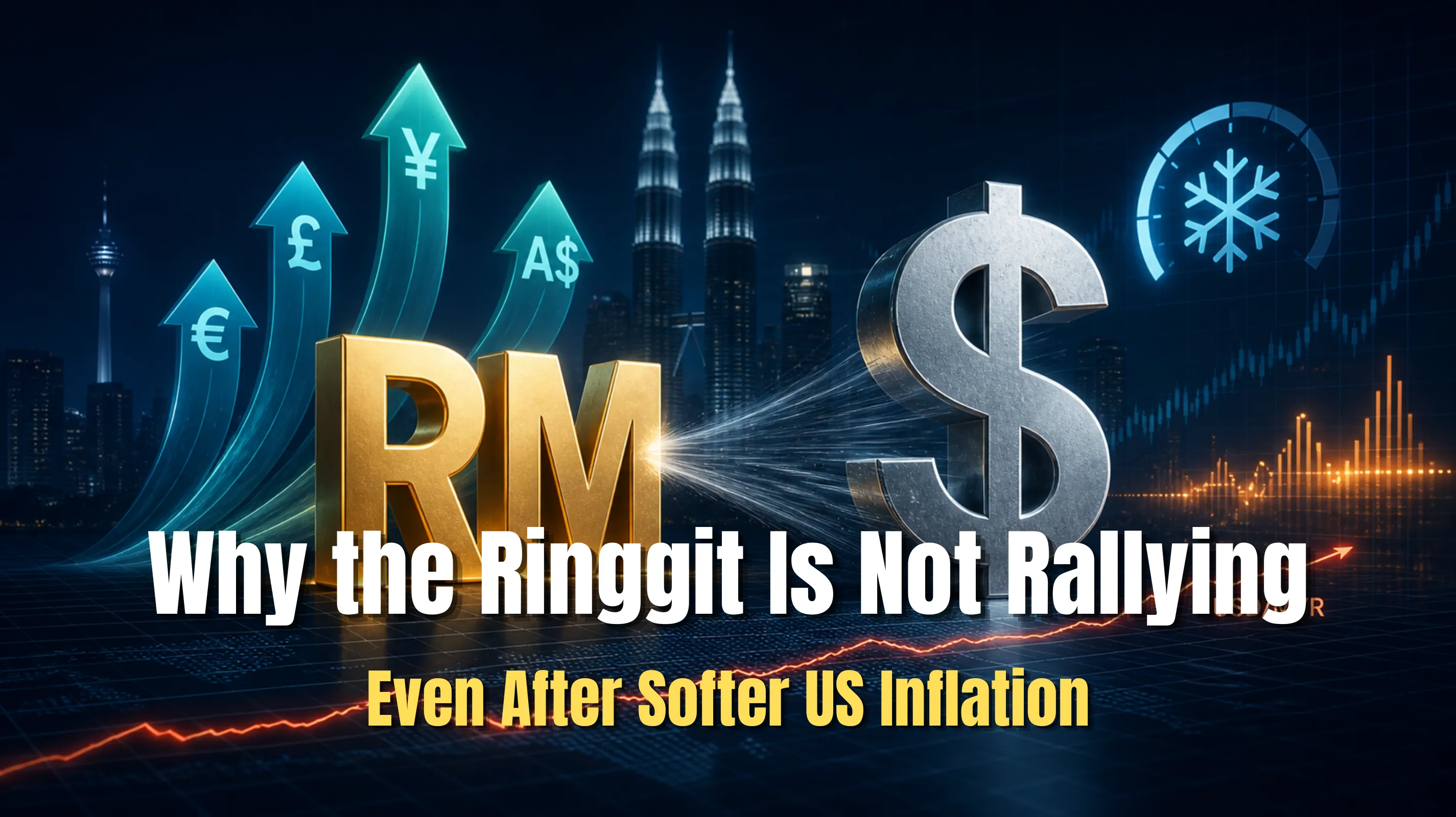
The Malaysian ringgit began August 13 on a mixed footing: stronger against several major currencies, but slightly weaker versus the US dollar.
At first glance, that may appear surprising. US consumer inflation moderated in July, reducing expectations that the Federal Reserve will raise interest rates at its September meeting. Lower US rate expectations would normally weaken the dollar and provide some breathing room for Asian currencies.
Instead, the ringgits reaction was restrained.
The reason is that markets are not trading on the Consumer Price Index alone. Investors are also waiting for Thursday nights US Producer Price Index, assessing the disagreement within the Federal Reserve and maintaining some exposure to the dollar amid geopolitical and energy-market uncertainty.
For anyone following the ringgit outlook, this mixed performance carries a clear message: softer US inflation is helpful, but it is not yet enough to produce a decisive USD/MYR move.
The Ringgit‘s Mixed Performance Is Not a Contradiction
The ringgit opened stronger against several major currencies on Thursday morning while easing marginally versus the dollar, according to Bernama’s August 13 market report.
This divergence reflects the different forces affecting each currency pair. The ringgit can appreciate against currencies such as the euro, pound or yen while simultaneously losing ground against the dollar.
Currencies do not rise or fall in isolation. Every exchange rate compares the relative strength of two currencies. If demand for the US dollar remains firm globally, USD/MYR can rise even when the ringgit is performing reasonably well against other currencies.
The dollar also holds a special position in global markets. It is the dominant reserve and funding currency and is commonly used as a defensive asset when investors face uncertainty. That demand can limit the ringgits gains even when US economic data appears dollar-negative.
The early trading movement should therefore be interpreted as caution, not necessarily broad-based ringgit weakness.
Softer US CPI Helped—But Did Not Settle the Debate
The latest inflation report offered genuine reasons for optimism.
US headline CPI increased 0.1% month-on-month in July after declining 0.4% in June. Annual inflation eased to 3.4% from 3.5%.
Core CPI, which excludes food and energy, rose 0.2% during the month and 2.5% from a year earlier. Shelter costs increased by only 0.1%, while energy prices fell 1.5%.
These figures support the argument that American inflation is gradually losing momentum. They also reduced the immediate pressure on the Fed to raise interest rates again.
However, inflation remains above the central banks 2% objective. Energy prices were also 14.7% higher than a year earlier, partly because gasoline prices had increased sharply over the 12-month period.
In other words, the report was softer—but not soft enough to guarantee that the Feds tightening cycle is over.
That distinction matters for the ringgit. A durable appreciation normally requires more than one favourable data point. Investors would need greater confidence that US rates have peaked and that Treasury yields are likely to move lower.
The Federal Reserve Is Still Divided
The cautious response also reflects a visible split within the Federal Reserve.
At its July meeting, the Fed kept the federal funds rate target at 3.50% to 3.75%. Three officials—Beth Hammack, Neel Kashkari and Lorie Logan—preferred to raise rates by 25 basis points.
A nine-to-three decision is a meaningful disagreement. It shows that the possibility of further tightening is not just a theoretical risk being discussed by traders. Several policymakers already believe current conditions justify higher rates.
The Fed also continued to describe inflation as elevated in its July policy statement. Therefore, while Julys CPI data weakened the case for an immediate hike, it did not close the debate ahead of September.
For USD/MYR, this creates a waiting game. Currency traders may be reluctant to sell dollars aggressively until the next set of inflation and employment data confirms that price pressures are cooling consistently.
Tonights PPI Could Determine the Next USD/MYR Move
The next major test is the July US Producer Price Index, scheduled for 8:30pm Malaysian time on August 13.
PPI measures changes in the prices received by domestic producers. Although it does not move in perfect step with consumer inflation, it can reveal whether businesses are experiencing cost pressures that may eventually reach consumers.
Junes headline PPI fell 0.3% month-on-month, driven by a 1.4% decline in goods prices. Services prices, however, increased 0.2%, while final-demand prices remained 5.5% higher than a year earlier.
That elevated annual reading helps explain why traders are unwilling to declare the inflation threat over before seeing the July figures.
Three broad scenarios could shape the ringgit forecast:
- A softer PPI report could reduce the perceived probability of a September Fed hike. US Treasury yields and the dollar may decline, potentially allowing the ringgit to strengthen against the greenback.
- A broadly neutral report may leave USD/MYR within its recent range. Investors would probably wait for further labour-market data and comments from Fed officials.
- A hotter PPI report could revive rate-hike expectations and lift demand for the dollar. In that scenario, the ringgit and other emerging-market currencies could face renewed pressure.
Investors should look beyond the headline number. Core PPI, service-sector costs and revisions to previous data may all influence the markets interpretation.
A Stronger Ringgit Creates Winners and Losers
A stronger ringgit is often welcomed because it can reduce the local-currency cost of imported products and foreign services.
Malaysian businesses that purchase raw materials, machinery or technology in US dollars may face lower costs when the ringgit appreciates. Consumers may also benefit through cheaper overseas travel, education and online purchases, although exchange-rate savings do not always reach retail prices immediately.
The effect on Bursa Malaysia is more complicated.
Export-oriented companies earning substantial revenue in US dollars may receive fewer ringgit when those earnings are converted. That can reduce the currency translation benefit enjoyed during periods of ringgit weakness.
By contrast, import-dependent companies may benefit from lower input costs. Airlines, consumer-product businesses and manufacturers relying on foreign equipment or components may become less exposed to currency pressure.
A weaker ringgit reverses much of this relationship. Exporters with dollar revenue may gain a translation advantage, while companies and households with dollar-denominated expenses face higher costs.
The effect therefore depends on each companys revenue mix, cost structure and hedging arrangements—not simply whether the ringgit rises or falls.
Bank Negara Malaysia Is Only One Part of the Equation
Malaysia‘s Overnight Policy Rate currently stands at 2.75%, according to Bank Negara Malaysia’s financial-market data. However, the ringgit is influenced by more than domestic interest rates. Bank Negara Malaysia
The gap between Malaysian and US yields can affect the relative attractiveness of ringgit assets. Foreign demand for Malaysian bonds and equities, commodity prices, trade flows and broader Asian currency movements are also important.
Bank Negara is unlikely to change policy in response to a single US inflation report. Nevertheless, the Feds decisions affect Malaysia through global capital flows, financing conditions and demand for the dollar.
This is why apparently encouraging US CPI data may not immediately translate into a stronger ringgit.
What Ringgit Traders Should Watch Next
The ringgits mixed opening suggests that markets want additional evidence before committing to a clear direction.
The immediate focus is the US PPI release at 8:30pm. After the figures arrive, investors should monitor US Treasury yields, expectations for the Feds September meeting, the dollar index and the reaction in USD/MYR.
Asian fund flows will offer the next layer of confirmation. A sustained rise in foreign participation in Malaysian equities or government bonds would provide stronger support for the ringgit than a brief post-data move.
The bullish case for the ringgit rests on continued US disinflation, lower Treasury yields and improving demand for Asian assets. The main counterargument is that persistent producer inflation, geopolitical risks or a more hawkish Fed could keep the dollar supported.
Softer US CPI has improved the ringgit outlook—but tonights PPI may determine whether that improvement becomes a genuine trend or remains another short-lived market reaction.
This article is for general information and education only. It does not constitute personalised financial or investment advice.

Read more

EUR/USD and EUR/JPY Outlook: Euro Strength Puts Breakouts in Focus
EUR/USD and EUR/JPY have both broken higher as the euro gains support from improved market sentiment and easing energy pressure. Key resistance and support levels are now coming into focus.

Is Malaysia the New Safe Haven? Global Investors Are Shifting Over Amid Middle East Turmoil
As global markets reel from the Iran conflict, Malaysia is rapidly becoming a critical safe haven for investors seeking to protect capital, driven by its energy advantage, policy stability, and accelerating growth in high value industries.
Exchange Rate Fluctuations: Key Facts Every Forex Trader Should Know
The forex market is a happening place with currency pairs getting traded almost non-stop for five days a week. Some currencies become stronger, some become weaker, and some remain neutral or rangebound. If you talk about the Indian National Rupee (INR), it has dipped sharply against major currencies globally over the past year. The USD/INR was valued at around 85-86 in Feb 2025. As we stand in Feb 2026, the value has dipped to over 90. The dip or rise, whatever the case may be, impacts our daily lives. It determines the price of an overseas holiday and imported goods, while influencing foreign investors’ perception of a country. The foreign exchange rates change constantly, sometimes multiple times a day, amid breaking news in the economic and political spheres globally. In this article, we have uncovered details on exchange rate fluctuations and key facts that every trader should know regarding these. Read on!

Fake FP Markets Exposure: Allegations of Fund Withdrawal Denials & Trade Manipulation
Did you experience a surprise cancellation of the profits made on the Fake FP Markets trading platform? Did you face more losses than what’s mentioned on your stop-loss order? Did you lose all your capital invested through a supposedly introducing broker? Failed to receive access to the FP Markets withdrawal despite a long delay from the application date? You are not alone! In this Fake FP Markets review article, we have investigated some complaints concerning withdrawal denials and trade manipulation. Read on as we share updates below.
WikiFX Broker
Latest News
NPBFX Broker Review: Regulated but Is It Safe for Traders?
WikiFXIndian Police Arrest Two in Alleged ₹10 Crore Crypto Investment Fraud
WikiFXRM12.47 Million in Cryptocurrency Vanishes From Malaysian Man’s Wallet
WikiFXU.S. Dollar Pulls Back From Yearly Highs: Analysis For EUR/USD, GBP/USD, USD/CAD, USD/JPY
WikiFXFirst Light News: Chip Rout Rattles Equities as Q3 Earnings Season Kicks Off
WikiFXClient Saved via WikiFX Exposure ! Is slay4x Considered a Safe Broker or a Scam in Q4 2026?
WikiFXUS Dollar Price Forecast: DXY Eyes 102.49, Can EUR/USD Hold 1.1180 Ahead of CPI?
WikiFXFirst Light News: US CPI, Aussie Jobs and Bank Earnings in Focus
WikiFXRetiree Loses RM118,000 Through Fake Stock Investment Website
WikiFXIndias retail inflation jumps to 5.54% in September, above estimates
WikiFXRate Calc
