BDSWISS Regulatory Status: A Complete Guide to Its Licenses and Company Registration
Abstract:When smart traders look at a new broker, the first and most important question is always about regulation. Before investing, understanding a broker's legal status and what protections they offer is absolutely essential. BDSWISS says it is a regulated trading partner globally. However, when we look closely at its regulatory setup, company structure and real-world track record, we find a big and worrying gap. The reality is much more complicated and concerning than what its marketing shows. This investigation will break down the key areas that every potential client needs to understand: its main offshore license, a history of serious regulatory warnings, a confusing company structure, and a huge number of user complaints that show a major problem. This analysis is designed to confirm your concerns and give you the evidence needed to avoid a potentially expensive mistake.
When smart traders look at a new broker, the first and most important question is always about regulation. Before investing, understanding a broker's legal status and what protections they offer is absolutely essential. BDSWISS says it is a regulated trading partner globally. However, when we look closely at its regulatory setup, company structure and real-world track record, we find a big and worrying gap. The reality is much more complicated and concerning than what its marketing shows. This investigation will break down the key areas that every potential client needs to understand: its main offshore license, a history of serious regulatory warnings, a confusing company structure, and a huge number of user complaints that show a major problem. This analysis is designed to confirm your concerns and give you the evidence needed to avoid a potentially expensive mistake.
Understanding The Official License
What “Offshore Regulated” Actually Means
The main company that most global clients deal with is BDS LTD. According to public records, this company is licensed by the Financial Services Authority (FSA) of Seychelles. This immediately puts the broker in a specific risk category.
The Seychelles FSA License (SD047)
The license held by BDS LTD is a Derivatives Trading License, number SD047, given by the Seychelles FSA. Importantly, independent rating platforms and regulatory experts all classify this as “Offshore Regulated.” This label is not neutral; it comes with a significant warning of “High potential risk.” While technically a licensed company, the level of protection and oversight this license provides is very small compared to what traders in well-regulated areas expect. This difference is not a small detail—it is the foundation of trader protection.
The Important Difference
To understand the risk, you must understand the huge gap between offshore regulation and the strict standards of top-level regulators. We have put together a comparison to show the key differences in trader protection.
| Feature | Top-Level Regulators (e.g., FCA, ASIC) | Offshore Regulators (e.g., Seychelles FSA) |
| Oversight | Strict, active, and frequent checks. | Often less strict, more reactive. |
| Client Fund Security | Required separate accounts, strict rules. | Rules may be less strict or poorly enforced. |
| Investor Compensation | Often includes a compensation plan (e.g., FSCS). | Usually no investor compensation fund. |
| Leverage Limits | Strict caps to protect regular clients. | Often allows very high leverage (e.g., 1:2000). |
| Dispute Resolution | Formal, independent complaint service. | Limited or non-existent; legal help is difficult. |
As the table shows, an offshore license means traders often give up basic protections, including access to a compensation fund if the broker goes bankrupt. This lack of a safety net is a major risk factor.
Checking The Current Status
A license is only one part of the story. The broker's real-world performance and safety rating are most important. While the Seychelles FSA license is its official regulatory credential, it is important to see how this translates to real-world safety scores and active warnings. We strongly encourage you to view the complete and up-to-date BDSWISS profile on WikiFX before proceeding.
A Series of Warning Signs
The Concerning Reality
A broker's trustworthiness is ultimately proven by its actions, not its paperwork. In the case of BDSWISS, the evidence gathered from regulatory bodies and a large number of users points to a serious operational crisis. The issues go far beyond the theoretical risks of an offshore license and into the practical, devastating reality of clients being unable to access their own funds.
Regulatory Warning: BaFin
A major warning sign appeared on March 1, 2022, when Germany's top financial regulator, the Federal Financial Supervisory Authority (BaFin), started an investigation into a BDSWISS company, BDS Markets. A public warning or investigation from a top-level regulator, such as BaFin, is one of the most serious alerts a trader can receive. It suggests possible unauthorized activities or serious rule-breaking within that area. Even though the investigation targets a specific company within the group, it casts doubt over the entire brand's compliance culture and operational integrity. Such an event should never be ignored.
What Users Are Saying
The most important and damaging evidence against BDSWISS comes directly from its users. An analysis of dozens of complaints filed throughout late 2024 and 2025 shows a consistent and devastating pattern of withdrawal failures. These are not isolated incidents but a clear sign of a widespread problem. We have organized the recurring themes below.
· Impossible Withdrawals: The most common and serious complaint is the complete inability to withdraw funds. Users report requests pending for months, some since September 2024. Direct quotes like *“Withdrawal = impossible, avoid at all costs!!!”* are common. Traders describe a system where deposits are processed instantly, but withdrawal requests enter a black hole of endless delays.
· Misleading Customer Service: When clients ask about their frozen funds, they report being met with a wall of repetitive and evasive excuses. Customer service agents repeatedly claim they are “fixing the withdrawal system” or facing “internal problems.” These excuses have been used for many months, which is not believable for a real technical issue, suggesting it is a delay tactic.
· Aggressive Fee Tactics: In a very concerning practice, users report that while their withdrawal requests are frozen and unprocessed, BDSWISS has charged their accounts “inactivity fees.” One user reported trying to withdraw their funds since October 2024, only to have the entire balance eaten up by inactivity fees in January and February 2025, even though the inability to transact was the broker's fault. This practice goes beyond poor service into what appears to be a predatory tactic.
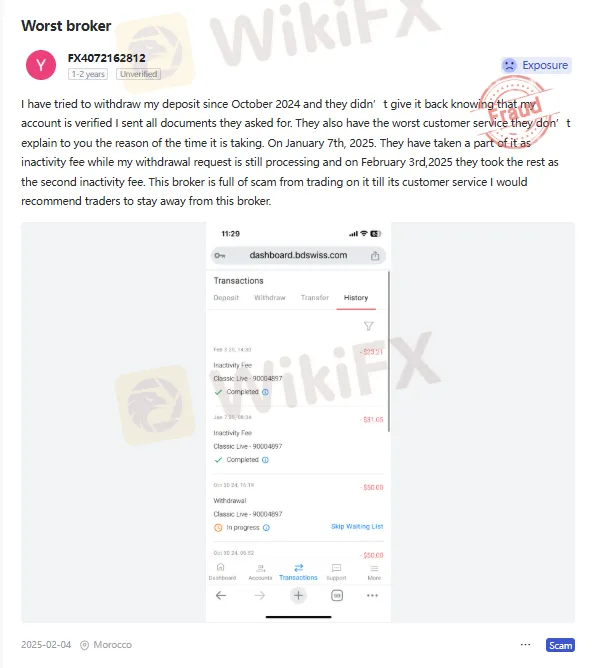
· Account Access Problems: Some users have reported being locked out of their accounts entirely after attempting to withdraw funds. This prevents them from even monitoring their trapped money, adding another layer of stress and lack of transparency.
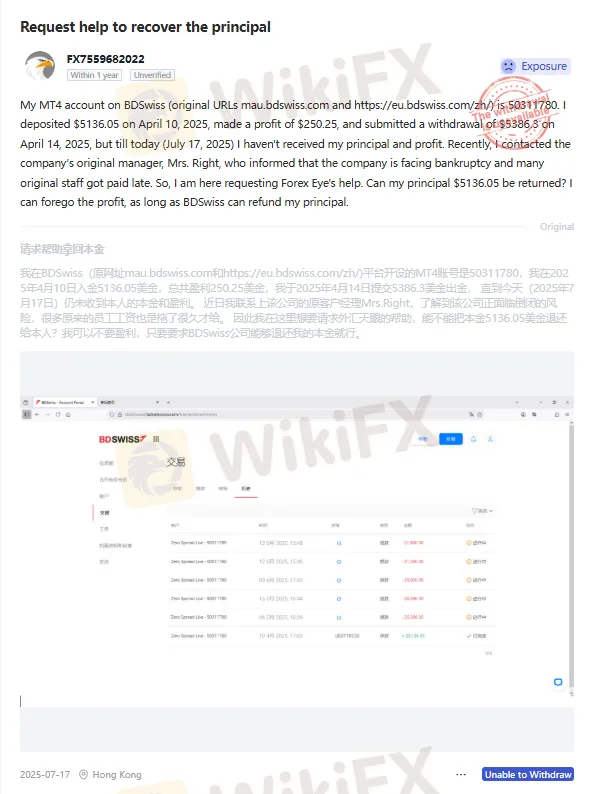
· Internal Problems: The most alarming piece of evidence comes from a user who was allegedly told by a company manager in July 2025 that the company is facing “bankruptcy” and that staff are not being paid on time. While this is a single report, it matches perfectly with the external symptoms of a severe money crisis—namely, the inability to process client withdrawals.
See The Evidence Yourself
The experiences detailed here are a summary of numerous public complaints. These are not just negative reviews; they are desperate pleas from traders who have lost access to thousands of dollars. We strongly advise you to read the first-hand user exposure reports on the BDSWISS WikiFX page to understand the full scope of the risks.
The Company Structure Puzzle
A Look at The Structure
Trustworthy brokers typically operate with a clear and transparent company structure. Clients should know the legal company they are dealing with and the laws that protect them. In contrast, high-risk operations often use a complex and fragmented web of different companies registered in various places. This can be a deliberate strategy to hide accountability and confuse clients. BDSWISS's company structure fits this high-risk pattern.
The BDSWISS Network
Our investigation found several companies associated with the BDSWISS brand, creating a confusing maze for any potential client or claimant:
· BDS LTD: Registered in Seychelles. This is the company holding the primary offshore license (SD047) and the one under which most global clients are likely registered.
· BDS Markets: Registered in Mauritius. This is the company that came under investigation by Germany's BaFin, highlighting the cross-border compliance risks.
· BDSWISS LLC: Registered in Delaware, USA. The source data shows this company exists, but its specific purpose and regulatory oversight concerning trading services are not clearly defined for global clients.
· BDS LTD.: Registered in Ontario, Canada. Another company registration whose function is not clearly tied to the trading services offered on the global website.
This fragmented structure is a significant warning sign. In the event of a dispute or a withdrawal failure, a client faces the difficult task of determining which legal company holds their funds, which area's laws apply, and who to hold accountable. This complexity works against the client and in favor of the broker, making it incredibly difficult to seek legal help.
Conclusion: A Fact-Based Decision
On BDSWISS's Trustworthiness
After a thorough review of the available evidence, we cannot be unclear. The information points to a broker in a state of serious crisis, posing an unacceptable risk to client funds.
Final Assessment
The verdict on BDSWISS Regulation is based on a combination of critical, undeniable warning signs:
· Weak Regulation: Its primary regulatory foundation is a single offshore license from Seychelles, which offers minimal trader protection, no compensation fund, and weak oversight.
· Serious Regulatory Warning: It has been the subject of an investigation by BaFin, one of the world's most respected financial regulators, casting serious doubt on its compliance standards.
· Overwhelming Negative Experience: There is a massive and consistent volume of user complaints from around the globe detailing a widespread failure to process withdrawals. This is the most serious warning sign a broker can have, strongly suggesting a fund crisis or fraudulent intent.
· Misleading Practices: The enormous gap between its marketing claims of being a reliable trading partner and the user-reported reality of frozen funds and predatory inactivity fees is unacceptable.
Based on all of this evidence, depositing funds with BDSWISS carries an extremely high and unacceptable level of risk. The widespread, unresolved issues with withdrawals are a clear and present danger to your capital.
Your First Line of Defense
Protecting your investments is most important. The issues highlighted with the BDSWISS License underscore the vital importance of thorough research. Before depositing with a broker, make it a non-negotiable step to check its complete profile, license status, and real-time user reviews on a trusted platform such as WikiFX. Download the app to start experiencing the best-in-class broker regulation inquiry experience.

Read more
TenX Prime Review: Investor Complaints and Regulatory Questions
This TenX Prime review examines the broker through the lens of regulatory status and user complaints recorded on WikiFX.
Exclusive Markets Exposed: Low Ratings, Missing Offices, and Investor Warnings Raise Red Flags
This Exclusive Markets review provides a detailed analysis of the broker’s regulatory framework, licensing structure, WikiScore rating, and user feedback based on information available on WikiFX.
BDSWISS Legitimacy Check: Is This a Fake Broker or a Legitimate Trading Partner?
You're asking 'Is BDSWISS Legit?' or maybe even 'Is BDSWISS a scam?' and you need clear, factual answers. The worry behind that question makes sense. When your capital is at risk, trust isn't just a nice extra feature; it's absolutely essential. This article promises a direct, fact-based investigation into whether BDSWISS is legitimate. We will cut through the marketing hype and analyze the broker based on three key areas: its regulatory status, independent expert ratings, and most importantly, a large number of real, recent user complaints. Our analysis is based on solid data to give you the clarity you need. We understand how serious your concern is, and our goal is to present the facts without exaggeration, allowing you to make an informed decision to protect your investments.
OnEquity Review: Regulation, WikiFX Score, & Hidden Fee Warnings
Is OnEquity a safe broker? Discover OnEquity’s regulatory status, its WikiFX score, and critical user exposure cases. Get the facts before you login or trade Forex with OnEquity. Read our in-depth review now!
WikiFX Broker
Latest News
ZERO MARKETS Review: Scam Warning & $116K Withdrawal Blocked
 WikiFX
XS Broker Review 2026: Withdrawal Scams & Regulation Issues
WikiFX24markets Exposed: Cloned License, $45,500 User Losses, and Withdrawal Scams Signal Stark Warning
WikiFXFOREX.com Analysis Report
WikiFXAXIORY Regulatory Status: A Complete Guide to Its Licenses and Company Details
WikiFXIs AXIORY Safe or Scam? A 2026 Deep Dive
WikiFXTradeview Markets Review: Regulation, WikiFX Score & Forex Trading Insights
WikiFXBinany Review: Examining Reported Withdrawal Denials & Deposit Failure Complaints
WikiFXMr Pips Forex Scam Exposed as Losses Hit RM240 Million
WikiFXCySEC Sets 8 May Deadline for CFD Brokers to File Last Year’s Data
WikiFXRate Calc
