Xlibre Deposit and Withdrawal Methods: A Complete 2026 Review

Abstract:When choosing a broker, how you move capital in and out of your account is extremely important. Investing funds and withdrawing them out are not just simple tasks - they show whether a broker is trustworthy and works properly. It doesn't matter if putting money in is easy if you can't get your money back out. This guide explains Xlibre deposit and withdrawal methods, but we also talk about managing risks and being careful. Sometimes it's easy to deposit funds in an account, but very hard to take out your profits and original capital. Our main goal is to keep your funds safe by giving you a clear analysis of how these processes work and, more importantly, what risks they involve.
Understanding Fund Transactions
When choosing a broker, how you move capital in and out of your account is extremely important. Investing funds and withdrawing them out are not just simple tasks - they show whether a broker is trustworthy and works properly. It doesn't matter if putting money in is easy if you can't get your money back out. This guide explains Xlibre deposit and withdrawal methods, but we also talk about managing risks and being careful. Sometimes it's easy to deposit funds in an account, but very hard to take out your profits and original capital. Our main goal is to keep your funds safe by giving you a clear analysis of how these processes work and, more importantly, what risks they involve.
What This Guide Includes
This guide gives you detailed information about the official Xlibre deposit and withdrawal methods. We will look beyond what the broker says in its advertising to carefully examine the possible risks, how long transactions take, and what real users have experienced. Our goal is to give you the complete picture so you can make a smart decision and protect your investments from unexpected problems.
Before trusting a broker, you must check if it is properly regulated and read what users say about it. This essential step can prevent you from losing a lot of capital. For example, a quick check on a broker verification website, such as WikiFX, can show you important information, such as Xlibre's unregulated status and high-risk warnings from users. You can see the full report here.`
Investing in Xlibre
This section shows the deposit methods that Xlibre says it offers, based on information available to the public. It gives you the step-by-step information that users often look for, presented in a clear, organized way that's easy to understand. Knowing these official methods is the first step, but you must also carefully think about the risks involved in the transaction.
Official Deposit Methods
Xlibre claims to accept payments through several common systems. To make this clear, we have organized the available information into a table. This format lets you quickly compare the methods, their stated fees, and the expected processing times that the broker provides.
| Deposit Method | Associated Fees | Stated Processing Time | Important Notes |
| VISA | No fee stated | Up to 10 minutes | Card payments are common but depend on your bank's processing and international transaction policies. |
| MasterCard | No fee stated | Up to 10 minutes | Similar to VISA; ensure your card is cleared for international payments to avoid declines. |
| SWIFT Bank Transfer | No fees for deposits > $100 | 2-7 business days | This method is significantly slower and is typically used for larger sums of capital. |
Important Deposit Considerations
While investing may seem simple, you must think about several important factors before committing your capital. The biggest concern with an unregulated broker, such as Xlibre, is that there's no guarantee your funds will be kept separate from the company's capital. In a regulated environment, client funds must be kept in separate accounts from the company's operating capital, protecting it if the broker goes out of business. With an unregulated company, this protection doesn't exist, meaning your personal funds could be at risk of being mixed together and used for company expenses.
Also, traders must understand what we call the “point of no return.” Depositing funds is designed to be easy and smooth by almost all brokers, whether they are legitimate or not. A smooth deposit experience is not, and should never be taken as, a sign that a broker is trustworthy or that withdrawing will be easy. The real test of a broker's character and reliability is always the withdrawal process.
The Xlibre Withdrawal Process
This section provides a deep look into the Xlibre withdrawal process. We will examine what the broker says about its methods and timelines, but more importantly, we will focus on the documented risks and problems that users have reported. This is the most important part of our analysis, because being able to successfully withdraw capital is the most critical function of any brokerage service. We move from what the broker claims to what users actually experience.
Stated Withdrawal Methods
Xlibre outlines several ways to withdraw capital, which are similar to their deposit options. However, a closer look shows a serious lack of detail, especially about fees. This unclear information is a major warning sign. We present the official information in the table below.
| Withdrawal Method | Associated Fees | Stated Processing Time |
| VISA | Not explicitly stated | 2-7 business days |
| MasterCard | Not explicitly stated | 2-7 business days |
| SWIFT Bank Transfer | Not explicitly stated | 2-7 business days |
Reported Withdrawal Problems
This is where claims meet reality. A review of public user complaints shows a troubling pattern of withdrawal difficulties. These are not small delays but serious claims involving large capital, suggesting major problems within the broker's payment processing operations.
We can analyze the evidence from user complaints filed on platforms such as WikiFX. These firsthand accounts provide valuable insight that cannot be found in a broker's promotional materials.
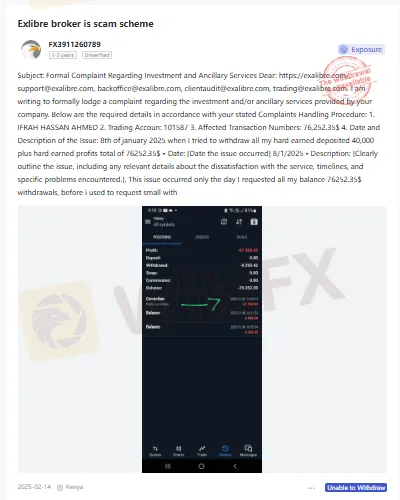
Case Study 1: On February 14, 2025, a user filed a formal complaint about a failed withdrawal attempt of $76,252.35. The user clearly states that the problem began exactly when they tried to withdraw their full balance, which included both their original deposit and earned profits. This situation, where withdrawals are blocked only when a user tries to cash out completely, is a classic tactic reported in connection with high-risk operations.
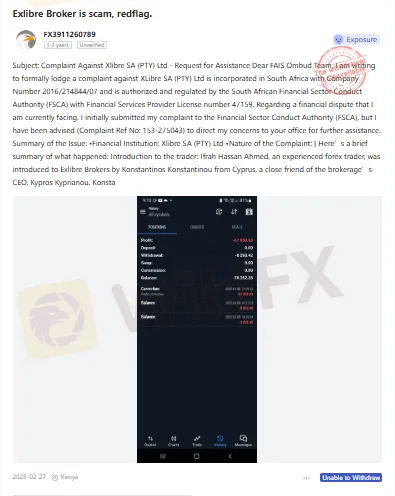
Case Study 2: Another complaint, filed on February 27, 2025, is even more direct. The user calls the broker a “scam” and a “red flag.” The user also mentions filing a formal complaint with regulatory bodies, showing a serious dispute where the client felt their funds were being unfairly held.
These are not isolated incidents; they are data points that strongly suggest a pattern of severe withdrawal problems. The stated processing window of “2-7 business days” should not be viewed as a standard service agreement. In light of these user reports, it must be interpreted as a potential period during which delays, excuses, and complications can arise, especially when significant profits or full account balances are requested. The gap between what the broker states and what users actually experience is a critical warning sign.
Analyzing Xlibre's Risk Profile
To fully understand why Xlibre deposit and withdrawal processes are filled with risk, we must connect them to the broker's basic operational and regulatory profile. The problems with transactions are not random; they are symptoms of a deeper lack of accountability and oversight. This analysis explains the “why” behind the warnings, helping you identify similar red flags with other brokers.
Impact of No Regulation
Regulation is the foundation of trust in the financial industry. A regulated broker is subject to oversight from a government-backed authority that enforces rules designed to protect investors. These rules often include mandatory fund separation, capital adequacy requirements, and access to an investor compensation scheme in case the broker fails.
The facts about Xlibre's status are clear and concerning:
· Broker: Xlibre
· Registered Region: Mauritius
· Regulatory Status: Unregulated
· WikiFX Score: 1.33 / 10 (a critically low score indicating extreme risk)
Operating without a valid regulatory license means there is no third-party authority to hold the broker accountable for wrongdoing. If Xlibre chooses to delay or deny a withdrawal request, there is no official regulator you can appeal to for help. Your capital is not protected by any compensation scheme, and the broker has no legal obligation to a higher authority to process your payment. This places the trader in a position of extreme vulnerability, where the broker holds all the power.
Claims Versus Reality
A telling sign of a high-risk broker is a big difference between its marketing claims and its verifiable status. In its list of “Pros,” Xlibre mentions “Fund segregation.” However, for an unregulated broker, this claim cannot be enforced and cannot be independently verified. There is no auditor or regulator ensuring that this practice is actually being followed. This is a critical point of contradiction that severely undermines the broker's trustworthiness.
When a broker's claims do not match its regulatory status, it is a major red flag that should not be ignored. Verifying these details is an essential step for any trader. The documented user complaints about Xlibre withdrawal failures on its WikiFX profile serve as a stark, real-world confirmation of the risks implied by its unregulated status and contradictory claims. You can review this evidence for yourself here.`
How to Verify a Broker
Given the significant risks associated with Xlibre, the most logical and safest course of action is to pause and conduct thorough verification. This section shifts from analyzing the problem to presenting a clear, actionable solution. By following a structured due diligence process, you can protect your capital not only from this specific broker but from any potential scams you may encounter in the future.
Pre-Transaction Checklist
Before depositing funds with any broker, use this simple checklist to perform your initial due diligence. Completing these steps takes only a few minutes but can save you from months of stress and potential financial loss.
· Check Regulatory Status: Is the broker regulated by a top-tier authority? Look for regulators such as the FCA (UK), ASIC (Australia), or CySEC (Cyprus). “Unregulated” or regulation from a weak offshore jurisdiction is a major warning.
· Read User Reviews & Complaints: Search for real user feedback on independent platforms. Pay special attention to comments about the withdrawal process, as this is where problems most often surface.
· Verify Company Information: Does the company's registered address and contact information seem legitimate? Be wary of brokers with no physical address or only a P.O. box.
· Use a Verification Tool: Leverage a trusted third-party app or website designed to consolidate this information for you.
Our Strong Recommendation
Based on the overwhelming evidence—the complete lack of valid regulation, the critically low trust score of 1.33 out of 10 and the severe, documented user complaints regarding failed withdrawals—we cannot recommend depositing capital with Xlibre. The risks far outweigh any potential benefits the platform may claim to offer.
The single most important step you can take to protect yourself before sending depositing with *any* broker is to check its complete profile on a comprehensive verification platform such as WikiFX. This tool is designed to do the heavy lifting for you, bringing together regulatory data, license details, server locations and real user reviews into a single, easy-to-understand report. It cuts through marketing claims and provides an unbiased picture of a broker's operational history and credibility.
Take action now. Before considering any online broker, make it a habit to search for it on WikiFX. See the complete, unbiased picture and make decisions based on facts, not promises. You can start by reviewing the full evidence on Xlibre for yourself here.
For extensive analysis on brokers, their regulatory status, scam reports (if any) and other updates, download the WikiFX app today. Scan the QR code below to get started.

Read more

Xlibre User Reputation: Looking at Real User Feedback and Common Complaints to Check Trust
When traders want to know if a broker is safe or a scam, they want a clear answer based on facts. After carefully studying regulation data and reports from users, Xlibre appears to be a high-risk brokerage. The direct answer to "Is Xlibre Safe or Scam?" is clearly no - it's not safe. The platform works without any proper financial regulation from a trusted authority, which is absolutely necessary to keep traders’ finances safe. This lack of oversight gets worse when you add the serious user complaints saying they cannot withdraw large amounts. These two problems - no regulation and believable claims about blocked withdrawals - are major warning signs. While "scam" is a legal term, Xlibre shows a pattern that puts it clearly in the unsafe and untrustworthy category. This article will break down the evidence step by step, giving you the information you need to make a smart decision and protect your capital.

Italy’s CONSOB Orders Blocking of Three Unauthorized Investment Websites
Italy’s financial markets regulator, Commissione Nazionale per le Società e la Borsa (CONSOB), has announced the blocking of access to three websites offering unauthorized investment services as part of its ongoing efforts to combat online financial fraud.
HeroFx Review: Withdrawal Problems, Scam Alert & Risks
Is HeroFx safe? Uncover withdrawal problems, payout issues, and scam risks before depositing. Download the WikiFX App now for regulation checks and trader complaints.
Warren Bowie & Smith Review: No Regulation, Risk Alert
Warren Bowie & Smith lacks valid regulatory oversight, raising serious risk concerns. Read this broker review and check warning signs now with the WikiFX App.
WikiFX Broker
Latest News
TAG MARKETS Review 2026: Allegations of Withdrawal Denials & Trading Glitches
WikiFXWikiFX Wishes You a Happy International Women's Day
WikiFXRetiree’s Tabung Haji Savings Gone: Elderly Retiree Loses RM277,000 After One Whatsapp Message
WikiFXOil prices jump above $100 for first time in four years
WikiFXForex Brief: Dollar Dips Ahead of NFP; RBA Bets Lift AUD
WikiFXCrude Oil Rallies to $85 on Escalating Middle East Geopolitical Risks
WikiFXChina Signals Tolerance for Slower Growth with Revised 2026 Outlook
WikiFXOil Surges as Qatar Warns of $150 Crude and 'Force Majeure' Across Gulf Exporters
WikiFXJRJR Review: Safety, Regulation & Forex Trading Details
WikiFXHeroFx Review: Withdrawal Problems, Scam Alert & Risks
WikiFXRate Calc
