EUR/USD Weekly Forecast: Wavers Ahead of US NFP Data

Abstract:The EUR/USD pair ended the week in the red last week as many investors remained in a holiday mood. It was trading at 1.1720, down slightly from last year’s high of 1.1910 ahead of key events this week.
US Non-Farm Payrolls Data
The EUR/USD exchange rate will likely be volatile this week as investors react to the upcoming US Non-Farm Payrolls (NFP) data, which are scheduled on Friday.
The report is expected to show that the American economy added over 55k jobs in December after adding 64k in the previous month. Most notably, the report is expected to show that manufacturing jobs continued falling, mostly because of Donald Trump's tariffs.
Economists expect the upcoming report to show that the unemployment rate dropped to 4.5% in December from the previous 4.6%. The unemployment rate has jumped in the past few months because of Donald Trump's policy to purge thousands of government workers.
The upcoming jobs report comes a week after the Federal Reserve published minutes of the last monetary policy meeting. These minutes showed that most officials hinted that they were supportive of interest rate cuts if the country's inflation continues falling.
The EUR/USD pair will also react mildly to the weekend events in which Donald Trump invaded Venezuela, took its leader, and charged him in a New York court. While Venezuela has vast oil resources, the amount of oil it ships to other countries is relatively lower than other countries.
The other major catalysts for the EUR/USD pair will be the upcoming macro data from Europe and the United States. For example, the ISM will publish the latest manufacturing PMI numbers, which will provide more data on the state of the sector.
Also, Eurostat will release the latest consumer price index (CPI) data on Wednesday, which will provide more information about the state of inflation and hints on what to expect from the European Central Bank.
EUR/USD Technical Analysis
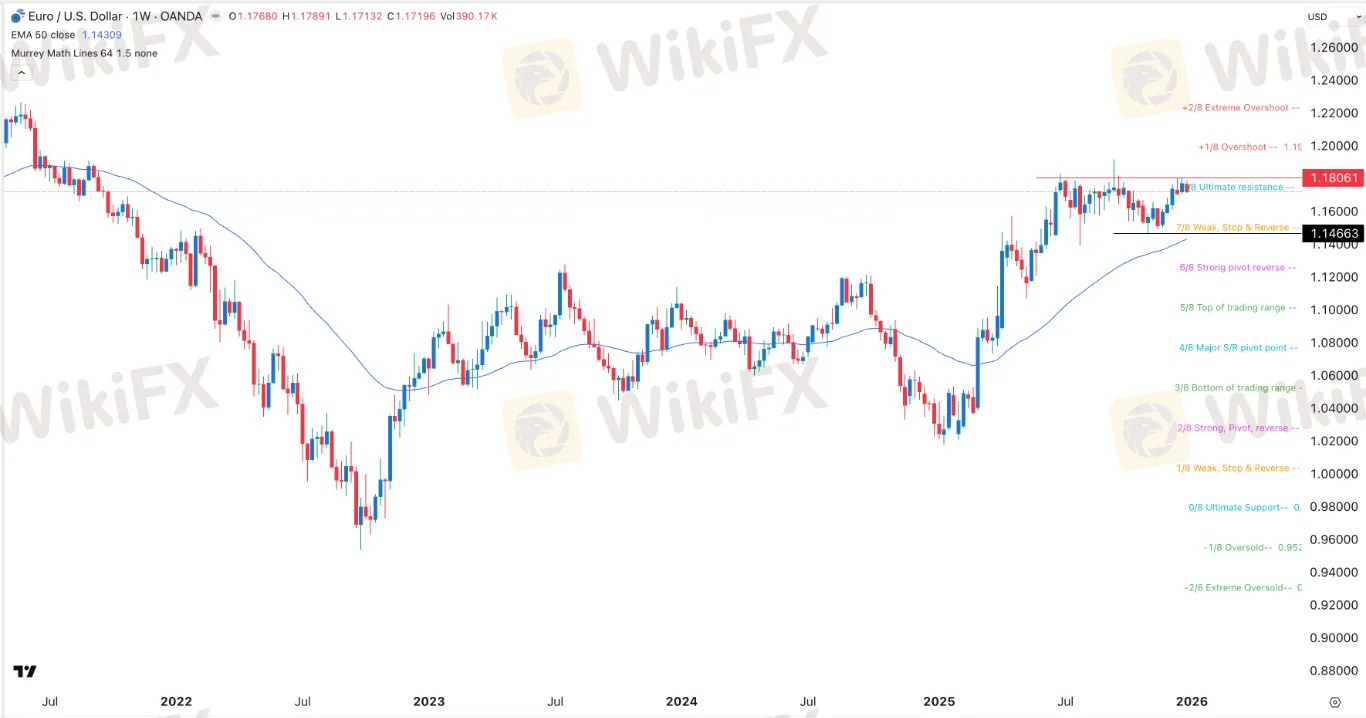
The weekly chart shows that the EUR/USD pair has remained in a tight range in the past few weeks. It was trading at 1.1720 on Friday, down slightly from last month's high of 1.1806.
The pair has remained slightly above the 50-week and 25-week Exponential Moving Averages (EMA), a sign that the bullish trend will continue. It has also remained above the Supertrend indicator.
However, a closer look shows that it has formed a double-top pattern at 1.1800 and a neckline at 1.1466. It also remains at the ultimate resistance level of the Murrey Math Lines tool.
Therefore, there is a likelihood that the pair will retreat this week as investors price in geopolitical risks. If this happens, it may drop to the key support level at 1.1600. A move above the resistance at 1.1800 will invalidate the bearish outlook.
Read more
EUR/USD and EUR/JPY Outlook: Euro Strength Puts Breakouts in Focus
EUR/USD and EUR/JPY have both broken higher as the euro gains support from improved market sentiment and easing energy pressure. Key resistance and support levels are now coming into focus.

Breaking: USD/JPY Breaks Through 1 Year Highs
USD/JPY just broke through 1-year highs earlier than expected.
U.S Dollar Gains Against Other Majors.
A Good Week For the US Dollar As It Gains Strongly Against Other Major Pairs.

Chinese Yuan makes new highs marking an historic performance.
Performance like this hasn't been seen since 2021
WikiFX Broker
Latest News
LQH MARKETS Review: Multiple Traders Report Withdrawals Blocked and Accounts Terminated
WikiFXSpread Cheating: The Invisible Trading Cost That Could Be Working Against You
WikiFX"They Want to See Your Face": Inside ATFX Cambodia's Rise
WikiFXTrump Memecoin Faces SEC Scrutiny After Nearly One Million Investors Suffer Heavy Losses
WikiFXApple Faces Lawsuit Over Fake Crypto App Exposing $1.8 Million Theft
WikiFXBorn2trade Adds Copy Trading to 1:5000 Leverage Platform
WikiFXLevels Review: No Regulation and Mounting Withdrawal Complaints – What Traders Need to Know
WikiFXPILOTFX Review: What Traders Should Know Before Depositing
WikiFXLMAX Group Review 2026: Users Report Disturbing Withdrawal Issues - Is the Broker Still Reliable?
WikiFXLuno Review: Unregulated Broker Warning After Frozen Accounts and Blocked Withdrawals
WikiFXRate Calc

