DMA Trading vs OTC Trading - Which Suits You?

Abstract:Foreign exchange trading is basically of two types: Direct Market Access (DMA) and Over the Counter (OTC). Both come with their own pros and cons. It’s important to understand these two concepts before figuring out the differences between them. In this article, we will explain all of these.
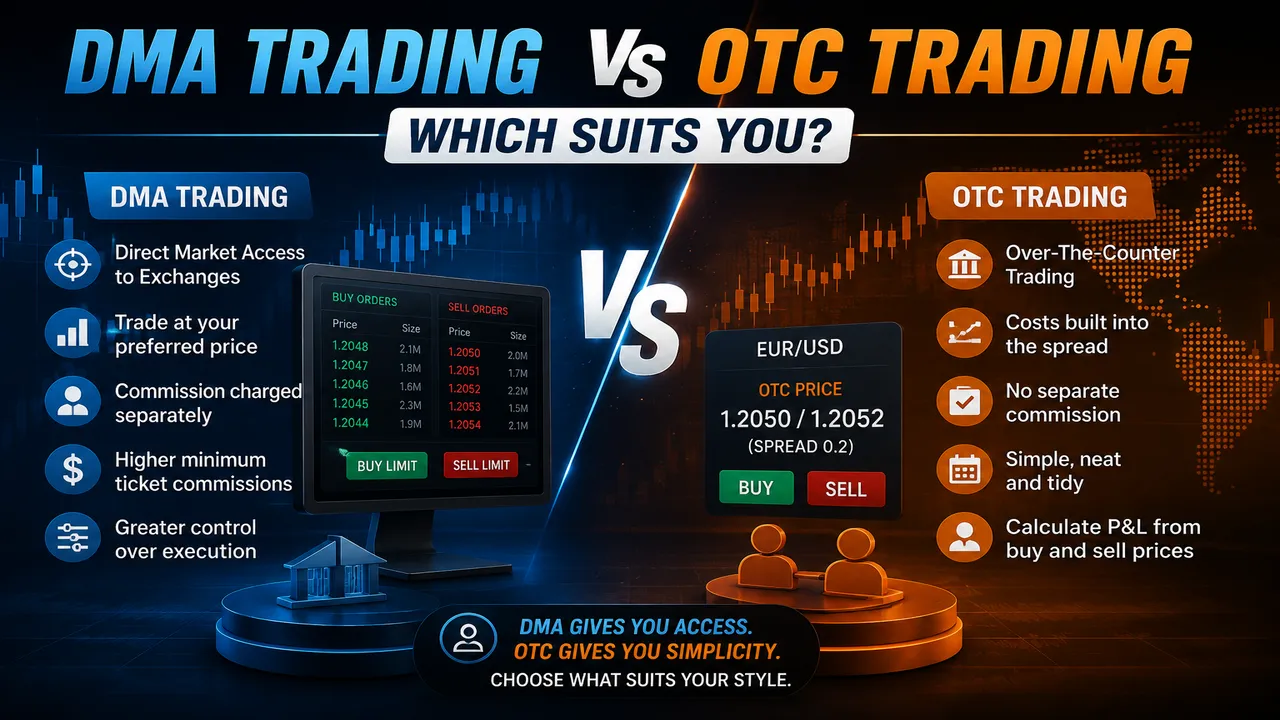
Foreign exchange trading is basically of two types: Direct Market Access (DMA) and Over-the-Counter (OTC). Both come with their own pros and cons. Its important to understand these two concepts before figuring out the differences between them. In this article, we will explain all of these.
What is DMA Trading?
DMA trading is a tool to deal in on-exchange contracts. This tool lets you trade prices set by several brokers and market makers, who feed their orders into a central exchange. This remains suitable for users with high-frequency trades. This set of users are usually professional or institutional traders, as well as scalpers.
Benefits of DMA Trading
- Better Pricing
- Enhanced Liquidity
- Availability of highly complex order types
Potential Shortcomings
- Commission applicable after trades
- Exchange fees (generally) charged on orders
- Live data subscriptions can increase for smaller accounts.
What is OTC Trading?
OTC trading platforms are a tool where users trade against the brokers price. Brokers can sometimes hedge a trade in the underlying market. However, the b-book usually manages the retail order flow. Retail traders with not much in need of liquidity for smaller orders will likely choose this trading tool.
Benefits of OTC Trading
- The price is inclusive of the commission.
- Seamless Profit & Loss Calculation
- Competitive prices
Potential Shortcomings
- Potential bet against your trades by the broker
- Counterparty risks with the broker
- The broker can willfully widen your prices.
Crucial Differences Between DMA and OTC Trading
Retail traders who want to upgrade from a CFD or spread betting broker to a DMA trading platform should be aware of the differences between DMA and OTC trading.
DMA Trading is Not Free of Taxes
Using a spread betting broker for trading comes with the obvious tax benefit. Yes, there are no taxes. Since these trades are structured as an amount per point move bet, they do not come under the purview of capital gains tax. As a profitable trader acting on your own, you need to assess which is more important - whether or not paying taxes on profits or direct market access. DMA trading is not available through spread betting. For this, you need a CFD broker.
Tighter Prices in DMA Trading
DMA trading lets you have direct market access to the underlying exchange. For example, if you trade a stock on the exchange: DMA:644.5/644.8 versus CFDs/spread betting: 644.5/646. However, with the DMA, the price becomes better as you can easily put your buy or sell orders within the spread to make it tighter. So, if you want to purchase at 644.6 instead of the offered price (644.8) and there are no sellers, you wont get filled. However, the scope for better pricing is enhanced.
Reduced Admin Expenses in OTC vs High Commission in DMA
One of the key advantages of OTC CFDs and spread betting is simplicity: most trading costs are built into the spread. You see the price, place the trade, and calculate your profit or loss from the buy and sell prices—without having to separately account for commission or administration.
DMA works differently. With direct market access, your orders are sent directly to the exchange through your broker. Instead of buying at the offer or selling at the bid, you can place a limit order at the bid and sell at the offer. Youre filled at your chosen price when another market participant is willing to trade against your order.
The trade-off is that DMA brokers charge commission separately, usually when you open and close a position. They may also impose minimum commissions per trade, which can make DMA less attractive for smaller traders. For example, if the round-trip minimum commission is around £10, a scalper needs to capture enough points to cover that cost before making a profit.
With OTC spread betting or CFDs, the broker effectively builds its costs into the quoted spread. With DMA, you get more direct control over your entry and exit prices, but you have to factor commission into every trade.
Ultimately, it comes down to preference. OTC CFDs and spread betting are neat and straightforward; DMA offers greater control over execution but comes with additional commission and cost considerations.
Download the WikiFX app for the latest forex updates.

Knowledge pays at WikiFX.Every time you share a WikiFX article, you'll receive 50 Reward Points. Grow your rewards with every share and unlock exclusive gifts in the WikiFX Points Mall. Start earning today!

Read more
XTrend Speed Review 2026: Reported Chart & Trade Order Discrepancies Along with Poor Withdrawals
Did you witness an opposite market movement to the candlestick chart shown on the XTrend Speed platform? Were your profits being allegedly cancelled by the South Africa-based brokerage firm? Faced losses due to incorrect trigger of limit order on the XTrend Speed login? Did the broker cancel your multiple withdrawal requests? Many traders have reportedly raised these issues on broker evaluation platforms such as WikiFX. This XTrend Speed review examines user-reported allegations and shares an outlook on the regulatory status.

A 19.2x Nifty is cheap in rupees. In dollars, the hurdle is 13–15%
Foreign funds pulled roughly Rs 3 lakh crore out of Indian equities in 2026, with about Rs 36,000 crore of that leaving in September alone. Those are the numbers in a widely shared post on X by Vivek Khatri (@CaVivekkhatri), whose argument runs in one direction: the Nifty is cheap in rupees and expensive in dollars. The post's snapshot: Nifty PE near 19.2, the rupee near 96.3, the US 10-year Treasury at 5.28%. Individually, those look calm. Over a year, they do not. According to the post, the rupee is down about 8.5% over the year, about 7% in 2026, and almost 10% in the last financial year alone. The Nifty is down about 13% over the same stretch. Nifty IT is down about 27%. "They still bought IPOs," the post says of foreign investors. "They sold the secondary market." Put in position terms: a single-currency valuation is not a cushion if the currency itself is moving against you.

WinproFx Review 2026: Mixed User Reports on Trading and Withdrawals
WinproFx, a Saint Lucia-based brokerage entity, has reportedly received mixed reports from traders worldwide. WikiFX, a globally recognized forex broker inquiry tool, recorded nearly 60 user feedback containing both positive and negative WinproFX reviews. While some traders reported smooth withdrawal and deposit experiences, some complained about profit cancellations on the trading platform. This article examines user reviews and shares its regulatory framework.

RoboForex Review: Examining a Pakistan User’s $1,627.39 Allegation
RoboForex review examines a Pakistan user’s $1,627.39 allegation, a balance photograph, official entity disclosures and the records still needed.
WikiFX Broker
Latest News
RBI MPC Meets Today: An Anticipated 25 BPS Hike Would be the First Since February 2023
WikiFXBOJ Interest Rate Forecast: Tokyo Inflation Builds Case for Next Hike
WikiFXA 19.2x Nifty is cheap in rupees. In dollars, the hurdle is 13–15%
WikiFXChris and Tiger Podcast – Euro Slides as France Fears, High Yields Shape Markets
WikiFXWinproFx Review 2026: Mixed User Reports on Trading and Withdrawals
WikiFXBangladesh ACC Files Case Against Eight Over Tk23.68 Crore Chattogram Land Fraud
WikiFXTrading Pro Review of the FCA Warning and Rejected Withdrawal
WikiFXWhy Gold and the Dollar Are Rising Together Today
WikiFXUS Dollar Price Forecast: Soft NFP Hits Fed Bets, Can GBP/USD and EUR/USD Recover?
WikiFXVizag Techie Loses ₹20 Lakh in Crypto Investment Scam
WikiFXRate Calc
