Why Your Forex Model Can Pass a Backtest but Fail a Stress Test

Abstract:Robustness testing reveals when a trading model is fragile. This article explains noise and extreme scenario tests with a simple EURUSD example.

Why a clean backtest is not enough
A backtest is a test of your rules on past prices. A model is any fixed set of trading rules: when to enter, when to exit, and where to place a stop. Many beginners see a steady profit curve and assume the model is sound. That assumption is dangerous: the past is only one version of what the market can do.
Noise is random price movement that carries no signal, such as small ticks caused by order flow. Extreme scenarios are sudden events: a data release, a central bank decision, or a liquidity gap. Robustness testing is the practice of deliberately adding noise and extreme scenarios to a model to see whether its results survive.
It does not predict future profit. It measures fragility. The boundary sentence to remember: robustness testing tells you how easily a model breaks, not whether it will make money.
A simple robustness test, step by step
Lets use a deliberately hypothetical example. It is not a recommendation to buy or sell anything.
Assume EURUSD is trading at 1.1593. A simple rule says: buy when the average of the last 20 prices crosses above the average of the last 100 prices, and sell when it crosses below. On a quiet price series, the rule takes 200 trades and shows an average gain of 25 pips (a pip is a standard unit of price movement) per trade. The largest single loss is 60 pips.
- Run the baseline test on clean data.
- Add noise by changing each price by a random amount between -6 and +6 pips.
- Rerun the exact same rule on the noisy series.
- Insert one extreme gap into the clean series: while price sits at 1.1593, a news shock sends it down to 1.1453 in one move.
- Compare the results.
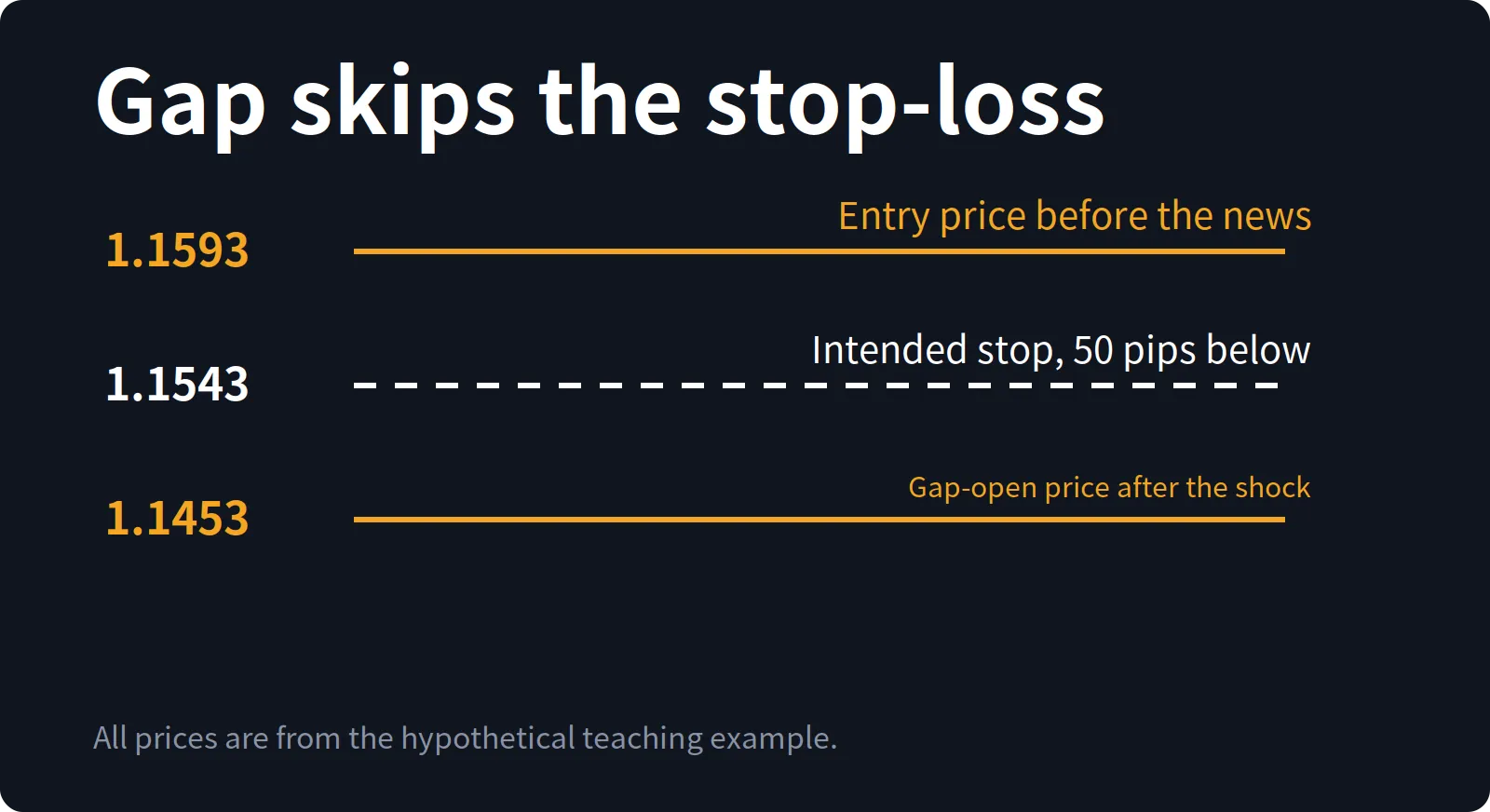
A price gap can pass through an intended stop-loss in one move.
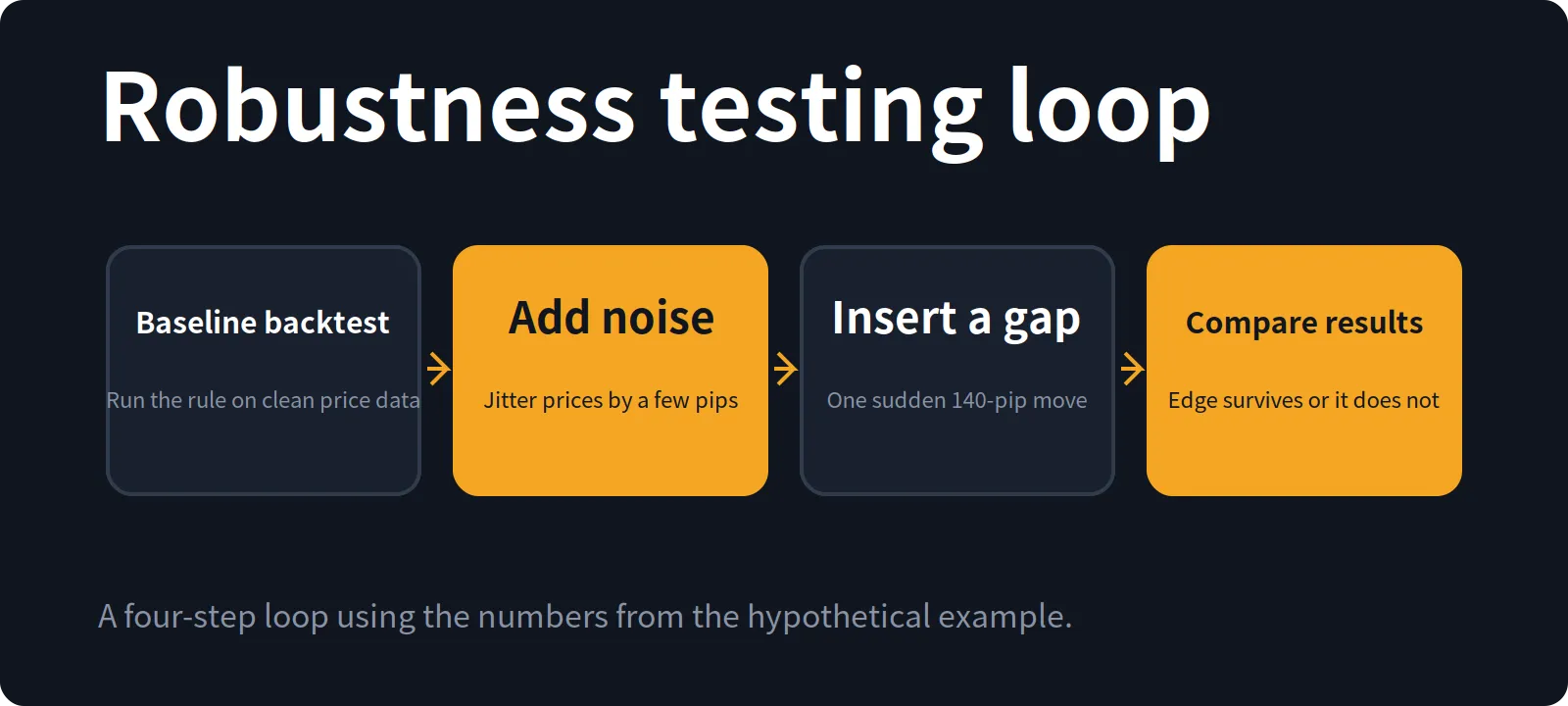
A simple robustness check compares the same rule under three conditions.
Common beginner misunderstandings
New traders often misunderstand what a single test proves.
- Robustness testing is only for algorithmic traders. Not true. Even a manual rule can be sketched on paper: add some noise to recent prices and ask whether your entry and exit logic still makes sense.
- One stress scenario is enough. Passing one gap proves survival on that one gap, not on all gaps. Robustness is a habit of checking several variations.
- A model with positive base results is a good model. The base result is only the starting point. The same quiet sample would make many weak models look good.
- Stress tests predict the next crash. They do not. They reveal which parts of a model are brittle before something unpredictable happens.
Overfitting is the hidden partner of fragility. If you adjusted a rule until it fit one price series perfectly, noise will almost always destroy that fit. A robustness test exposes overfitting quickly.
What robustness testing is and is not
Robustness testing is an early warning system. It compares a model under clean conditions, noisy conditions, and extreme conditions. It helps you see whether the model has structural logic behind it or simply memorised the sample. In short, robustness testing is a core part of forex risk management, not a technical extra.
It is not a guarantee of future returns. A model that survives ten stress tests can still fail on the eleventh. It is not an instruction to trade. It is a measurement tool, like checking the brakes on a car before a long trip.
Trading psychology enters here as well: a model that looks unbeatable in a backtest creates false confidence. Running a noise test and a gap test is one way to cool that confidence before real money is at risk.
Remember the boundary: robustness testing tells you how easily a model breaks, not whether it will make money.
WikiFX Broker
Latest News
RBI MPC Meets Today: An Anticipated 25 BPS Hike Would be the First Since February 2023
WikiFXBOJ Interest Rate Forecast: Tokyo Inflation Builds Case for Next Hike
WikiFXA 19.2x Nifty is cheap in rupees. In dollars, the hurdle is 13–15%
WikiFXChris and Tiger Podcast – Euro Slides as France Fears, High Yields Shape Markets
WikiFXWinproFx Review 2026: Mixed User Reports on Trading and Withdrawals
WikiFXBangladesh ACC Files Case Against Eight Over Tk23.68 Crore Chattogram Land Fraud
WikiFXTrading Pro Review of the FCA Warning and Rejected Withdrawal
WikiFXWhy Gold and the Dollar Are Rising Together Today
WikiFXUS Dollar Price Forecast: Soft NFP Hits Fed Bets, Can GBP/USD and EUR/USD Recover?
WikiFXVizag Techie Loses ₹20 Lakh in Crypto Investment Scam
WikiFXRate Calc
