Who Really Moves the Forex Market? The Invisible Players

Abstract:An overview of the forex market's multi-tier structure, from central banks and interbank dealers to hedge funds, corporations, and retail traders. A hypothetical order shows how retail trades are routed, and common misunderstandings are addressed.

Many beginners picture the forex market as a single exchange where everyone trades together. In reality, it is a decentralized, multi‑tier network whose participants range from central banks to retail traders. The market on your screen is only the surface of a deep hierarchy, with different players acting for completely different reasons.
Understanding who is on the other side of your trade explains why prices move, why spreads exist, and why news causes sudden gaps.
The Key Participants in the Forex Market
Forex players can be grouped into layers, each with a distinct role and influence on price.
- Central Banks: Being the most powerful participants, they manage national currency reserves and set monetary policy. They rarely trade for profit, but when they intervene, buying their own currency to strengthen it or selling to weaken it, their actions can move rates by hundreds of pips in minutes. (A pip is typically the fourth decimal place in a currency pair, or 0.0001 for most pairs.) For example, if the Bank of Japan sells massive yen against the dollar, USD/JPY can spike sharply. Such interventions are infrequent but highly disruptive.
- Commercial Banks and Interbank Dealers: This is the markets core. Large banks trade huge volumes, often $10 million or more per transaction, providing liquidity to everyone else. They act as market makers, profiting from the spread (the gap between buy and sell prices), hedge client flows, or sometimes trade for their own books. The interbank network is a private club where credit lines decide who can trade.
- Hedge Funds, Pension Funds and Institutional Investors: These firms trade currencies as part of broader strategies, often using high leverage. Their large speculative bets can shift sentiment and create trends that retail traders try to ride.
- Multinational Corporations: Businesses such as exporters or manufacturers need to convert currencies for trade and investments. They hedge long‑term exposure through banks, creating steady, non‑speculative demand. Even a single large conversion, say $500 million, can momentarily nudge exchange rates.
- Retail traders: You. According to the Bank for International Settlements, daily global forex turnover exceeds $7 trillion. Retail trading accounts for less than 5% of that; interbank dealers around 40%, other financial institutions 25%, and non‑financial corporations 15%. Retail traders are price takers, not price makers.
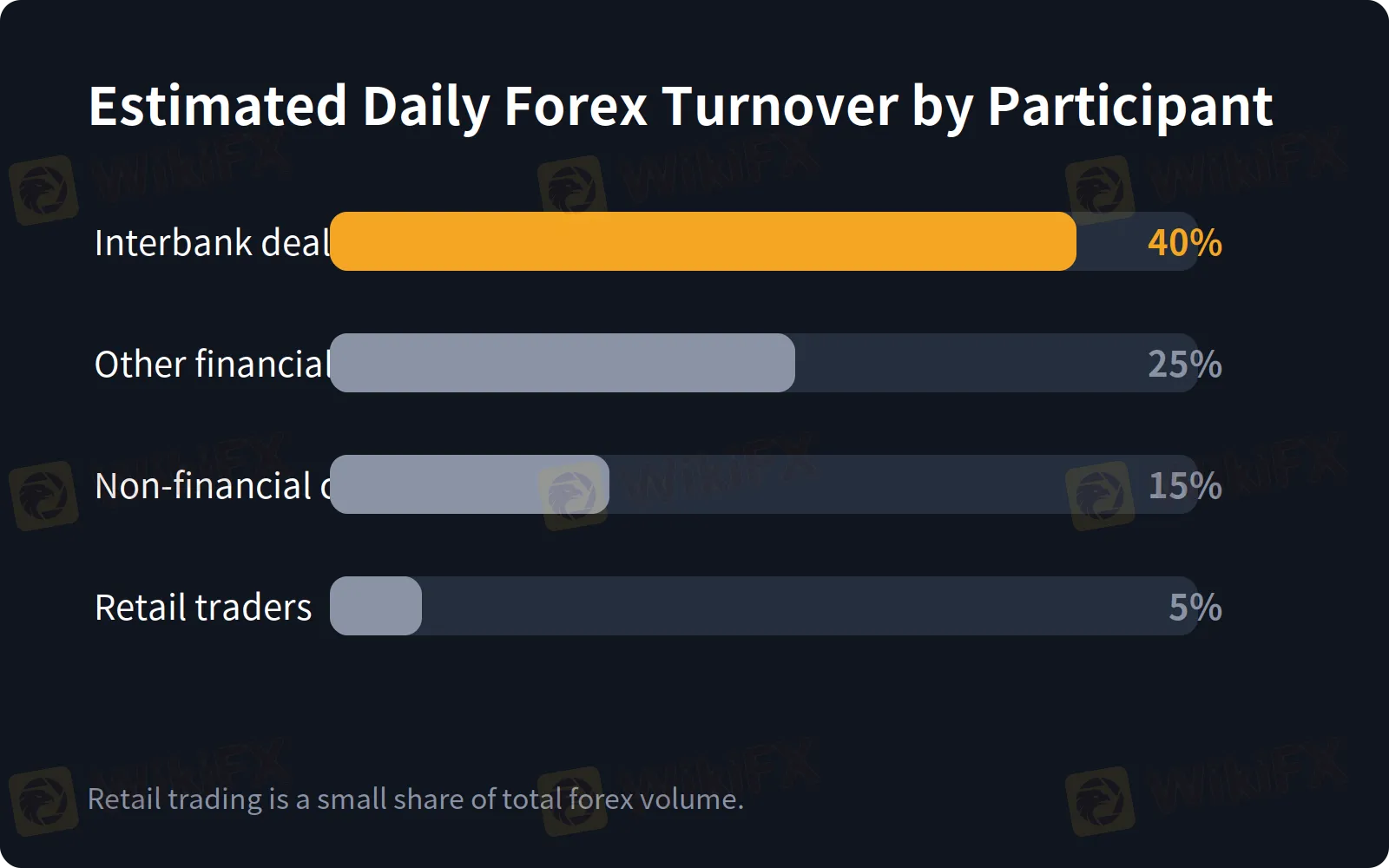
Hypothetical breakdown based on BIS data; actual shares fluctuate.
From Your Screen to the Interbank: A Hypothetical Order
Assume you open your platform and place a buy order for 100,000 EUR/USD (1 standard lot) at the reference price 1.1535. Your broker may act as a market maker, instantly taking the other side internally, or as an ECN/STP broker, sending the order to a liquidity pool of banks and non‑bank providers.
Either way, your 100,000 units are a drop in the ocean. The broker aggregates many such small trades and hedges the net exposure with a prime brokerage at a major bank. (Prime brokerage is a service that lets smaller institutions access the interbank market through a larger bank.) That bank may then offset the risk with another bank in the interbank market, dealing in chunks of several millions.
Now imagine a European manufacturer needs to convert $100 million to euros for an acquisition. It calls its relationship bank, which quotes an institutional rate and executes a trade a thousand times larger than your retail order. That corporate transaction can drain available euros and nudge EUR/USD higher. The bank then hedges its own risks, triggering a cascade that ripples across the market.
The spread, the difference between the buy (ask) and sell (bid) price, reflects your tier in this structure. Banks quote very narrow spreads to their biggest clients but wider ones to retail aggregators. So, the 1.2‑pip EUR/USD spread you see covers multiple layers of cost. The corporate treasurer, trading directly with the bank, might get only 0.1 pips.
Not every retail trade reaches the interbank; many are netted internally. Yet the pricing on your screen is derived from interbank quotes streamed through your broker‘s liquidity pool. Big players’ actions still reach you.
Common Misunderstandings About Market Players
- “A Big Order from Me will Move the Price.” Unless you trade institutional size, your order has zero impact. Even with high leverage, retail capital is tiny amid $7 trillion daily turnover. Your 10‑lot trade is absorbed without a ripple.
- “Central Banks Trade Every Day.” Central bank interventions are rare and typically happen only when currency moves threaten economic stability. Daily monetary policy decisions are separate, they influence currencies but are not the same as direct buying or selling.
- “All Participants Get the Same Spread.” Your spread pays for the brokers costs, liquidity provider fees, and a markup. Corporate treasuries with direct bank access enjoy much tighter spreads. Retail spreads can be five to ten times wider, this is the cost of being a smaller player.
- “News Moves the Market Because Everyone Reacts.” News matters because it changes how funds, banks and institutions position billions. The retail reaction is a fraction; the big repositioning causes the actual swing. As a retail trader, you are often last to know and last to act.
Grasping who really moves forex helps you see why prices gap, why spreads widen at news events, and why certain levels hold or break. The market is a hierarchy, and retail traders sit at the edge. That is not a disadvantage, by accepting your place, you can focus on risk management and execution instead of fighting forces beyond your control. You benefit every time you enjoy tight spreads and deep liquidity, services made possible by the layers above you.
WikiFX Broker
Latest News
LOTAS CAPITAL Review 2026: MISA Record Discrepancy and Recent Withdrawal Complaints
WikiFXFormer Minister Remanded Over Tabung Haji Saudi Lease
WikiFXMalaysia: Hawkish pause keeps options open – DBS
WikiFXAUD/JPY Price Forecast: Rebounds above 112.50, while staying constrained below 100-day SMA
WikiFXRM6 Million Crypto Windfall Vanishes In Three Days
WikiFXMalaysian Ringgit: BNM hawkish tilt supports MYR – Commerzbank
WikiFXFed September Hike: What Malaysian Traders Should Watch
WikiFXThe Australian Dollar thanks Waller's comments, which sink the USD
WikiFXChinese Yuan: Services PMI rebound keeps PBoC cautious – Commerzbank
WikiFXFCA Warns Against Multiple Unauthorised Forex Brokers
WikiFXRate Calc

