ZForex Review: Is It Safe for Traders?
Abstract:ZForex Review highlights the lack of regulation, risky leverage, and withdrawal issues reported by traders worldwide.
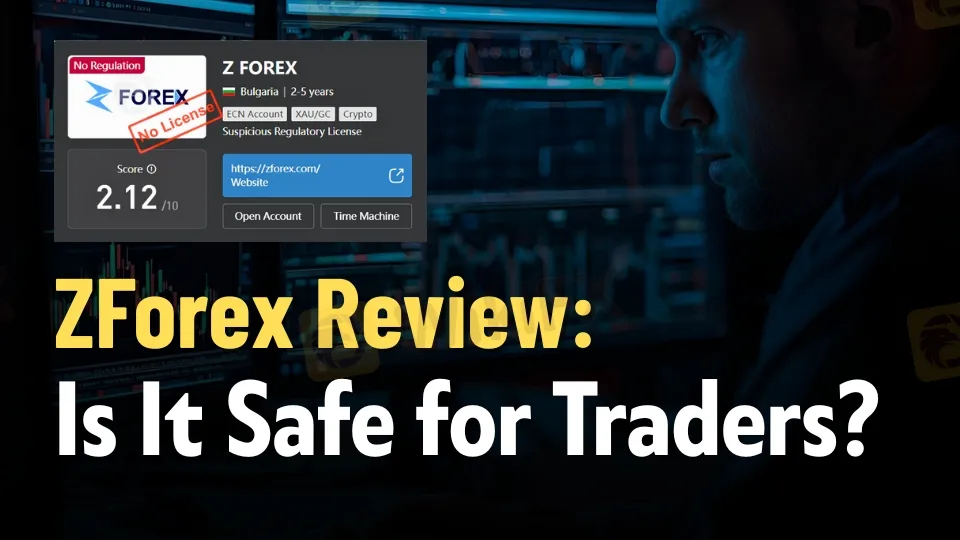
ZForex Review Overview
ZForex, founded in 2006 and registered in Bulgaria, presents itself as a multi-asset broker offering forex, stocks, indices, commodities, metals, and cryptocurrencies. Despite its longevity in the market, the broker operates without valid regulatory oversight, a fact confirmed by multiple independent sources. This absence of regulation raises immediate red flags for traders concerned about transparency, fund safety, and dispute resolution.
The brokers official domains include zforex.com and zglobaltrade.com, with servers hosted in the United States and the United Kingdom. While ZForex promotes advanced trading platforms such as MetaTrader 5 (MT5) and cTrader, its operational framework is undermined by questionable licensing claims and a WikiFX score of just 2.12/10, signaling high risk.
Regulation and Licensing Concerns
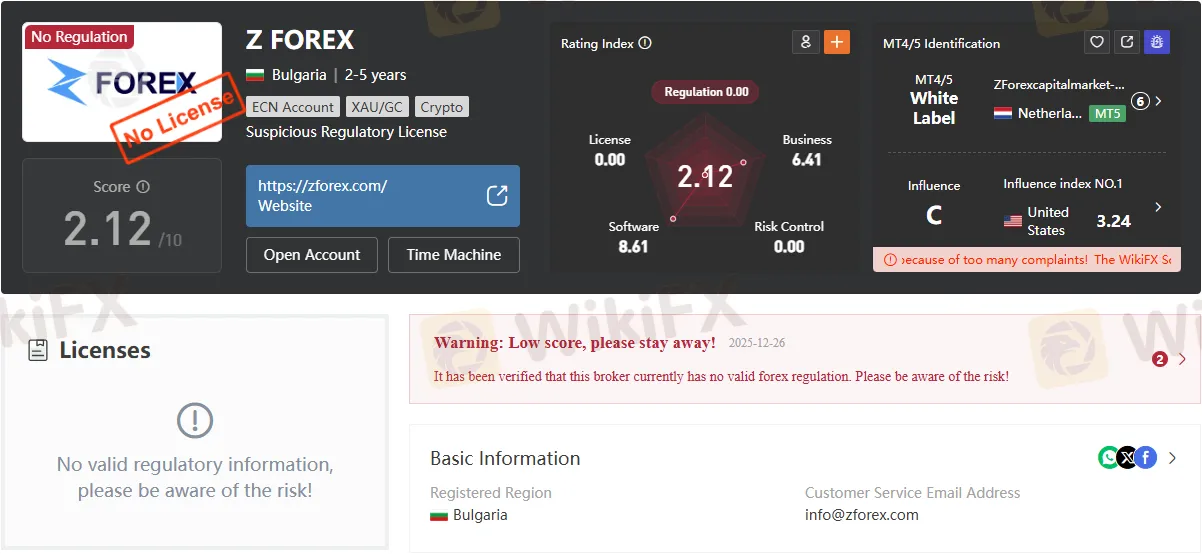
The most pressing issue in this ZForex Review is the brokers unregulated status. According to WikiFX data “No valid regulatory information, please be aware of the risk!” Traders should note that ZForex has been flagged for suspicious regulatory licenses and operates without oversight from any recognized financial authority.
- Registered Country: Bulgaria
- Regulation: None
- WikiFX Score: 2.12/10
- Risk Control Index: 3.24
In contrast, reputable competitors such as XTB or IG Markets hold licenses from tier-one regulators like the FCA (UK) or CySEC (Cyprus), offering far greater investor protection. ZForexs lack of regulation means clients have no recourse in cases of fraud, withdrawal disputes, or platform manipulation.
Trading Instruments and Platforms
ZForex claims to provide access to a wide range of instruments:
- Forex pairs
- Stocks
- Indices
- Commodities
- Metals
- Cryptocurrencies
- Bonds, options, funds, ETFs
The broker supports MetaTrader 5 (MT5) and cTrader, both recognized platforms in the industry. However, it reveals that ZForex operates white-label servers, which often lack the stability and technical support of fully licensed MT4/MT5 providers. Average execution speed is listed at 184 ms, but without regulatory audits, these figures remain unverifiable.
Account Types and Fees
ZForex offers three live accounts alongside a demo option:
| Account Type | Minimum Deposit | Leverage | Commission | Spread |
| Standard | $10 | 1:1000 | $0 | 1.2 pips |
| ECN | $10 | 1:1000 | $7 Forex / $15 Metals | From 0 pips |
| Swap-Free | $2,500 | 1:500 | $10 Forex / $15 Metals | 0.7 pips |
- Leverage: Up to 1:1000, with dynamic adjustments based on equity tiers.
- Margin Call: 100%
- Stop Out: 30% (50% for Swap-Free accounts)
While the low minimum deposit of $10 may attract beginners, the extremely high leverage exposes traders to significant risk. Competitor brokers typically cap leverage at 1:30 (EU) or 1:50 (US), aligning with regulatory standards to protect retail investors.
Deposits and Withdrawals
The broker advertises same-day withdrawals and multiple payment methods, including credit cards, wire transfers, e-wallets (SticPay, Jeton, Fasapay), and cryptocurrencies. However, user reports series of claims:
- Case 1: A trader reported ZForex withheld $4,000, marking withdrawals as “pending” indefinitely.
- Case 2: Another user stated $3,200 in withdrawals were deducted without explanation.
- Case 3: A Hong Kong-based trader claimed withdrawals had been on hold since October 2024, with accusations of “abuse” used as a pretext to deny payouts.
These cases highlight a pattern of withdrawal issues, undermining ZForexs credibility. By comparison, regulated brokers are required to segregate client funds and process withdrawals transparently.
Pros and Cons
Pros:
- Wide range of trading instruments
- MT5 and cTrader platforms supported
- Low minimum deposit ($10)
- Multiple contact channels (live chat, phone, email, social media)
Cons:
- Unregulated broker with suspicious licensing claims
- High leverage (up to 1:1000) increases risk exposure
- Documented withdrawal disputes and complaints
- Commission fees on ECN and Swap-Free accounts
- Regional restrictions (USA, Turkey, Iran, DPRK, Myanmar)
Domain and Transparency Check
- Primary Domains: zforex.com, zglobaltrade.com
- IP Hosting: United States (23.106.37.153), United Kingdom (104.21.89.108)
- Company Address: Sofia, Bulgaria, Olimpiyska str., SiteGround, Sofia Park, fl. 4, No: 2, post code: 1756
Despite listing a Bulgarian address, the brokers lack of regulatory registration in Bulgaria or the EU raises transparency concerns. Competitors like RaiseFX or Assexmarkets provide verifiable licensing details, which ZForex fails to match.
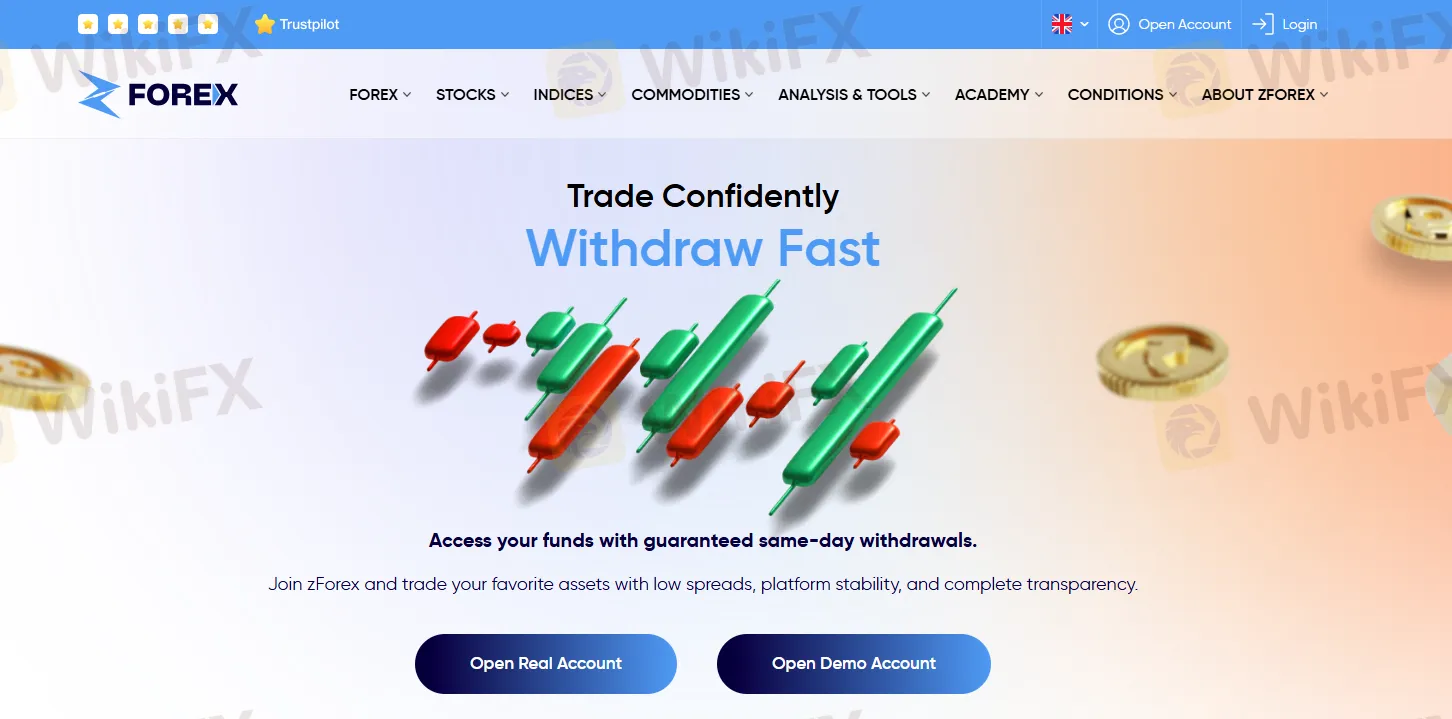
User Complaints and Exposure Cases
Based on the reported cases recieved, 59 user reviews, with multiple exposures highlighting serious issues:
- Funds withheld despite evidence provided by clients.
- Accounts closed after withdrawal requests.
- Accusations of abuse without proof, used to deny payouts.
These cases align with common warning signs of unregulated brokers: delayed withdrawals, lack of communication, and arbitrary account closures.
Bottom Line: Should Traders Trust ZForex?
This ZForex Review underscores a broker operating outside regulatory frameworks, with a history of withdrawal disputes and unverified licensing claims. While the platform offers attractive features such as MT5 support, diverse instruments, and low entry deposits, these benefits are overshadowed by serious risks.
Traders seeking security and transparency should consider regulated alternatives. Brokers licensed by authorities such as the FCA, ASIC, or CySEC provide far stronger safeguards, including fund segregation, compensation schemes, and audited operations. ZForex, by contrast, remains a high-risk choice with limited accountability.
Final Verdict: ZForex is not safe for traders. The lack of regulation, risky leverage, and repeated withdrawal complaints make it unsuitable for anyone prioritizing fund security and fair trading conditions.

Read more
Zenstox Review 2026: Unexplained Profit Cancellation & Account Termination Allegations
Have you suspected Zenstox of cutting your profit amount on the trading platform? Failed to receive a proper response from the customer support team of the broker on this profit deduction? Did you face an unexplained account termination by the Seychelles-based forex brokerage firm? Broker review platforms, such as WikiFX, are flooded with negative user comments in 2026. In this Zenstox review article, we have examined these allegations. Take a close look at the same.
Pepperstone Review 2026: Massive Deposit & Withdrawal Complaints Against This Regulated Broker
Have you experienced issues with Pepperstone deposit & withdrawal processing? From your experience, do you feel that the Australia-based forex broker causes losses to its clients? Did the brokerage entity freeze your account and give you a margin call? All these trading allegations have been rampant on broker review platforms such as WikiFX. This Pepperstone review article takes a close look at the user complaints, especially in 2026. Additionally, we have given an overview of the regulatory framework under which the brokerage entity operates.

Wundersys vs tradgrip: Two Offshore Newcomers Go Head to Head — and Neither Brings Home a Trophy
Some broker comparisons end with a confident "go with this one." This is not one of them — and that honesty is exactly what makes it worth reading. Wundersys and tradgrip are two young, offshore-registered brokers that keep popping up in front of beginner traders, often through aggressive online marketing. Both promise the usual buffet: tight spreads, generous leverage, multiple account tiers. And both, according to WikiFX, sit near the very bottom of the safety scale. So instead of crowning a champion, this comparison is really about something more useful: learning to read the warning signs, understanding the small differences that still matter, and knowing why "the better of two risky options" is still a conversation about risk.
The 6 Lowest-Commission Forex Brokers South Asian Traders Are Flocking To in 2026
If you trade forex from India, Pakistan, Bangladesh, Sri Lanka, or Nepal, you already know the quiet truth that eats into every trader's results: it is not just the market that decides whether you profit — it is the cost of getting in and out of each trade. Shave a couple of dollars off your commission on every lot, multiply it across hundreds of trades a year, and you are looking at the difference between a strategy that works and one that bleeds out slowly. South Asian traders are some of the most cost-conscious in the world, and rightly so. So we pulled the data on the brokers most often recommended for the region, cross-checked every name on WikiFX, and ranked them by the one number that matters most here: what they actually charge you to trade. Before the list, one quick lesson that will make this whole ranking click.
WikiFX Broker
Latest News
The May inflation numbers are due out Wednesday morning. Here's what to expect
 WikiFX
The Market's Ledger: Why Price Returns to Fill Liquidity Voids
WikiFXKeeping Your Forex Profits Safe With Trailing Stop Losses
WikiFXReview 2026: Japan FSA Regulation, Platform Access, and Complaint Signals
WikiFXHEADWAY Review: Broker Complaints Point to Withdrawals, Zeroed Balances, and Login Blocks
WikiFXIndian Stocks Take a Beating, Sensex Falls by Over 600 Points Today: Check Out Why
WikiFXDollar Hits Two-Month High Amid Surging Yields
WikiFXGetting Started in Forex: Understanding Currency Pairs, Central Banks, and Legal Risks
WikiFXIndia Left Reeling as Net FDI Crashes from $28 Billion to Just $1 Billion in Two Years
WikiFXTenX Prime Review: PAMM Blackout, Login Blocks, and Broker Regulation Questions
WikiFXRate Calc

