BitDelta Pro Review: Unregulated or Legit Broker?
Abstract:BitDelta Pro Review: No valid regulation, risky spreads, and hidden broker issues. Traders should proceed with caution.
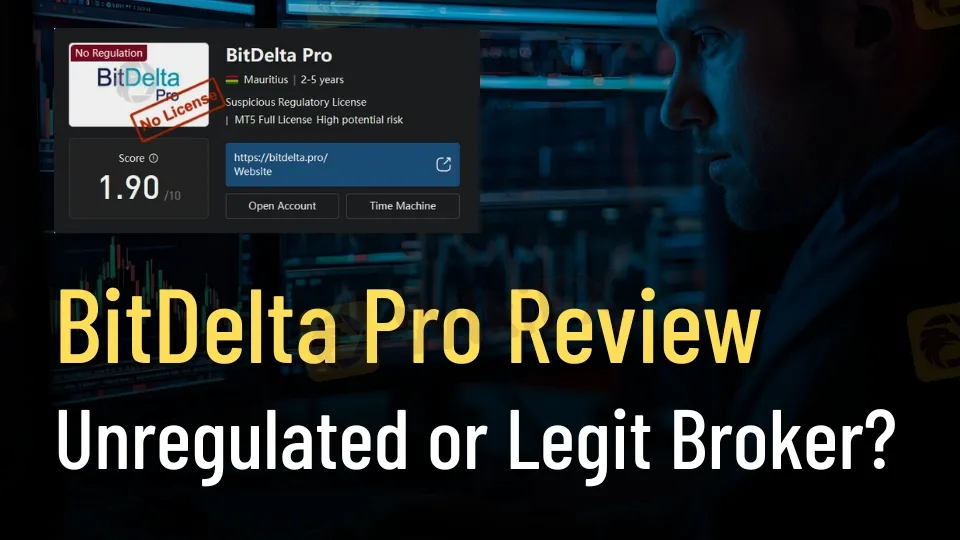
Is BitDelta Pro Broker Legit or a Scam?
BitDelta Pro positions itself as a multi-asset broker offering access to over 5,000 CFDs across forex, commodities, indices, shares, ETFs, and crypto. On paper, this looks impressive. However, a closer investigation reveals that BitDelta Pro Broker operates without valid regulation.
The company claims to hold a license from the Financial Services Commission (FSC) in Mauritius, but official records show no such authorization. WikiFX rates the broker at 1.90/10, explicitly warning traders to stay away due to suspicious licensing and lack of transparency.
This raises the critical question: Is BitDelta Pro a scam or legit? Evidence strongly suggests that BitDelta Pro is unregulated, exposing traders to significant risks.
BitDelta Pro Regulation and Licensing Explained
- Claimed License: FSC Mauritius, License no: GB24202926
- Verified Status: No record found in FSCs database
- WikiFX Assessment: “No valid regulation, high potential risk”
Without proper oversight, BitDelta Pro Regulation is essentially non-existent. Traders should note that unregulated brokers can change terms, manipulate spreads, or even restrict withdrawals without accountability.
For comparison, trusted online broker reviews of regulated firms (e.g., IG, Pepperstone, or Saxo Bank) highlight transparent licensing, audited financials, and investor protection schemes. BitDelta Pro offers none of these safeguards.
BitDelta Pro Review: Account Types & Fees
BitDelta Pro provides three main account tiers: Standard, VIP, and Institutional.
| Account Type | Spreads (EURUSD/XAUUSD/WTI) | Leverage | Commission | Minimum Deposit | Bonus |
| Standard | 0.00008 / 0.27 / 0.028 | 1:200 | $0 | $10 | None |
| VIP | 0.00007 / 0.24 / 0.028 | 1:200 | $0 | $50 | 20% |
| Institutional | 0.00003 / 0.15 / 0.025 | 1:200 | $5 Commodities / $3 Forex | $5,000 | None |
Key takeaways:
- Low entry barrier: $10 minimum deposit for Standard accounts.
- Hidden costs: Institutional accounts charge commissions despite marketing “low fees.”
- Bonus inconsistency: VIP accounts offer a 20% bonus, but others do not.
Compared to regulated brokers, these spreads and commissions are inconsistent and often higher than industry averages.
BitDelta Pro Spreads and Leverage Explained
BitDelta Pro advertises dynamic leverage up to 1:500, but most accounts cap at 1:200. While high leverage can amplify profits, it also magnifies losses.
Spreads are problematic:
- Commodities spreads reach 35 points on Standard accounts.
- Forex spreads average 20 points, far above industry norms.
This means traders face slippage and inflated costs, eroding profitability. In contrast, leading brokers typically offer EURUSD spreads below 1 pip with transparent commission structures.
BitDelta Pro Trading Platform Features
BitDelta Pro supports MetaTrader 5 (MT5) alongside its proprietary platform and CQG.
- Execution Speed: Average 174 ms
- Supported Devices: Web, mobile, desktop
- Tools: Charting, automated trading, technical indicators
While MT5 is a respected platform, the broker‘s infrastructure raises concerns. Reports of severe slippage and inconsistent execution suggest that BitDelta Pro’s servers may not meet professional standards.
For traders comparing options, regulated brokers like Pepperstone or IC Markets deliver faster execution and audited performance metrics.
BitDelta Pro Deposit and Withdrawal Methods
The broker advertises flexible deposits starting at $10. However, transparency around withdrawal methods is limited.
- Deposit Minimums: $10 (Standard), $50 (VIP), $5,000 (Institutional)
- Withdrawal Transparency: Unclear, with no detailed policies published
- Customer Service: 24/7 chat, email (support@bitdelta.pro), phone, and social media
The lack of clear withdrawal terms is a red flag. In trusted online broker reviews, withdrawal speed and reliability are critical benchmarks. BitDelta Pro fails to provide sufficient assurance.
Pros and Cons of BitDelta Pro Broker
Pros
- Wide range of trading instruments (5,000+ CFDs).
- Multiple account types with low entry deposits.
- MT5 platform support.
- 24/7 customer service.
Cons
- Unregulated – no valid license.
- High spreads and slippage.
- Lack of transparency on withdrawals.
- Relatively new (founded 2023).
- Institutional accounts require $5,000 minimum deposit.
Comparing BitDelta Pro Broker vs Competitors
When placed against regulated competitors, BitDelta Pro falls short:
| Feature | BitDelta Pro | Regulated Broker (e.g. IG, Pepperstone) |
| Regulation | None | FCA, ASIC, CySEC, BaFin |
| Minimum Deposit | $10 | $100–$250 |
| Spreads (EURUSD) | 20 points | <1 pip |
| Leverage | Up to 1:500 | Typically capped at 1:30 (EU/UK) |
| Transparency | Low | High – audited, investor protection |
This comparison underscores why the best forex broker comparison consistently favors regulated firms over unregulated entities like BitDelta Pro.
The Bottom Line on BitDelta Pro Broker
BitDelta Pro markets itself as a modern broker with diverse instruments and MT5 support. Yet, beneath the surface, the lack of regulation, suspicious licensing claims, and high spreads make it a high-risk choice.
Traders seeking security should prioritize brokers with verifiable licenses, transparent fee structures, and proven track records. BitDelta Pro does not meet these standards.
Final Verdict: BitDelta Pro is not a trusted broker. Its unregulated status, hidden costs, and questionable transparency place traders at risk. Those looking for reliable trading should consult trusted online broker reviews and choose regulated alternatives.


Read more

Is TradingPRO Safe? FCA Warning, Indonesia Blocklist Evidence, and 7 Checks Before You Deposit
This Trading Pro broker review checks the FCA warning, Indonesia blocklist evidence, licence claims, and what South Asian users should verify before depositing.
MT4 White Label Cost in 2026: What Brokers Must Budget Beyond the Platform Fee
The visible fee in an MT4 white label proposal is rarely the real cost of operating it. For an existing broker, the decision is not simply whether an MT4 white label platform is “cheap” or “expensive.” The real question is whether the commercial model remains viable after integration, support, data, client migration, compliance, and exit costs are included. That is why an MT4 white label cost review should be built as a 24- to 36-month operating case. It should compare three credible choices: 1. Keep the present MT4 setup and improve its weakest controls. 2. Replace the MT4 white label provider but retain the client proposition. 3. Migrate selected clients or products to another platform while running MT4 in parallel. This guide explains how to build that case without relying on headline prices or generic vendor claims.

Best White Label Trading Platform 2026
The decision to switch white label providers or migrate to a modern white label trading platform is no longer a luxury for growth-minded brokers—it's a strategic necessity for survival in 2026. The convergence of technological stagnation, regulatory evolution, and shifting client expectations has created a perfect storm.

ABET Review 2026: Users Allege Missing Funds and Trade Manipulation - Our Investigation
ABET, a Bulgaria-based brokerage firm, faces severe allegations from users for the reportedly inefficient way it handles their funds. While some alleged illegitimate account blocks by the broker, others reported fund scams and trade manipulations. These ABET reviews have raised question marks over the broker’s legitimacy.
WikiFX Broker
Latest News
BX Trade Review: Is This Unregulated Broker Worth the Risk?
 WikiFX
STMARKET Review: Withdrawal Complaints Cloud a Low-Rated Broker, What to Know Before You Deposit
WikiFXWhy the Dollar Moves Almost Every Forex Pair
WikiFXCONSOB Orders Blocking of 24 Unauthorized Investment Websites
WikiFXBitDelta Receives UAE Category 5 Licence for Introducing Activities
WikiFXRinggit Gains on Majors but Slips vs US Dollar Ahead of Fed
WikiFXtrading.com Review: FCA-Regulated, But Withdrawal Complaints Persist
WikiFXDeriv Review: What Traders Should Know Before Depositing
WikiFXDollar Steadies as Rupee Finds Market Support
WikiFXPRIME VEST SAFE Review: Is Your Deposit Safe?
WikiFXRate Calc

