Silver Price Forecast: XAG/USD Rebound as The Fed Is Still Unconvinced About Interest Rate Prospects
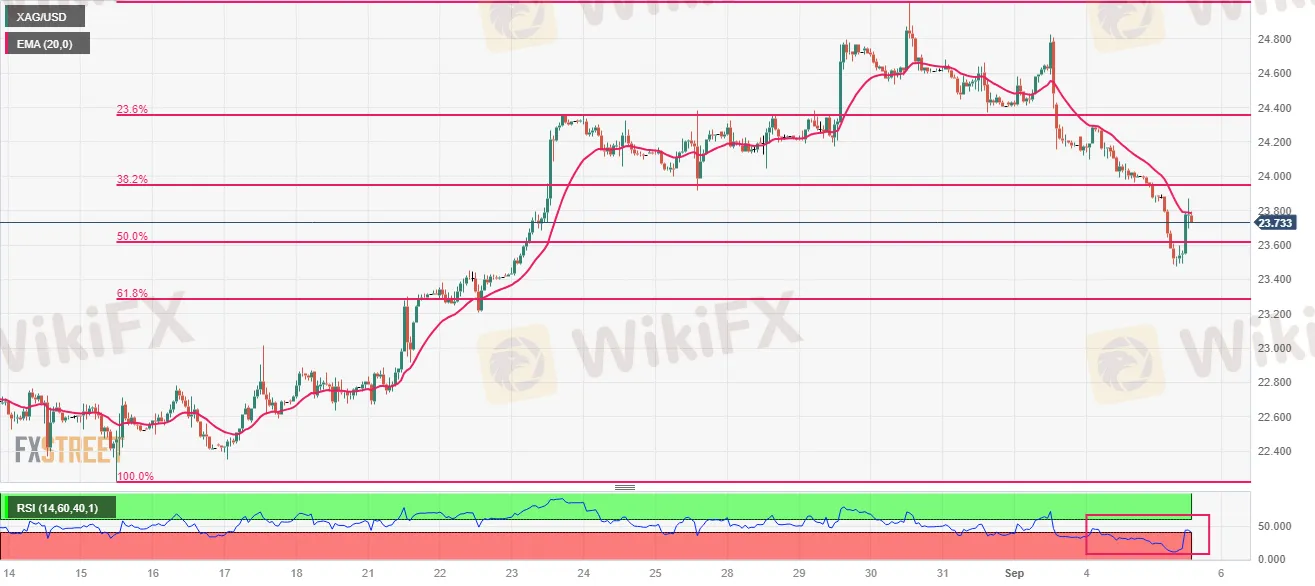
Abstract:At the onset of the New York trading session, Silver's (XAG/USD) price encountered significant buying interest around $23.50.

• Silver prices are trying to recover while the negative bias remains strong due to the strength of the US Dollar.
• The Fed's Waller said more economic data is needed to state that the Fed has finished raising interest rates.
• Silver price produced a mean-reversion movement near the 20 EMA around $23.80.
At the onset of the New York trading session, Silver's (XAG/USD) price encountered significant buying interest around $23.50. The precious metal is currently attempting a recovery aftermath of a substantial sell-off, primarily caused by the steadfastness of the US Dollar. On a larger spectrum, the outlook stays pessimistic as predictions of the US Dollar Index (DXY) persisting on its upward trend continue.
The S&P500 opened with a negative note because market sentiment is still cautious due to the deepening risk of a global recession. The US dollar benefited from gloomy global data, especially China's weak Services IMP. Economic data for August dropped significantly to 51.8 compared to the previous release of 54.1. China's service sector faces the pressure of deflation risk due to worsening demand conditions.
The US Dollar Index faced profit-taking action after hitting a new five-month high near 104.80 because Federal Reserve Governor (The Fed) Christopher Waller is still not confident about the interest rate outlook. The Fed governor told CNBC on Tuesday that economic data will guide whether the Fed needs to raise interest rates again and added that he will need more data to say the Fed is done raising interest rates, as reported by Reuters. He further added that one more increase in interest rates is unlikely to lead the economy into recession.
Regarding the labor market, the Governor of The Fed stated that the higher Unemployment Rate is not surprising. The labor market has started to weaken but is still very strong.
Silver Technical Analysis
The movement of silver prices is presenting a mean reversion near the 20-period Exponential Moving Average (EMA) at approximately $23.80. The asset is attempting to recuperate following an examination of the 50% Fibonacci retracement, charted from the low of $22.23 on August 15 to the peak of $25.02 on August 30, at $23.62.
Furthermore, the Relative Strength Index (RSI) has escalated to a 40.00-60.00 spectrum from the earlier bearish range of 20.00-40.00. This suggests a weakening in the bearish momentum.


Read more
UK Retail Sales July 2026 Fall 0.5%: What the Result Means for GBP
UK retail sales fell 0.5% in July 2026, while the three-month measure rose 1.1%. See the ONS details and what the mixed result may mean for GBP.

Pakistan Forex Reserves Reach $22.5 Billion: Why a Stable USD/PKR Snapshot is Not Yet a Trend
Pakistan forex reserves stood at $22.506 billion on 13 August 2026, while the SBP dashboard showed a USD/PKR mark to market rate of 277.5713 on 20 August. This article separates the SBP forex reserves facts from predictions about the Pakistan rupee and the forex market Pakistan.

Multi-Asset Liquidity Solution in 2026: Expand Instruments Without Fragmenting Execution
A multi-asset liquidity solution can help a broker support FX, CFDs, commodities, and indices through a more unified operating model. But adding asset classes can also create fragmented symbols, pricing, routing, margin rules, records, and client messages if controls are not designed first. This 2026 guide explains how a multi asset liquidity provider, forex CFD liquidity setup, commodity liquidity provider, and indices liquidity provider fit into a broker-owned execution service. It outlines the due-diligence questions, shared-control model, cost drivers, and 90-day implementation plan that help teams expand without making the execution chain harder to explain. The aim is not to promise deeper liquidity or better trading outcomes. It is to create evidence that a broker can supervise market access, trace order events, reconcile costs, and communicate consistently to the relevant clients when conditions are difficult.

XAU/USD Hits $4,500: Washington Bought Bonds—and Gold Exploded
Gold surged above $4,500 after the US Treasury expanded its purchases of longer-dated government bonds, pushing yields and the dollar lower. But this was not debt forgiveness or Federal Reserve money printing—it was a liquidity operation that exposed a much bigger fear: America may be finding it increasingly difficult to live with market-driven interest rates.
WikiFX Broker
Latest News
Dow Jones Industrial Average round-trips a Fed that promised nothing
 WikiFX
Poland: Growth supported by investment rebound – ING
WikiFXSilver Price Forecast: False breakout and hawkish Fed sink XAG
WikiFXBreaking: Nonfarm Payrolls benchmark revision to lower US employment by 79,000 through March 2026
WikiFXSouth Korean Won: BoK tightening supports KRW against US Dollar – Commerzbank
WikiFXJapanese Yen dips further despite hotter inflation, upbeat employment data
WikiFXOEXN Broker Review: Regulated but is it Safe for Traders?
WikiFXMexican Peso tumbles as Warsh embarks on inflation fight
WikiFXFXDD Malta Licence Ends: What Traders Need to Know
WikiFXEC Markets Marketing Director Nick Xydas Steps Down
WikiFXRate Calc
