Ichimoku Cloud Analysis 19.07.2023 (GBPUSD, EURJPY, NZDUSD)
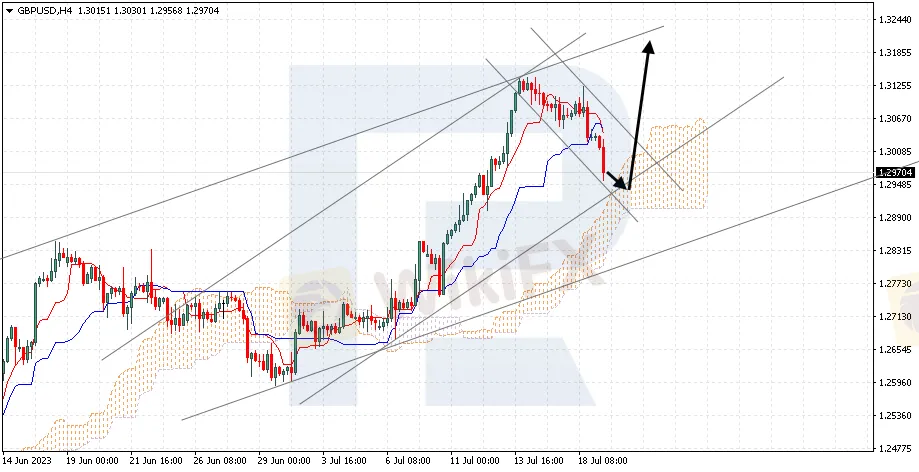
Abstract:GBPUSD is correcting after an aggressive rise. The instrument is going above the Ichimoku Cloud, which suggests an uptrend. A test of the upper boundary of the Cloud at 1.2945 is expected, followed by a rise to 1.3185. An additional signal confirming the rise will be a rebound from the lower boundary of the bullish channel.

GBPUSD, “Great Britain Pound vs US Dollar”
GBPUSD is correcting after an aggressive rise. The instrument is going above the Ichimoku Cloud, which suggests an uptrend. A test of the upper boundary of the Cloud at 1.2945 is expected, followed by a rise to 1.3185. An additional signal confirming the rise will be a rebound from the lower boundary of the bullish channel. The scenario can be cancelled by a breakout of the lower boundary of the Cloud with the price securing under 1.2875, which will mean a further decline to 1.2785. Meanwhile, the growth could be confirmed by a breakout of the upper boundary of the descending channel with the price securing above 1.3070.
EURJPY, “Euro vs Japanese Yen”
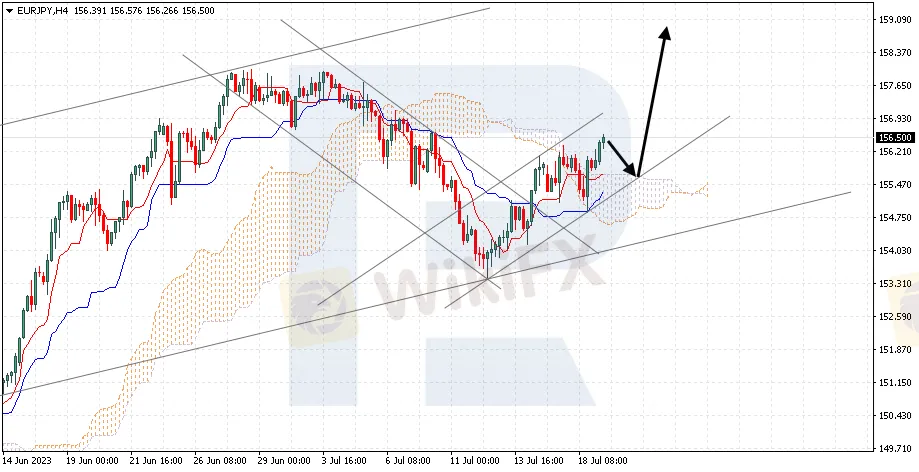
EURJPY is growing within a bullish channel. The instrument is going above the Ichimoku Cloud, which suggests an uptrend. A test of the upper boundary of the Cloud at 155.60 is expected, followed by a rise to 158.55. An additional signal confirming the rise will be a rebound from the lower boundary of the bullish channel. The scenario can be cancelled by a breakout of the lower boundary of the Cloud with the price securing under 154.25, which will mean a further decline to 153.35.
NZDUSD, “New Zealand Dollar vs US Dollar”
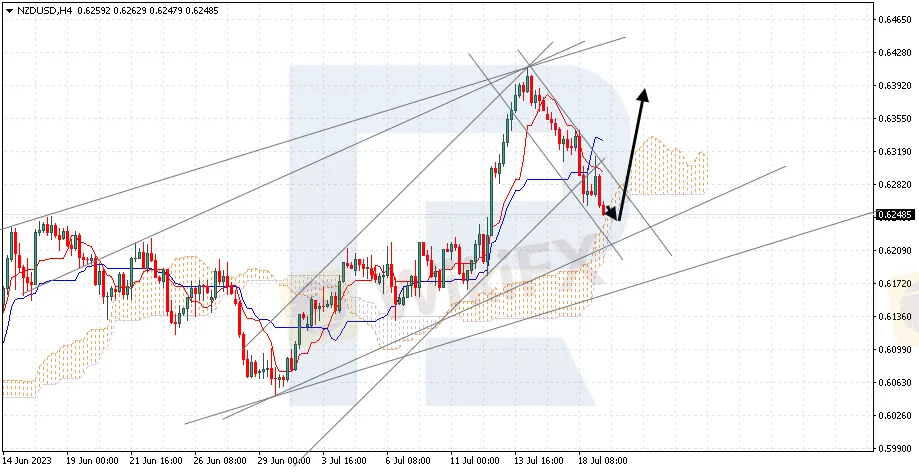
NZDUSD has secured under the signal lines of the indicator. The instrument is going above the Ichimoku Cloud, which suggests an uptrend. A test of the lower boundary of the Cloud at 0.6235 is expected, followed by a rise to 0.6395. An additional signal confirming the rise will be a rebound from the lower boundary of the bullish channel. The scenario can be cancelled by a breakout of the lower boundary of the Cloud with the price securing under 0.6205, which will mean a further decline to 0.6110. Meanwhile, the growth could be confirmed by a breakout of the upper boundary of the bearish channel with the price securing above 0.6305.


Read more
FNmarkets Review India 2026: Mauritius Licence and RBI Checks
This FNmarkets review for Indian readers starts with four verifiable facts. The Mauritius FSC public register lists FNmarkets (Mauritius) Ltd as an Investment Dealer, licensed on 12 August 2025. The broker website identifies the same entity and states licence GB25204149. However, the RBI list of authorised electronic trading platforms checked on 9 September 2026 did not show FNmarkets. The broker's help centre also sets a $50 minimum withdrawal and requires full account verification. These facts do not prove fraud, but they make FNmarkets regulation and payment checks essential before an Indian resident deposits money.

UK Retail Sales July 2026 Fall 0.5%: What the Result Means for GBP
UK retail sales fell 0.5% in July 2026, while the three-month measure rose 1.1%. See the ONS details and what the mixed result may mean for GBP.

Pakistan Forex Reserves Reach $22.5 Billion: Why a Stable USD/PKR Snapshot is Not Yet a Trend
Pakistan forex reserves stood at $22.506 billion on 13 August 2026, while the SBP dashboard showed a USD/PKR mark to market rate of 277.5713 on 20 August. This article separates the SBP forex reserves facts from predictions about the Pakistan rupee and the forex market Pakistan.

Multi-Asset Liquidity Solution in 2026: Expand Instruments Without Fragmenting Execution
A multi-asset liquidity solution can help a broker support FX, CFDs, commodities, and indices through a more unified operating model. But adding asset classes can also create fragmented symbols, pricing, routing, margin rules, records, and client messages if controls are not designed first. This 2026 guide explains how a multi asset liquidity provider, forex CFD liquidity setup, commodity liquidity provider, and indices liquidity provider fit into a broker-owned execution service. It outlines the due-diligence questions, shared-control model, cost drivers, and 90-day implementation plan that help teams expand without making the execution chain harder to explain. The aim is not to promise deeper liquidity or better trading outcomes. It is to create evidence that a broker can supervise market access, trace order events, reconcile costs, and communicate consistently to the relevant clients when conditions are difficult.
WikiFX Broker
Latest News
EUR/USD: Bearish Structure Shift
 WikiFX
Kudotrade Review 2026: Reported Slippage & Trade Execution Issues You Should Know
WikiFXEURUSD | Demand Zone Holding, Bulls Eyeing Higher Resistance
WikiFXValutrades Rejects Exit Rumors Amid Client Review
WikiFXFxPro Opens Five CFDs To Weekend Trading
WikiFXMalaysia Pursues RM4.2 Billion Claim Against Singapore's DBS Bank
WikiFXFxPro Adds Weekend Trading for Five CFD Markets
WikiFXYen Speculators Turn Net Long as USD/JPY Holds Near Seven-Month Low
WikiFX1MDB Recovery Still Leaves RM20 Billion Burden
WikiFXRate Calc

