TYPE OF FOREX BROKERS
Abstract:Forex brokers are an essential component of successful trading. They provide you with the trading platforms and tools required to trade the markets and usually are the first ones to reach out to in times of trouble.

Forex brokers are an essential component of successful trading. They provide you with the trading platforms and tools required to trade the markets and usually are the first ones to reach out to in times of trouble.
There are two types of Forex Broker: Dealing Desk and No Dealing Desk
No Dealing Desks can be further subdivided into:
1. Straight Through Processing (STP) and
2. Electronic Communication Network + Straight Through Processing (ECN+STP).

What is a Dealing Desk Broker?
A dealing desk broker – also known as a ‘market maker’ – will take trades from its clients without necessarily trading in the underlying market itself. They will offer a quote based on the underlying market price, and then sit on the other side of the clients trade.
When a dealing desk broker accepts a trade, they may or may not trade in the underlying market to cover their exposure. They may also offset this exposure with other clients‘ opposing trades that are similarly kept ’in house‘. This practice of keeping trades in house is known as running a ’B book‘, and it enables dealing desk brokers to keep all of the profit on its clients’ losing trades.
Lets say you place a buy order for EUR/USD for 100,000 units with your Dealing Desk broker.
To fill you, your broker will first try to find a matching sell order from its other clients or pass your trades on to its liquidity provider, i.e. a sizable entity that readily buys or sells a financial asset. By doing this, they minimize risk, as they earn from the spread without taking the opposite side of your trade. However, in the event that there are no matching orders, they will have to take the opposite side of your trade.
What is a No Dealing Desk Broker?
No Dealing Desk (NDD) brokers do NOT pass their clients‘ orders through a Dealing Desk.Instead, NDD forex brokers send the buy and sell orders directly to the forex market (via liquidity providers, banks, other brokers, etc). When a company says it has a ’no dealing desk policy it means that it provides trading with immediate execution in the underlying market.
This is different from trading through a dealing desk, where the broker is likely to remain on the other side of your trade. With the ‘no dealing desk’ model, the broker offsets its exposure on its clients trades by matching each trade in full in the underlying market. When there is no dealing desk, the company might only profit from the dealing spread per trade. They will have no financial interest in whether your trade makes or loses money. You will have access to a high-liquidity pool full of competitive bid and ask prices, and you will know that – whatever position you take – your broker is not taking a position against you.
What is an STP Broker?
STP brokers or Straight Through Processing brokers, is the name given to brokers that, when upon receipt of a client order, will pass on the orders directly to their liquidity provider. Liquidity providers can include a Bank, a Hedge Fund, Investment corporations or another broker and as such no intermediary in the order will be involved – in other words the STP broker will not be filtering the orders through a Dealing Desk. The absence of a Dealing Desk intervention is what makes the brokers electronic trading platform STP.
With the absence of such an intermediary process (dealing desk) the STP broker will be able to process its clients orders without any delay and in addition the STP broker will not send re-quotes to its clients something that most investors will regard as a huge advantage, as the STP broker in effect will allow its clients to trade during the release times of financial news without any restrictions.
STP brokers benefit from having several liquidity providers as an increase in the number of providers in the system means the better the fills for the client. A large number of STP brokers will use banks, which trade on the Interbank market (the top-level foreign exchange market where banks exchange different currencies) as their liquidity providers. Lets say your NDD STP broker has four different liquidity providers. In their system, they will see four different pairs of bid and ask quotes.
Their system then sorts these bid and ask quotes from best to worst. In this case, the best price in the bid side is 1.2565 (you want to sell high) and the best price on the ask side is 1.2575 (you want to buy low). Your broker will add a small, usually fixed, markup, if their policy is to add a 1-pip markup.
So when you decide to buy 100,000 units of EUR/USD at 1.2575, your order is sent through your broker and then routed to either Bank C or A. This changing bid/ask quote is also the reason why most STP type brokers have variable spreads. If the spreads of their liquidity providers widen, they have no choice but to widen their spreads too.

What is an ECN Broker?
An ECN broker is a No Dealing Desk broker that routes orders only through the central interbank market. An ECN broker is a forex financial expert that uses electronic communications networks (ECNs) to give clients direct access to other participants in currency markets. Because an ECN broker consolidates price quotations from several market participants, it can generally offer its clients tighter bid/ask spreads than would be otherwise available to them.
ECN brokers are non-dealing desk brokers, meaning that they do not pass on order flow to market makers. Instead, they match participants in a trade electronically and pass the orders to liquidity providers. Since an ECN broker only matches trades between market participants, it cannot trade against the client, an allegation often directed against some unscrupulous retail forex brokers. Because ECN spreads are much narrower than those used by everyday brokers, ECN brokers charge clients a fixed commission per transaction.
An ECN broker facilitates trades for interested investors across the ECN. Working with brokers of this nature often results in lower fees as well as additional trading time availability because of how the ECN functions.
Dealing Desk vs. No Dealing Desk Forex Brokers
Usually, day traders and scalpers prefer the tighter spreads because it is easier to take small profits as the market needs less ground to cover to get over transaction costs.
Meanwhile, wider spreads tend to be insignificant to longer term swing or position traders.


Read more
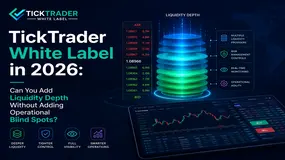
TickTrader White Label in 2026: Can You Add Liquidity Depth Without Adding Operational Blind Spots?
A TickTrader white label can look like the fastest route to a modern branded trading environment, but a fast launch is not the same as a controlled launch. This 2026 broker guide explains what the TickTrader platform is, where a Soft-FX broker solution can sit in a wider operating stack, and how to evaluate the difference between a white label, a server licence, and a connected CRM or Client Office setup. It also unpacks TickTrader cost beyond the monthly headline, including implementation, integration, support, data, governance, migration, and exit assumptions. Use the practical questions, workflow tests, comparison table, and launch checklist to assess a Soft-FX TickTrader provider without mistaking a feature demo for evidence that your brokerage can run the service safely at scale.
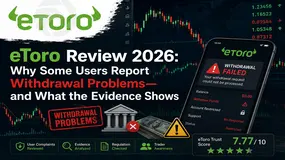
eToro Review 2026: Why Some Users Report Withdrawal Problems - and What the Evidence Shows
eToro, a United Kingdom-based brokerage entity, is facing serious user allegations concerning the basic facility a trader expects - Fund Withdrawal. Users worldwide are complaining about the lack of a withdrawal option, account restriction, and lack of customer support in real time. Many of their complaints appeared on credible broker review platforms such as WikiFX. In this eToro review, we have examined these complaints.
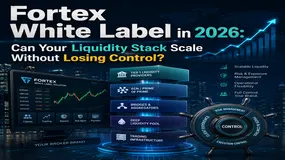
Fortex White Label in 2026: Can Your Liquidity Stack Scale Without Losing Control?
A Fortex white label can look like the fastest route to a modern branded trading environment, but a fast launch is not the same as a controlled launch. This 2026 broker guide explains what the Fortex platform is, where a Fortex broker solution can sit in a wider operating stack, and how to evaluate the difference between a white label, a server licence, and a connected CRM or Client Office setup. It also unpacks Fortex cost beyond the monthly headline, including implementation, integration, support, data, governance, migration, and exit assumptions. Use the practical questions, workflow tests, comparison table, and launch checklist to assess a Fortex provider without mistaking a feature demo for evidence that your brokerage can run the service safely at scale.
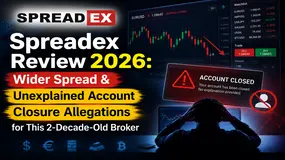
Spreadex Review: Wider Spread & Unexplained Account Closure Allegations for This 2-Decade-Old Broker
Did you incur trading losses on the Spreadex platform due to wider spreads? Have you experienced delays in trade processing by the United Kingdom-based forex broker? Has your Spreadex trading account been closed without any explanation? You are not alone! Many traders have expressed concerns on online broker review platforms. In this Spreadex review 2026, we have covered user allegations and provided a regulatory framework the broker operates under.
WikiFX Broker
Latest News
OANDA Broker: Regulated but Is It Really Safe for Traders?
 WikiFX
Yen Surges on Joint Intervention
WikiFXVonway Review: Users Report Withdrawal Blocks and Account Freezes , What Traders Should Know
WikiFXMangaluru Woman, 61, Loses Rs 16.2 Lakh in Facebook Scheme
WikiFXATFX Trading Volumes Drop 29% After Record Q1
WikiFXAI GOLD Review: Is Your Deposit Safe?
WikiFXFD Review: What Traders Should Know Before Depositing
WikiFXWhy a 90% Win Rate Can Still Lose You Money
WikiFXRazor Markets Review: What Traders Should Know Before Depositing
WikiFXMASTER MIND CAPITALS Review: Withdrawal Complaints Pile Up Against This Unregulated Broker
WikiFXRate Calc

