Fidelity Has Launched CryptoCurrency Trading For Retail Investors
Abstract:Fidelity, one of the world's major financial services companies, has begun to provide consumers with bitcoin trading accounts.

This follows their earlier disclosure of a wait list earlier this month. According to The Block, select users, presumably those on the queue, got an email outlining the release with the message “The wait is gone.”
Fidelity has been involved in the bitcoin sector for some time, beginning mining bitcoin in 2014, according to the company website. In addition, in December 2021, it will offer a spot bitcoin ETF in Canada.
The financial services behemoth's involvement in bitcoin has not gone unnoticed, with US lawmakers questioning its provision of a 401k plan that enables customers to allocate to bitcoin.
The same group of senators recently revived the same concern, stating in their newest letter, “Fidelity Investments has decided to go beyond conventional finance and plunge into the very unstable and more dangerous digital asset sector.”
Despite these cautions, Fidelity looks to be jumping into bitcoin wholeheartedly, as interest in bitcoin within the conventional banking industry grows. It should be emphasized that the move comes at a very intriguing moment, considering recent events surrounding the collapse of FTX and the increased focus on volatility in the sector.
With the industry image so shaky, the acts of behemoths like Fidelity will almost surely have repercussions for bitcoin legislation in the future.
Aside from FTX, senators claim that cryptocurrency investments have only developed as a dangerous and speculative bet, and they are afraid that Fidelity would assume similar risks with millions of Americans' retirement assets.
Fidelity is the biggest retirement plan provider in the United States, with more than $10 trillion in assets under management, and its move was considered a crucial driver for making cryptocurrency even more popular. The cryptocurrency option is now accessible to the 23,000 employers that use Fidelity to manage their 401(k) retirement funds.
You may check out more of Fidelity news here: https://www.wikifx.com/en/dealer/5871434190.html
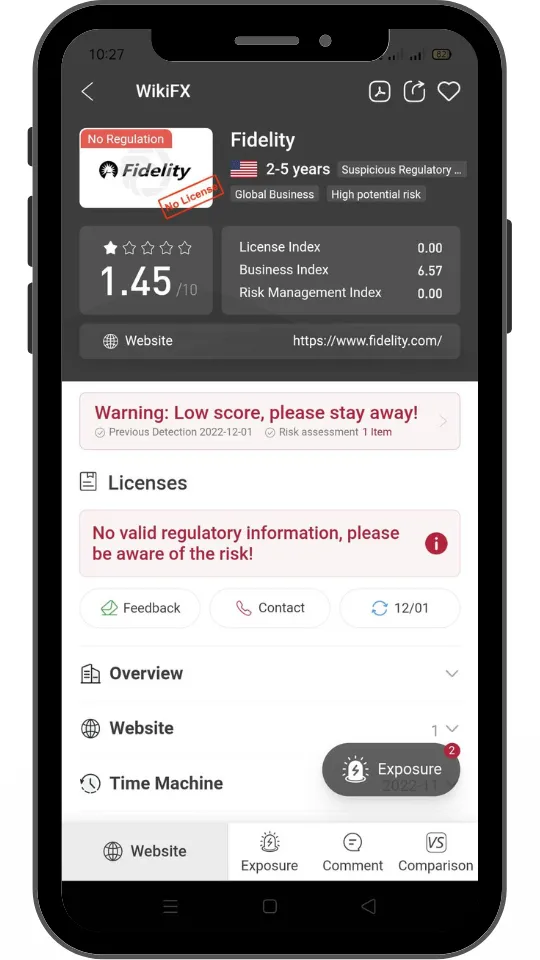
Always remember to check the true identity of a broker before investing. Being regulated online trading broker must be known to public to be considered as trustworthy broker.
Stay tuned for more Online Trading news.
Download the WikiFX App from the App Store or Google Play Store to stay updated on the latest news.


Read more

capital.com Review 2026: Traders Report Alleged Trade Manipulation & Withdrawal Concerns
Did you have to pay extra fees to recover your deposited funds on capital.com, a Bahamas-based brokerage entity? Were you denied withdrawals in the name of an invalid account? Did the broker fail to respond to your withdrawal requests for weeks? Faced losses due to alleged slippage and stop-loss errors? This capital.com review investigates user allegations and shares how the broker's regulatory structure appears.
One X Post, 12 Likes: A Trump Tariff Warning Aimed at Indian Markets
A vital post contains three separate assertions, and only the first is about trade policy. One, that Trump will impose large tariffs on India over Russian crude purchases. Two, that the H-1B visa action taken on the day of the post is the first in a sequence. Three, that Indian equities and the rupee are exposed to both. There is no figure attached to "large," no indication of which Indian exports would be covered, and no timeline other than the 3 November election date the post itself cites. The H-1B reference is equally bare.

FBS Regulation Checks Before Choosing the Company Behind an Account
FBS regulation should be checked against the company named in an account agreement, not a brand-level statement alone. The FBS About page archived on 24 September 2026 describes operations under several local licences. That statement does not identify the provider for every applicant in South Asia. Before using an FBS login link to apply or submit documents, establish which company would contract with you and what the relevant authorisation covers.
RBI Vows to Steady 'Undervalued' Rupee After It Hits Five-Month Low
The Reserve Bank of India (RBI) said on Wednesday it would ensure that the "undervalued" rupee finds its correct level, after the currency slid to a five-month low of 96.8450 per dollar. The central bank also raised its policy rate by 25 basis points, its first tightening since February 2023, but the rupee still weakened as foreign capital flowed out of Indian markets.
WikiFX Broker
Latest News
Oil Turned on Its Vertex Day: What It Means for Gold
 WikiFX
Gold and Silver Bounce After Trump Rules Out Pre-Election Strikes
WikiFXDoctor Loses RM300,000 in an Investment That Promised 10% Monthly Returns
WikiFXFBS Regulation Checks Before Choosing the Company Behind an Account
WikiFXShareflo Finds 33,675 UK Companies Behind on Filings as Director ID Checks Take Effect
WikiFXInflation fears on the rise as one-year outlook in Fed survey hits highest level since May 2023
WikiFXRBI Vows to Steady 'Undervalued' Rupee After It Hits Five-Month Low
WikiFXSingaporean Man Arrested Over Gambling Investment Scam Linked to S$2.2 Million in Losses
WikiFXOil, Yields and French Debt Keep Global Markets Under Pressure
WikiFXGold Near Nine Week Low as Fed Rate Fears Intensify
WikiFXRate Calc
