WIKIFX REPORT: Yen does not waste words. Forecast as of 17.10.2022
Abstract:The potential for a 29% USDJPY rally since the beginning of the year is still untapped. Only currency interventions can stop the pair's growth. Let us discuss the Forex outlook and make up a trading plan.
The potential for a 29% USDJPY rally since the beginning of the year is still untapped. Only currency interventions can stop the pair's growth. Let us discuss the Forex outlook and make up a trading plan.
Weekly yen fundamental forecast
While the Bank of England is tightening monetary policy, and the Liz Truss government is about to introduce a fiscal stimulus, Japan is doing the opposite. The BoJ will not give up yield curve control and ultra-low interest rates, while the Ministry of Finance is tough on the rapidly falling yen. In such conditions, the pound managed to stabilize, while USDJPY bears only dream of improving the situation.
Japanese officials made contrary statements at a meeting of central bankers and G20 finance ministers. Haruhiko Kuroda insisted that high inflation in Japan is temporary, and by the end of the year, it will fall below the target of 2%, so the Bank of Japan will not abandon the ultra-easy monetary policy.
According to Finance Minister Shunichi Suzuki, the government cannot tolerate excessive USDJPY fluctuations caused by speculation. Although exchange rates are determined by the market, they have an impact on inflation, foreign trade and the economy as a whole. In this regard, it is important to be on alert.
It's hard not to get angry when the massive ¥2.84 trillion currency intervention fails. The dollar is trading near 32-year highs against the yen, and investors wonder when Japanese officials will start another currency intervention.
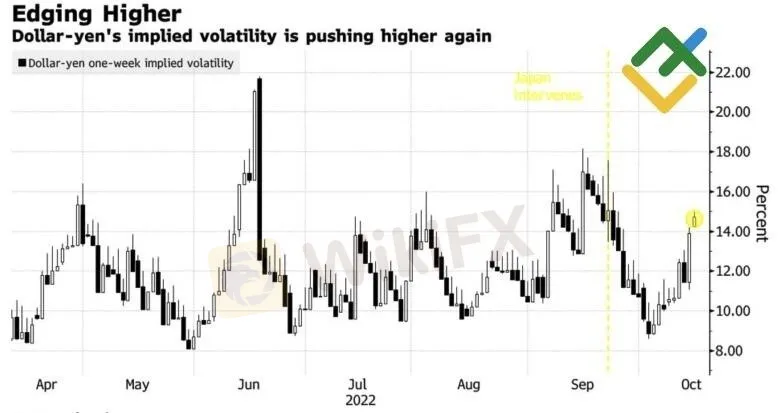
This will happen either when USDJPY reaches the psychologically important level of 150 or after the volatility increases. It is currently lower than during previous yen purchases, and the government has repeatedly noted that it is concerned about movements, not specific levels.
Dynamics of yen volatility

Read more

Pepperstone Review 2026: Massive Deposit & Withdrawal Complaints Against This Regulated Broker
Have you experienced issues with Pepperstone deposit & withdrawal processing? From your experience, do you feel that the Australia-based forex broker causes losses to its clients? Did the brokerage entity freeze your account and give you a margin call? All these trading allegations have been rampant on broker review platforms such as WikiFX. This Pepperstone review article takes a close look at the user complaints, especially in 2026. Additionally, we have given an overview of the regulatory framework under which the brokerage entity operates.

Wundersys vs tradgrip: Two Offshore Newcomers Go Head to Head — and Neither Brings Home a Trophy
Some broker comparisons end with a confident "go with this one." This is not one of them — and that honesty is exactly what makes it worth reading. Wundersys and tradgrip are two young, offshore-registered brokers that keep popping up in front of beginner traders, often through aggressive online marketing. Both promise the usual buffet: tight spreads, generous leverage, multiple account tiers. And both, according to WikiFX, sit near the very bottom of the safety scale. So instead of crowning a champion, this comparison is really about something more useful: learning to read the warning signs, understanding the small differences that still matter, and knowing why "the better of two risky options" is still a conversation about risk.
The 6 Lowest-Commission Forex Brokers South Asian Traders Are Flocking To in 2026
If you trade forex from India, Pakistan, Bangladesh, Sri Lanka, or Nepal, you already know the quiet truth that eats into every trader's results: it is not just the market that decides whether you profit — it is the cost of getting in and out of each trade. Shave a couple of dollars off your commission on every lot, multiply it across hundreds of trades a year, and you are looking at the difference between a strategy that works and one that bleeds out slowly. South Asian traders are some of the most cost-conscious in the world, and rightly so. So we pulled the data on the brokers most often recommended for the region, cross-checked every name on WikiFX, and ranked them by the one number that matters most here: what they actually charge you to trade. Before the list, one quick lesson that will make this whole ranking click.

XPO Fund Wants $10,000 Before You Trade a Single Real Dollar — Read This Stunning Revelation
If you have spent even a week inside trading communities lately, you already know the pitch by heart. Pass a quick "challenge," get handed a funded account worth tens of thousands of dollars, and keep up to 80% of everything you make. No risking your own savings, no slow grind of building capital from scratch — just skill, a small fee, and a fast track to the big leagues. It is the exact dream every new trader is secretly chasing, and an entire industry has sprung up to sell it. XPO Fund is one of the louder voices selling that story right now. Its website is slick, its plans sound generous, and its marketing leans hard on words like "industry's lowest fee" and "fast payouts." But before you reach for your card, there is one number sitting quietly on this firm's profile — a number it would rather you scroll past — that every experienced trader would beg you to look at first. And no, it is not the profit split. Let's pull XPO Fund apart piece by piece: what it actually is, who is real
WikiFX Broker
Latest News
The Market's Ledger: Why Price Returns to Fill Liquidity Voids
 WikiFX
Keeping Your Forex Profits Safe With Trailing Stop Losses
WikiFXReview 2026: Japan FSA Regulation, Platform Access, and Complaint Signals
WikiFXHEADWAY Review: Broker Complaints Point to Withdrawals, Zeroed Balances, and Login Blocks
WikiFXIndian Stocks Take a Beating, Sensex Falls by Over 600 Points Today: Check Out Why
WikiFXDollar Hits Two-Month High Amid Surging Yields
WikiFXGetting Started in Forex: Understanding Currency Pairs, Central Banks, and Legal Risks
WikiFXAssetsFX Review 2026: Unregulated Status, Withdrawal Complaints, and Extreme Risk Signals
WikiFXNews Update: LTCG on Government Securities Slashed to Zero
WikiFXCySEC Withdraws Conotoxia Ltd Licence
WikiFXRate Calc

