
2026-08-10 20:47
IndustryGood vs Bad Breakout
We’ve all been there , a huge candle smashes through a key level, you get hit with instant FOMO, click "Enter," and the market immediately reverses to hunt your stop loss. The issue usually isn't the pattern itself; it's entering on a weak breakout.
The trick to avoiding these "fakeouts" comes down to one simple rule: look at where the candle actually closes relative to your key level.
1. Bullish Breakouts: Is it real or a trap?
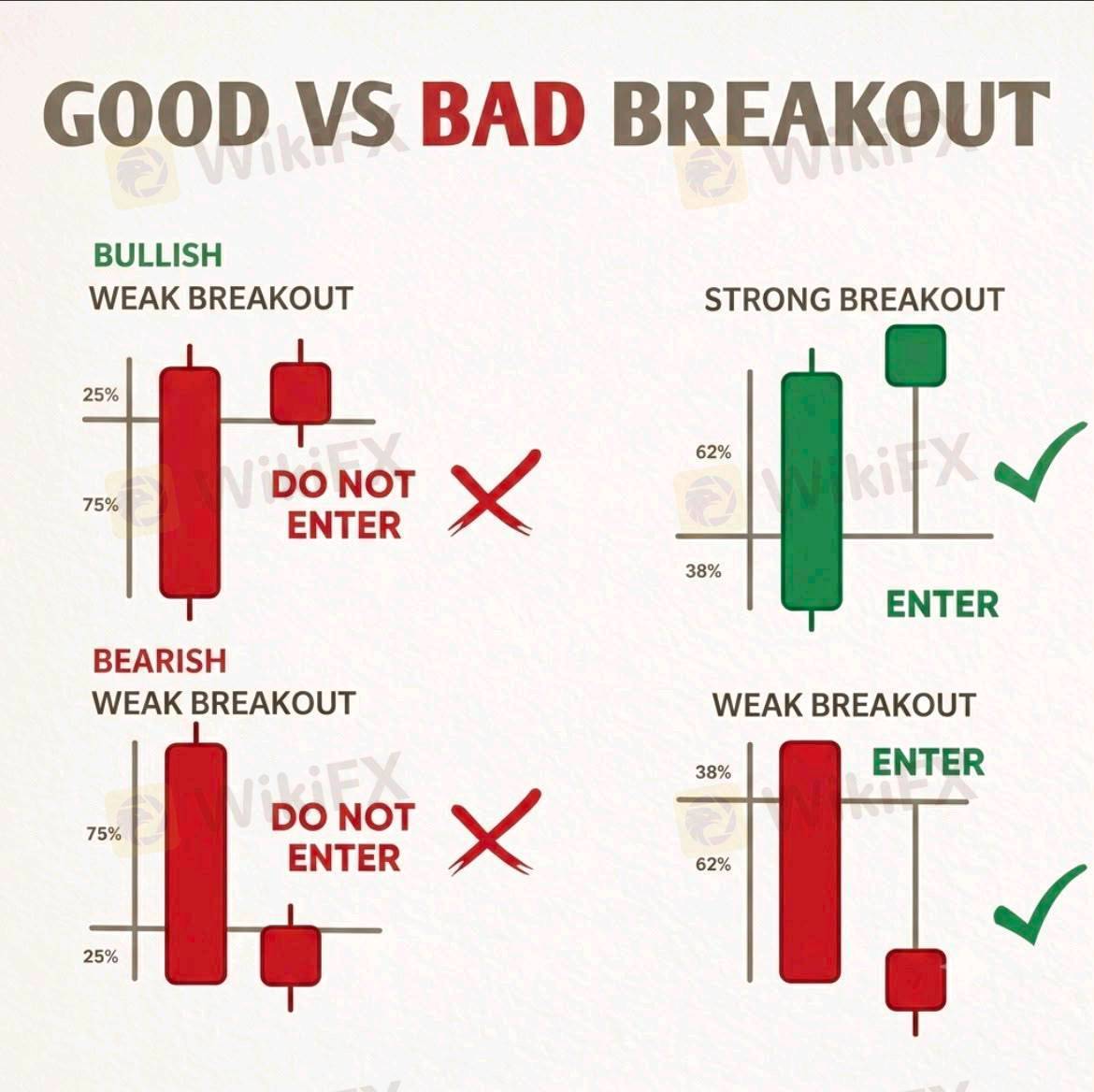
Weak Breakout (DO NOT ENTER): The top-left setup shows a big push, but 75% of the candle's body remains stuck below resistance, leaving only 25% above it. The follow-up candle hesitates. Buyers are already losing power, making a reversal highly likely.
Strong Breakout (ENTER): The top-right setup shows 62%+ of the candle body closing cleanly above resistance, with the next candle holding firmly above the line. This confirms real buyer momentum and gives you the green light to go long.
2. Bearish Breakouts: Spotting genuine selling pressure
Weak Breakout (DO NOT ENTER): On the bottom-left, most of the candle body (75%) stays above support. It merely poked through the level rather than breaking it. Shorting here usually traps you right at the bottom.
Strong Breakout (ENTER): On the bottom-right, the candle smashes through support, with 62%+ of its body closing below the line. The follow-up candle confirms sellers are in complete control—this is your signal to sell.
The Quick Rule
Before taking your next breakout trade, pause and ask: Did the candle actually close across the line with most of its body, or is it mostly stuck behind it?
If more than half the candle body is still behind the key level, sit on your hands and wait for a proper close. It takes 10 seconds to check, but it will save you from countless fakeouts!
Like 0

ThexproLLC
Trader
Hot content
Industry
Event-A comment a day,Keep rewards worthy up to$27
Industry
Nigeria Event Giveaway-Win₦5000 Mobilephone Credit
Industry
Nigeria Event Giveaway-Win ₦2500 MobilePhoneCredit
Industry
South Africa Event-Come&Win 240ZAR Phone Credit
Industry
Nigeria Event-Discuss Forex&Win2500NGN PhoneCredit
Industry
[Nigeria Event]Discuss&win 2500 Naira Phone Credit
Forum category

Platform

Exhibition

Agent

Recruitment

EA

Industry

Market

Index
Good vs Bad Breakout
United Kingdom | 2026-08-10 20:47We’ve all been there , a huge candle smashes through a key level, you get hit with instant FOMO, click "Enter," and the market immediately reverses to hunt your stop loss. The issue usually isn't the pattern itself; it's entering on a weak breakout.
The trick to avoiding these "fakeouts" comes down to one simple rule: look at where the candle actually closes relative to your key level.
1. Bullish Breakouts: Is it real or a trap?
Weak Breakout (DO NOT ENTER): The top-left setup shows a big push, but 75% of the candle's body remains stuck below resistance, leaving only 25% above it. The follow-up candle hesitates. Buyers are already losing power, making a reversal highly likely.
Strong Breakout (ENTER): The top-right setup shows 62%+ of the candle body closing cleanly above resistance, with the next candle holding firmly above the line. This confirms real buyer momentum and gives you the green light to go long.
2. Bearish Breakouts: Spotting genuine selling pressure
Weak Breakout (DO NOT ENTER): On the bottom-left, most of the candle body (75%) stays above support. It merely poked through the level rather than breaking it. Shorting here usually traps you right at the bottom.
Strong Breakout (ENTER): On the bottom-right, the candle smashes through support, with 62%+ of its body closing below the line. The follow-up candle confirms sellers are in complete control—this is your signal to sell.
The Quick Rule
Before taking your next breakout trade, pause and ask: Did the candle actually close across the line with most of its body, or is it mostly stuck behind it?
If more than half the candle body is still behind the key level, sit on your hands and wait for a proper close. It takes 10 seconds to check, but it will save you from countless fakeouts!
Like 0
I want to comment, too
Submit
0Comments

There is no comment yet. Make the first one.
Submit
There is no comment yet. Make the first one.