Digital Arrest, Fake Trading App, a ZIP file: Three Hyderabad Victims Lost ₹5.35 crore in One Day

Abstract:Three people in Hyderabad lost a combined ₹5.35 crore to cyber fraud in a single day, city police commissioner V.C. Sajjanar said. The complaints were separate: a digital arrest, a fake trading app, and a suspicious ZIP file. The victims were a doctor, an accountant and an elderly woman.
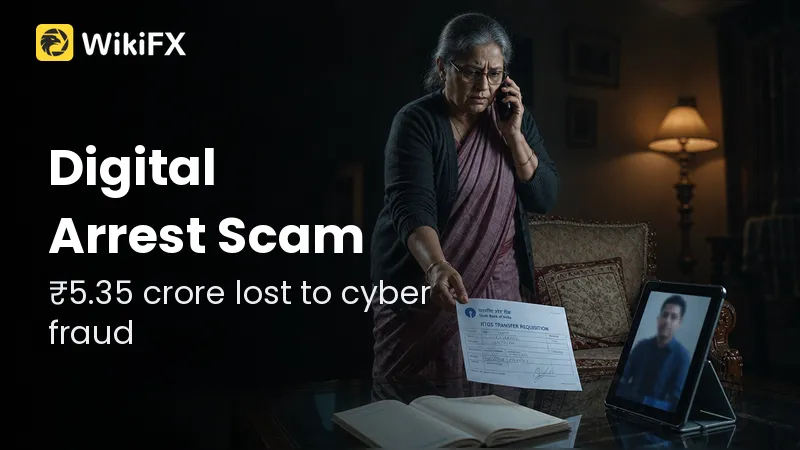
Split three ways, that comes to roughly ₹1.8 crore a person. Police have not released a case-wise breakdown, so the actual distribution is unknown. ₹5.35 crore. One day. Three complaints.
Sajjanar's warning to citizens rested on three levers that turn up in almost every one of these files: fear, impersonation, and the promise of quick profit. Two of the three are visible in the Hyderabad cases. The third, the ZIP file, has no public detail attached to it yet.
₹5 crore or ₹5.35 crore? Both numbers are in circulation
The social post that pushed this story out put the loss at ₹5 crore. Police put it at ₹5.35 crore, and that is the figure carried by NewsMeter, Deccan Chronicle, The Siasat Daily and Hyderabad Mail's own news report on the same incident.
Read headlines only and you miss ₹35 lakh. That is not a rounding error for the families involved.
The Siasat Daily dates the complaints to Monday, October 12. Hyderabad Mail says they were reported on Monday. Every account agrees on the part that should worry you: the three cases landed on the same day, and police are treating them as unconnected. This is not one crew running one script. It is at least three scripts running at once, in one city.
The digital arrest playbook runs on months, not minutes
The cleanest illustration of how a digital arrest works comes from outside Hyderabad. The Times of India reported on an elderly woman in Kothrud, Pune, who spent nearly eight months under what the callers told her was a digital arrest and lost ₹68 lakh.
The men on the phone posed as officials. The offence they accused her of: pornography and money laundering. Two accusations picked so the victim will not call a lawyer, a son, or a bank manager. Shame is the lock on the door.
Eight months. That is not a moment of panic. It is a sustained operation in which the victim's own phone becomes the leash, and the daily calls make the threat feel official.
The Hyderabad digital arrest case fits that template. What it added in size, at least one of the three victims here lost crores rather than lakhs.
₹100 in, ₹11.60 lakh to get out: how a fake trading app is built
Prabhat Khabar reported the mechanics of a fake trading app case in Agra, and the sequence is worth walking through because it repeats almost line for line in complaint after complaint.
A woman named Suman Rathore, who lives in Neeraj Nagar near Asopa Hospital in Agra's Sikandara area, was added to a trading group on 8 July. The group operated in the name of FinSol Securities Private Limited. The pitch was standard: invest, earn well.
The first deposit was ₹100, sent over UPI. Same day, ₹9,900 more. On 9 July, ₹8,000. Small tickets. They clear. They build belief.
Then the amounts jump. ₹2 lakh by RTGS on 20 July. Another ₹5.30 lakh on 27 July, into a different account. Adding the instalments listed in the FIR comes to about ₹7.5 lakh. None of it went to a brokerage. It went to accounts held in the name of various enterprises at Kotak Mahindra Bank.
By then the app was showing ₹21,31,847, principal plus profit. On a phone screen, she had nearly tripled her money.
The exit is where the trap closes. When she tried to move the balance to her own bank account, the group admin, identified in the report as Ananya Kulkarni, told her to deposit ₹11.60 lakh more. Only then, she was told, would the shares be sold and she would be paid. She smelled fraud instead.
An FIR was registered at the cyber crime police station. DCP Cyber Crime Aditya Singh said police were working out which accounts had received her money and who was involved. And one detail from that report deserves to be read twice: the trading group and its admin were still active.
The money never leaves the banking system
Nothing in the Agra case or the Hyderabad cases required crypto, a hawala channel, or a foreign broker. UPI for the small test transfers. RTGS for the big ones. Accounts at a mainstream bank, held in the name of entities that have nothing to do with the platform on your screen.
That is why the first 24 to 72 hours decide everything. Once the money lands in a mule account and gets layered onward, tracing gets slow and expensive. In the Agra case police were still trying to establish which accounts received the money. That work only starts after somebody files.
The app, meanwhile, is the last thing to fail. It will show a growing balance long after your bank account has been emptied, because the number on the screen is generated, not earned.
Social media: one post, zero engagement
The only social post flagged on this story has zero likes, zero reposts and zero comments. There is no second or third post on the same incident in the material available, so there is no user discussion to summarise, no disagreement between traders, no eyewitness accounts to weigh.
The single divergence that does exist sits inside the same outlet: the post headline rounds the loss down to ₹5 crore while the underlying report and the police figure say ₹5.35 crore. Treat the post as a pointer to the police statement, not as a source in its own right.
What we still don't know
The gaps are worth stating plainly, because a lot of what circulates after a story like this is guesswork.
There is no per-victim breakdown of the ₹5.35 crore. It is not public which of the three victims lost what, or which scam hit the doctor, the accountant or the elderly woman. No suspect has been named or reported arrested in the Hyderabad cases.
The ZIP file case is named as a vector and nothing more, no amount, no mechanics. And police have not published a consolidated case-wise ledger for the three complaints.
On the Agra side, the FIR names the group and the admin, but the investigation into account recipients is not concluded.
The signals that repeat across all of these cases
If you want a checklist, this is what the police statements and FIRs put on the table.
A caller tells you that you are under arrest, or under investigation, on a phone call or a video link, and keeps you on that line for weeks. The Pune woman was held that way for nearly eight months.
The offence you are accused of is deliberately chosen so you will not talk to anyone. Pornography. Money laundering.
A trading group adds you. You did not find it. The Agra victim was added on 8 July.
The first deposit asked of you is so small it feels pointless. ₹100 over UPI.
The app shows your money growing while your bank statement shows money only going out. ₹7.5 lakh deposited, ₹21.31 lakh displayed.
The withdrawal turns into a demand for more money. ₹11.60 lakh, in the Agra case.
And the payment pattern: small transfers by UPI, large ones by RTGS, all landing in accounts held in the name of unrelated entities.
The two Hyderabad vectors that police flagged, fear and quick profit, cover almost all of it. Fear for the digital arrest. Quick profit for the fake trading app.
If money has already moved, speed is the only lever you have
Preserve everything before you argue with anyone. Screenshots of the group, the chat, the app balance page. UPI and RTGS reference numbers. The account numbers you sent money to, and the names on those accounts.
The name of the group admin and the entity the app claimed to represent. That is precisely the trail Agra police used, and DCP Cyber Crime Aditya Singh's team was still working it at the time of the report.
File the complaint at a cyber crime police station, as the Agra victim did, and do it the same week the transfer happens rather than the same month. Account tracing starts with a registered FIR.
One clarification for readers who trade: none of the three Hyderabad cases named a platform or a broker in the information available, and the fake trading app in that city was not identified by name. There is no basis to connect these complaints to any licensed brokerage or exchange.
If you are still deciding, apply the checklist above before you send a rupee, not after. The ₹100 test deposit is the cheapest signal you will ever get, and it is designed to make you ignore everything else you have noticed.


Read more
Score Capital Markets Ltd 2026 Review: Gateway or Trap?
Comprehensive 2026 review of Score Capital Markets Ltd forex broker (scorecm.com): An in-depth analysis of offshore regulatory risks, WikiFX safety scores, trading conditions, and South Asian investor security.

ED Files Charge Sheet in Nexa Evergreen Investment Case Involving Rs 2,676 Crore
India's Enforcement Directorate has filed a charge sheet in the Nexa Evergreen investment case, alleging Rs 2,676 crore was collected from investors and that returns fell short by Rs 932.54 crore.

Client Saved via WikiFX Exposure ! Is slay4x Considered a Safe Broker or a Scam in Q4 2026?
Is slay4x Considered a Safe Broker or Suspected of Being a Scam in Q4 2026? Read our detailed analysis on withdrawal delays, regulatory risks, and South Asian trader reviews.

Lucknow doctor's trading app showed ₹26 crore profit. He lost ₹3.52 crore.
A doctor in Lucknow lost ₹3.52 crore to an online investment fraud, and the trading account he was watching showed him profits of nearly ₹26 crore. The420.in reported the case, naming the investor as Abhay Gupta. The account was fake.
WikiFX Broker
Latest News
U.S. Dollar Pulls Back From Yearly Highs: Analysis For EUR/USD, GBP/USD, USD/CAD, USD/JPY
WikiFXNPBFX Broker Review: Regulated but Is It Safe for Traders?
WikiFXThe Dollar Surges as Gold Slides. Could a Turning Point Be Near?
WikiFXConsumer prices rose at 3.7% annual rate in September as gas costs skyrocket
WikiFXFirst Light News: Earnings & US CPI in Focus
WikiFXClient Saved via WikiFX Exposure ! Is slay4x Considered a Safe Broker or a Scam in Q4 2026?
WikiFXRetiree Loses RM118,000 Through Fake Stock Investment Website
WikiFXFirst Light News: Chip Rout Rattles Equities as Q3 Earnings Season Kicks Off
WikiFXScore Capital Markets Ltd 2026 Review: Gateway or Trap?
WikiFXED Files Charge Sheet in Nexa Evergreen Investment Case Involving Rs 2,676 Crore
WikiFXRate Calc
