Fortex White Label in 2026: Can Your Liquidity Stack Scale Without Losing Control?

Abstract:A Fortex white label can look like the fastest route to a modern branded trading environment, but a fast launch is not the same as a controlled launch. This 2026 broker guide explains what the Fortex platform is, where a Fortex broker solution can sit in a wider operating stack, and how to evaluate the difference between a white label, a server licence, and a connected CRM or Client Office setup. It also unpacks Fortex cost beyond the monthly headline, including implementation, integration, support, data, governance, migration, and exit assumptions. Use the practical questions, workflow tests, comparison table, and launch checklist to assess a Fortex provider without mistaking a feature demo for evidence that your brokerage can run the service safely at scale.
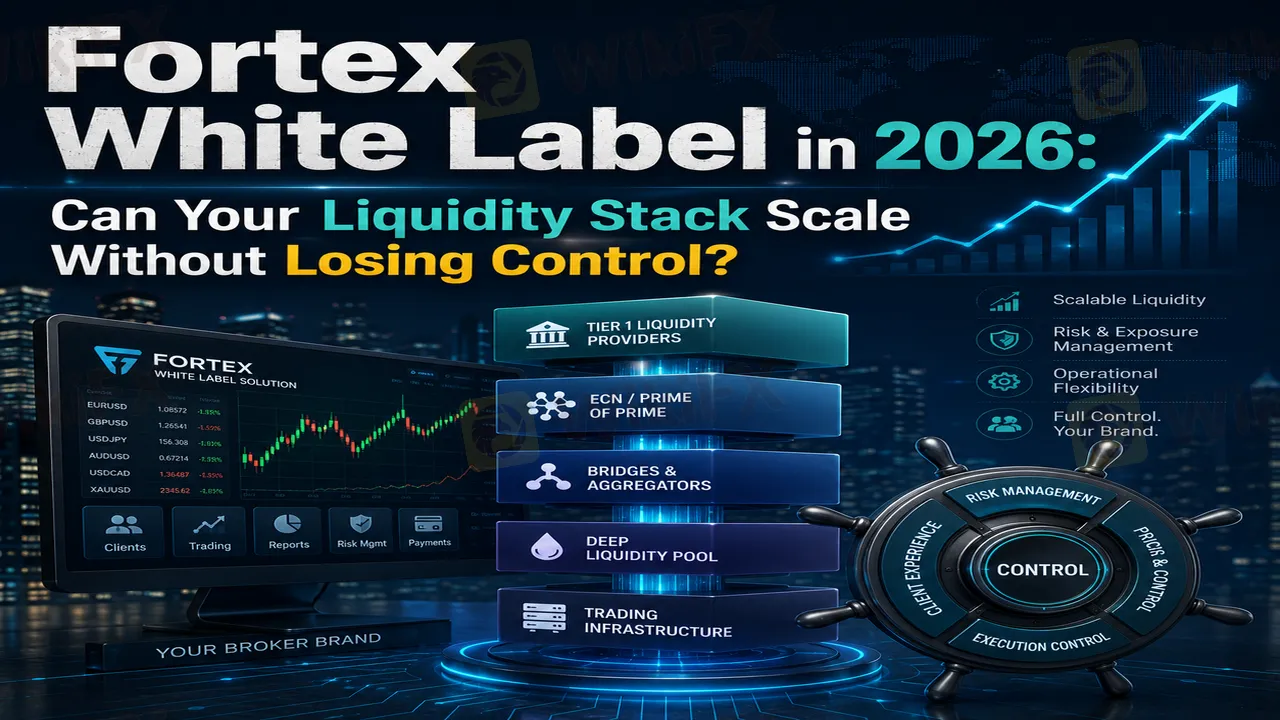
Editorial and risk notice:** This B2B buyer guide is for brokerage founders, product leaders, operations teams, technology teams, and compliance stakeholders. It is not investment advice, a recommendation of a provider, or a promise about execution quality, licensing, client acquisition, platform availability, or trading outcomes. Confirm product scope, local rules, contract terms, integrations, and controls with the relevant provider and qualified advisers.
At 08:40 on launch day, a broker's branded app is live, the trading interface opens, and the first internal screen shots look excellent. By lunch, the issue is not the front end. A withdrawal question has no agreed owner between Client Office, payment provider, and support. An account-status label means one thing to the client and another thing to operations. The launch was quick; the service model was unfinished.
That is the central decision behind a Fortex white label in 2026. The question is not whether a broker can obtain a branded platform. It is whether the broker can define a safe, intelligible service across trading, onboarding, funding, support, reporting, data, and change control. A credible implementation keeps that operating model clear whether the broker uses Fortex as a standalone platform, an all-in-one stack, or one connected component among specialist systems.
Executive takeaways
· Treat Fortex platform evaluation as an operating-model exercise, not a screen-by-screen comparison.
· A Fortex broker solution may combine platform, Client Office, CRM, APIs, payments, and other connectivity, but each boundary must be confirmed in writing.
· Compare Fortex cost through lifecycle assumptions: setup, recurring commercial terms, integrations, service operations, control work, change, migration, and exit.
· A white label may shorten initial delivery. It does not remove the broker's accountability for client communications, outsourcing risk, incident ownership, or regulatory obligations.
· Use a limited cohort and pre-agreed rollback conditions before presenting a rapid launch as a scalable model.
1. Why “quick to market” can become “hard to operate”

Editorial image: broker team mapping liquidity, technology and control responsibilities.
Broker leaders often face a legitimate commercial need: a legacy experience is slow, mobile behaviour has changed, or the current platform cannot support a new audience, brand, or business line. A white label may reduce the time needed to build core trading technology from scratch. That is useful. The error is turning a delivery benefit into an assumption that the whole brokerage service is ready.
For a client, a trading experience is one journey. It may include account opening, identity checks, risk notices, account funding, instrument availability, trading, support, statements, and withdrawal requests. Internally, those points may involve several tools and third parties. A decision that changes the visible interface can change data ownership, ticket routing, reconciliation, scripts, permissions, and audit evidence.
Composite scenario: the branded launch that created a reconciliation queue
This scenario is illustrative, not a customer case study. A broker launches a branded Fortex environment with a connected client portal. Demo accounts and the trading interface work as planned. In the first week, a payment-status exception reaches the portal before the internal reconciliation has completed. Support can see the client message but cannot explain which system owns the next action. The broker pauses promotion, maps the event states and escalation path, and changes the client wording before resuming.
The lesson is not to avoid a connected stack. It is to define, for every material event: what the client sees; what the operator sees; which system is the source of record; who owns the exception; what is logged; and when communications must be updated.
**Common implementation mistake:** treating branding, app-store presence, or a new workspace as a marketing deliverable. Those choices are also service changes and need acceptance criteria, support readiness, and a rollback plan.
Key takeaways: start with service boundaries
· “Faster” is only valuable when the broker can explain its operating responsibilities on day one.
· One client journey can span several providers; design for the hand-offs, not just the happy path.
· A precise launch brief is more valuable than a long generic feature list.
2. What Fortex publicly describes - and what you still need to verify
Fortex's public materials describe Fortex as independent trading technology that can be used as a standalone platform or as part of a broader brokerage stack, including liquidity aggregation, bridge/connectivity, data feeds, and APIs. Its platform page also describes branded applications, client-account management functions, ticketing through live chat, and configurable connections. These are useful starting points for a demo brief, not confirmation that every component, jurisdiction, workflow, or commercial term is included for your broker.
The provider also distinguishes white-label and server models in public materials. That distinction should frame a procurement discussion. A white label can allocate more of the underlying environment and routine administration to the provider; a server arrangement may offer a different level of control, configuration responsibility, and operational burden. Do not infer the exact division from a product page. Ask for a written responsibility matrix and named environments.
Current product positioning also points to a broader trend: brokers increasingly want a mobile-ready client experience, integrated analytics/charting, configurable client journeys, partner connectivity, and the ability to add modules without replacing an entire stack. In 2026, this increases the value of integration discipline. Every optional module can change the client promise, data movement, support demand, and operational-resilience profile.
Questions for the Fortex provider demonstration
1. Which functions are in the base white-label scope, which are add-ons, and which require external contracts?
2. Which party configures user roles, symbols, markups, client communications, and changes - and how are approvals evidenced?
3. How do Client Office, CRM, payments, KYC, liquidity, market data, and reporting exchange event states?
4. Which APIs are available in the proposed model, what access is granted, and what controls apply to credentials and rate limits?
5. What support, incident, maintenance, backup, data export, and exit commitments are contractual rather than promotional?
Key takeaways: provider claims versus broker evidence
· Use public product information to formulate test cases, not to skip due diligence.
· Confirm the exact commercial and technical scope for the entity, jurisdiction, and business model you plan to operate.
· A provider's capability is only useful if the broker can operate, monitor, and explain it.
3. White label, server, or connected stack: choose the accountability model
The most important comparison is not “which option has more features?” It is “which party controls and owns each material decision?” A white label can be right for a broker seeking a defined operating perimeter. A server licence can suit a broker prepared to assume more technical and change responsibility. A connected model can be appropriate where existing CRM, client-office, payment, or reporting systems are strategic. Each path requires a different evidence pack.
| Decision area | White-label-led model | Server or more self-managed model | Connected-stack question |
| Platform configuration | Confirm provider-managed versus broker-managed settings | Define internal configuration owners and release authority | Does each connected system receive the same event meaning? |
| Client journey | Validate branded app, portal, and client messages in scope | Validate design, testing, and support capacity in-house | Where does onboarding or funding status become authoritative? |
| Incident response | Confirm monitoring, escalation, client-notice roles | Confirm on-call, access, and recovery responsibility | Can teams trace one incident across the stack? |
| Change control | Ask how requests are priced, approved, tested, and rolled back | Set internal release governance and evidence standards | Are downstream dependencies tested before release? |
| Data and exit | Confirm exports, retention, portability, and timing | Define backup, audit, and migration responsibilities | Can records be reconciled after a provider hand-off? |
Composite scenario: choosing “more control” without a release owner
An illustrative broker selects a model with more configuration flexibility because it expects several brands and a specialised client segment. During evaluation, the team focuses on permissions and customisation. Six weeks later, no one has been formally assigned to approve changes that affect trading conditions, client notices, support materials, or linked reports. The project does not fail technically; it stalls because each function assumes another function owns release risk.
Resolve this before contract signature. Name a product owner, an operational owner, a compliance reviewer where required, a technical release owner, and an incident owner. For each high-impact change, record the decision, test scope, client communication, success metric, and rollback trigger.
Key takeaways: accountability first
· Choose the operating model that your team can genuinely govern, not the model that appears most flexible in a demo.
· More configuration normally creates more responsibility for testing, evidence, and support.
· Contract terms should reflect the real hand-off points in the client journey.
4. Turn a Fortex platform demo into an operational test

Conceptual workflow: controlled platform and connectivity release.
Feature tours are useful for orientation, but they rarely expose the questions that matter after launch. Replace a generic demo with a scenario-based session attended by product, operations, technology, support, compliance, and finance stakeholders. The group should see normal cases, exception cases, and a controlled change.
Scenario A: account onboarding to first funded trade
Walk through a new client from registration to eligibility checks, account creation, account funding, first login, a trade, and a statement. At each point ask: which system owns the status; what does the client receive; how is a failed or delayed event handled; and who can correct it? Do not accept “the integration handles that” without a specific event path.
Scenario B: a client support and withdrawal exception
Introduce a realistic but controlled exception: an account restriction, a payment review, a missing document, or a disputed status. Observe how the support agent locates the full context, which system creates the ticket, whether the client message is consistent, and where the final resolution is recorded. This shows whether the Fortex broker solution has an accountable service layer rather than only a functional interface.
Scenario C: a configuration release
Ask the provider and internal team to change a client-visible parameter in a safe test environment. Follow the workflow from request through approval, configuration, test, communication, monitored release, and rollback. This is the practical test of the platform's governance fit.
Governance workflow
The intended workflow is: business need -> impact assessment -> written approval -> configuration -> normal and exception testing -> client/support readiness -> monitored release -> retain, amend, or roll back. The impact assessment should cover client communications, permissions, status language, data reconciliation, reporting, support scripts, third-party dependencies, and local legal or compliance review.
Public FCA guidance on outsourcing and operational resilience offers a useful general principle for any broker using material third parties: understand the people, processes, technology, information, and dependencies needed to deliver important services, while retaining accountability for the associated risks. It is not a substitute for your local regulatory analysis, but it is a sensible way to organise discovery.
**Common implementation mistake:** marking a change complete when it passes a user-interface test. A change is not complete until the broker has confirmed the operating evidence, communication, support route, monitoring, and rollback condition.
Key takeaways: demonstration discipline
· Test the whole client and operator journey, including exceptions and recovery.
· The best proof is a traceable event path with named owners, not a polished screen recording.
· Turn every demo gap into a contract, implementation, or internal-owner action.
5. Fortex cost: model the lifecycle, not a headline fee
Searches for Fortex cost often expect one public number. Fortex's public 2024 pricing announcement described white-label packages from USD 2,500 per month and server licences from USD 5,000 per month for the stated offer. That is dated provider material and not a quote for your configuration. It should never be used as a current total-cost-of-ownership estimate.
For decision-making, build a commercial model with at least these lines:
6. provider subscription, account/volume metric, currency, tax treatment, term, renewal, and minimum commitments;
7. initial branding, configuration, environment setup, testing, and acceptance;
8. CRM, Client Office, KYC, payment, liquidity, data-feed, and reporting integrations;
9. application-store, hosting, security, monitoring, access, and business-continuity responsibilities;
10. support training, knowledge base, client notices, partner/IB workflows, and operational staffing;
11. change requests, custom development, provider professional services, and post-launch remediation;
12. data export, retention, migration, contingency, and termination assistance.
A three-case cost review
Use a base case, a growth case, and a stress case. The base case tests the contracted scope. The growth case tests additional brands, accounts, client segments, integrations, or service hours. The stress case asks what happens when a payment or data-feed dependency fails, a change must be rolled back, or a migration is required. The cost of unresolved exception handling is often not visible in a simple recurring-fee comparison.
Key takeaways: commercial diligence
· A monthly platform price is only one input; the operational cost of ownership can be larger.
· Put every assumption beside a service boundary and a named owner.
· Clarify data portability and exit before the platform becomes business-critical.
6. A controlled 75-day launch path
| Period | Objective | Evidence before moving forward |
| Days 0-15 | Define business model and operating boundaries | client journey map, target segments, system inventory, responsibility matrix, initial cost assumptions |
| Days 16-30 | Evaluate Fortex provider scope | scenario demonstrations, written inclusions/exclusions, integration map, security and support questions, known gaps |
| Days 31-50 | Configure and prove the operating model | role matrix, test cases, reconciliation samples, support playbook, communication templates, change and incident process |
| Days 51-75 | Pilot and decision gate | limited cohort results, defects, evidence of exception handling, open-risk register, go/no-go/rollback decision |
At the pilot stage, track more than logins or accounts opened. Measure whether support can classify cases consistently, whether client-facing and operational statuses reconcile, whether manual interventions are increasing, whether incidents have a clear owner, and whether the release record can be understood by a person who did not build the configuration. A pilot that finds friction early is working as intended.
7. Executive checklist for a Fortex white label decision
· [ ] Have we written the business model, target client segments, and allowed jurisdictions rather than assuming a generic platform setup?
· [ ] Can we show one end-to-end client journey and one exception journey with source systems and owners?
· [ ] Are provider, broker, and third-party duties documented for support, incidents, changes, data, and exit?
· [ ] Have we tested the proposed Fortex platform configuration in the environments and roles we will actually use?
· [ ] Is the Fortex broker solution commercial scope separated from optional modules, integrations, and professional services?
· [ ] Does the Fortex cost model include growth, stress, migration, and contingency assumptions?
· [ ] Are legal, compliance, data-protection, client-communication, and marketing approvals completed for the markets in scope?
· [ ] Does the launch have a limited cohort, evidence gate, and practical rollback condition?
FAQs
What is a Fortex white label?
A Fortex white label is a broker-branded trading-platform arrangement using Fortex technology and related services. The exact scope - including platform functions, branding, Client Office, CRM, payments, integrations, hosting, support, and commercial terms - depends on the signed proposal and should be confirmed directly with the provider.
Is the Fortex platform only for forex brokers?
The provider describes Fortex as supporting forex and CFD brokers, prop firms, and other business models through platform, CRM, API, and related technology options. A broker should still verify product availability, instrument scope, local permissions, and required controls for its own intended model.
How should a broker assess Fortex cost?
Start with the written provider proposal, then add internal and third-party cost for configuration, integrations, access, monitoring, client support, compliance controls, changes, migration, and exit. Compare the same scope across base, growth, and stress scenarios.
Conclusion
A Fortex white label may help a broker modernise its client experience and shorten initial implementation work. The durable advantage comes from something less visible: a service model that keeps event ownership, client communications, controls, evidence, and decision rights coherent across the platform and every connected system. Test that model before launch, price it across the lifecycle, and use a controlled cohort to prove it. That is how a broker pursues speed without quietly accumulating operational risk.
For more details, connect with us on WhatsApp.
Here's our number - +852 6317 7384 with this name - Wikifx-link.
Sources and further reading
· Fortex trading platform overview
· Fortex platform and ecosystem overview
· Fortex ECN platform overview
· Fortex white-label and bridge overview
· FCA: outsourcing and operational resilience
Download the WikiFX app for the latest forex updates.

Knowledge pays at WikiFX.
Every time you share a WikiFX article, you'll receive 50 Reward Points. Grow your rewards with every share and unlock exclusive gifts in the WikiFX Points Mall. Start earning today!
Here's how you can grab rewards.

Read more

RBI's $40.82 Billion Forex Surge: A Bigger Rupee Shield—or Just Borrowed Time?
RBI's concessional forex swap facility had mobilised $40.82 billion by 31 July 2026, with FCNR(B) deposits providing $36.725 billion of the total. This India-focused analysis separates confirmed inflows from the $80–85 billion SBI Research projection, compares the 2026 programme with the 2013 FCNR(B) window, and explains what the numbers can—and cannot—do for the Indian rupee. It also shows how banks, NRI depositors, importers, exporters and institutional investors may be affected, while highlighting the oil, dollar, maturity and hedging risks that still matter for USD/INR and forex trading in India.
Spreadex Review: Wider Spread & Unexplained Account Closure Allegations for This 2-Decade-Old Broker
Did you incur trading losses on the Spreadex platform due to wider spreads? Have you experienced delays in trade processing by the United Kingdom-based forex broker? Has your Spreadex trading account been closed without any explanation? You are not alone! Many traders have expressed concerns on online broker review platforms. In this Spreadex review 2026, we have covered user allegations and provided a regulatory framework the broker operates under.
cTrader White Label Platform: A Practical Guide for Broker Evaluation and Multi-Asset Expansion in 2
A broker can launch a white-label platform quickly and still fail the first serious operating test. The failure often begins quietly: an assets expansion has been approved, the client app is branded, and a new account journey looks complete. Then a client asks why a trade-related status, funding hand-off, or account restriction looks different across channels. Support cannot see the same reference trail as operations. The product owns the screen, but no one owns the explanation. The issue is not a missing feature. It is an untested operating model. That is why a cTrader white label platform should be evaluated as a route to a multi-asset service - not as a shortcut to a more attractive terminal. The central question is whether the broker can add instruments, client channels, integrations, and service capacity without making its controls harder to operate or explain.

Perry Warjiyo Resigns: Why the Rupiah Moved Above Rp18,000 per US Dollar
Perry Warjiyo resigned as Bank Indonesia governor, Destry Damayanti became acting governor, and the rupiah traded above Rp18,000. Here is what forex traders should monitor next.
WikiFX Broker
Latest News
FxPro Review: Is This 1.80-Rated Broker Safe for Your Funds?
WikiFXRazor Markets Review: What Traders Should Know Before Depositing
WikiFXAGILE GLOBAL LIMITED Review: What Traders Should Know Before Depositing
WikiFXMASTER MIND CAPITALS Review: Withdrawal Complaints Pile Up Against This Unregulated Broker
WikiFXMangaluru Woman, 61, Loses Rs 16.2 Lakh in Facebook Scheme
WikiFXATFX Trading Volumes Drop 29% After Record Q1
WikiFXWhy a 90% Win Rate Can Still Lose You Money
WikiFXAI GOLD Review: Is Your Deposit Safe?
WikiFXFD Review: What Traders Should Know Before Depositing
WikiFXOANDA Broker: Regulated but Is It Really Safe for Traders?
WikiFXRate Calc

